 NeoBit Daily

Introduction to Optical Computing Chips in 2026
The year 2026 marks a pivotal shift in technology as optical computing chips transition from research labs into commercial markets. These photonic processors use light instead of electricity to perform calculations, promising breakthroughs beyond the physical limits of traditional silicon-based electronics. This development addresses growing demands in data centers for faster processing and lower power consumption amid exploding AI and big data workloads. Industry observers note that the move signals the beginning of a post-silicon era where photons enable unprecedented parallelism in computation.
Search interest in this topic centers on how these chips compare to conventional hardware, their real-world viability, and what early adopters can expect. Unlike incremental improvements in electronic chips, optical computing represents a fundamental architectural change that leverages photons for data transmission and computation. Organizations evaluating this technology must understand both the opportunities and the practical hurdles involved in deployment.
How Optical Chips Work: A Technical Overview
At their core, optical computing chips manipulate light waves through waveguides, modulators, and detectors fabricated on silicon photonics platforms. Data is encoded in the amplitude, phase, or wavelength of light pulses rather than voltage levels. This approach eliminates electron mobility constraints that slow traditional transistors at nanoscale dimensions.
Engineers achieve logic operations by interfering light beams in carefully designed interferometers. The result is computation performed at the speed of light with minimal resistive losses, enabling sustained high-frequency operation without the thermal throttling common in electronic processors.
Performance Benchmarks: Optical vs Electronic Chips
Optical computing chips demonstrate significant advantages in speed for specific tasks. Photonic architectures can achieve data transfer rates exceeding those of electronic counterparts by avoiding resistance and heat buildup inherent in metal interconnects. Benchmarks from leading prototypes show optical chips handling matrix multiplications central to AI training up to 10 times faster in parallel operations while maintaining signal integrity over longer distances within the chip.
However, electronic chips still lead in general-purpose computing flexibility. Hybrid systems combining both technologies are emerging as the practical path forward in 2026 deployments, allowing organizations to route latency-sensitive workloads to photonic sections and sequential tasks to electronic cores.
Energy Efficiency Gains and Real-World Impact
One of the strongest selling points is energy efficiency. Optical chips consume far less power for high-throughput tasks because light generates minimal heat compared to electrical currents. Data centers could see substantial reductions in cooling requirements, aligning with global sustainability goals. This efficiency becomes especially valuable as AI model sizes continue to grow exponentially.
Early tests indicate photonic processors can deliver equivalent performance at a fraction of the energy cost of electronic GPUs in targeted applications like neural network inference. Facilities that adopt these chips early report improved power usage effectiveness metrics, contributing to both cost savings and regulatory compliance.
Integration Challenges with Existing Infrastructure
Despite the promise, integration poses hurdles. Optical chips require specialized interfaces to connect with electronic systems, including precise alignment of lasers and waveguides. Compatibility issues with current motherboards and software stacks mean retrofitting existing data centers involves careful planning and potential downtime during transitions.
Manufacturers are addressing these through standardized photonic-electronic co-packaging solutions, but full interoperability remains a work in progress. Teams must also update firmware and drivers to handle optical signaling protocols correctly.
Real-World Deployments by Leading Manufacturers
Major players like IBM and Intel have announced initial commercial shipments of optical computing chips in 2026. These deployments focus on hyperscale data centers where bandwidth demands are highest. Partnerships with cloud providers are accelerating adoption through pilot programs that test mixed photonic-electronic clusters.
Success stories include seamless scaling of inference pipelines, where optical accelerators handle the bulk of tensor operations while electronic components manage orchestration.
Comparisons of Photonic Versus Electronic Architectures
Photonic chips excel in parallelism and low-latency communication but face limitations in logic density. Electronic architectures offer mature ecosystems and lower initial costs for broad applications. The choice depends on workload: optical for data-intensive AI, electronic for versatile computing needs that require frequent branching logic.
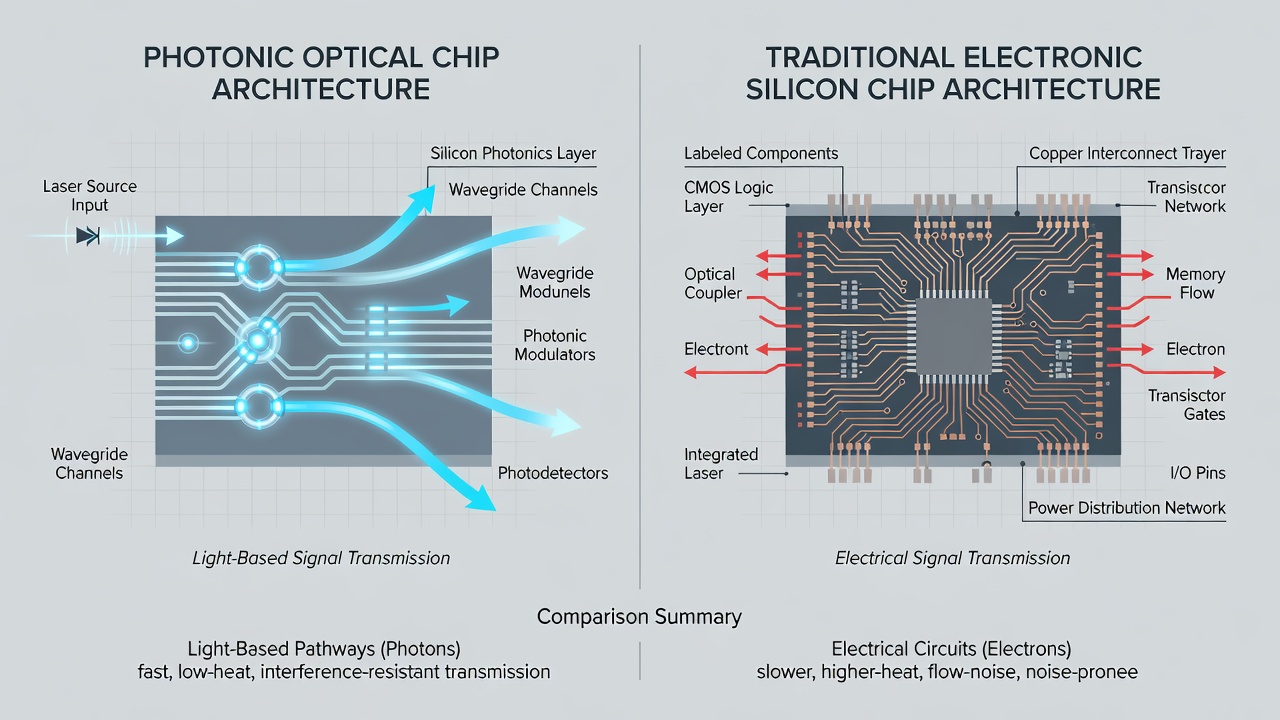
Key Differences at a Glance
- Speed: Optical leads in optical signal processing and interconnect bandwidth
- Power: Photonic chips show superior efficiency under sustained high loads
- Scalability: Electronics currently easier to mass-produce at consumer volumes
- Cost trajectory: Optical expected to become more accessible as production ramps up
- Maturity: Electronic software tools remain far more developed today
Early Adopter Case Studies from Data Centers
Leading cloud operators have piloted optical chips in inference clusters, reporting improved throughput for machine learning models. One case involved replacing portions of an electronic GPU farm, yielding measurable gains in operations per watt and reduced thermal management overhead. Another deployment focused on real-time analytics workloads where low-latency photonic links improved overall cluster responsiveness.
These studies underscore the value for organizations prioritizing performance-per-energy metrics. Lessons learned include the importance of workload profiling before migration and the benefit of phased rollouts that begin with non-critical services.
Adoption Timelines and Practical Considerations
Analysts project gradual rollout through 2027, with broader availability by 2028 as manufacturing scales. Initial adoption will likely target specialized workloads before expanding to general enterprise use. Decision makers should begin by auditing current infrastructure for optical-ready ports and evaluating software frameworks that support photonic acceleration.
Teams planning adoption benefit from starting with vendor-provided evaluation kits to test compatibility in controlled environments.
Mistakes to Avoid When Evaluating Optical Chips
Common pitfalls include assuming universal performance gains without workload-specific testing and underestimating the need for staff training on photonic systems. Organizations should also avoid rushing full-scale replacements before validating hybrid configurations in production-like settings.
Another frequent error is neglecting long-term supply chain considerations, as early optical components may have limited second-source options compared to mature electronic alternatives.
FAQ: Optical Computing Chips Compatibility and Beyond
Will optical chips work with my current data center setup?
Hybrid solutions are designed for backward compatibility, but specialized optical interconnects may require infrastructure upgrades such as new cabling or transceiver modules.
How soon can businesses expect ROI?
Early adopters in high-demand sectors report benefits within 18-24 months through efficiency savings and performance uplifts, though results vary by workload intensity.
Are there security implications?
Photonic systems introduce new considerations around optical signal integrity but do not inherently increase cyber risks compared to electronic alternatives when proper encryption layers are maintained.
What training is required for IT teams?
Staff typically need targeted workshops on photonic interfaces and updated monitoring tools, usually completed in one to two weeks for experienced hardware engineers.
Can optical chips replace all electronic processors?
Full replacement is unlikely in the near term; hybrid architectures that combine the strengths of both technologies represent the most realistic near-future path.
Conclusion
The commercial entry of optical computing chips in 2026 signals the start of a new era in high-performance computing. Organizations evaluating this technology should assess specific use cases against integration requirements to determine fit. Staying informed through industry sources will be essential as the market matures and additional real-world data becomes available.


No comments yet. Be the first!