 NeoBit Daily

Introduction: The 2026 Shift Toward Sustainable Tech
The surge in biodegradable electronics represents one of the most significant developments in 2026 tech news and breaking tech coverage. As global e-waste continues to mount at alarming rates, manufacturers and innovators are turning to advanced materials that break down naturally without harming ecosystems. This comprehensive guide examines the trend in depth, comparing traditional hardware lifecycles with biodegradable alternatives, sharing detailed real-world case studies from startups and established manufacturers, and offering practical guidance for consumers, businesses, and policymakers seeking actionable insights into sustainable tech adoption.
Traditional electronics rely heavily on non-degradable plastics, petroleum-based polymers, and rare earth metals that persist in landfills for centuries, leaching harmful chemicals into soil and water. In contrast, biodegradable versions incorporate organic substrates such as cellulose nanofibers, silk proteins, chitosan from crustacean shells, and plant-derived polymers like polylactic acid. These materials are engineered to decompose within months under industrial composting conditions while delivering reliable performance in consumer devices ranging from smartphones to medical wearables. The shift aligns with growing consumer demand for eco-friendly products and tightening global regulations on electronic waste management.
Material Lifecycles: Traditional Plastics vs. Biodegradable Options
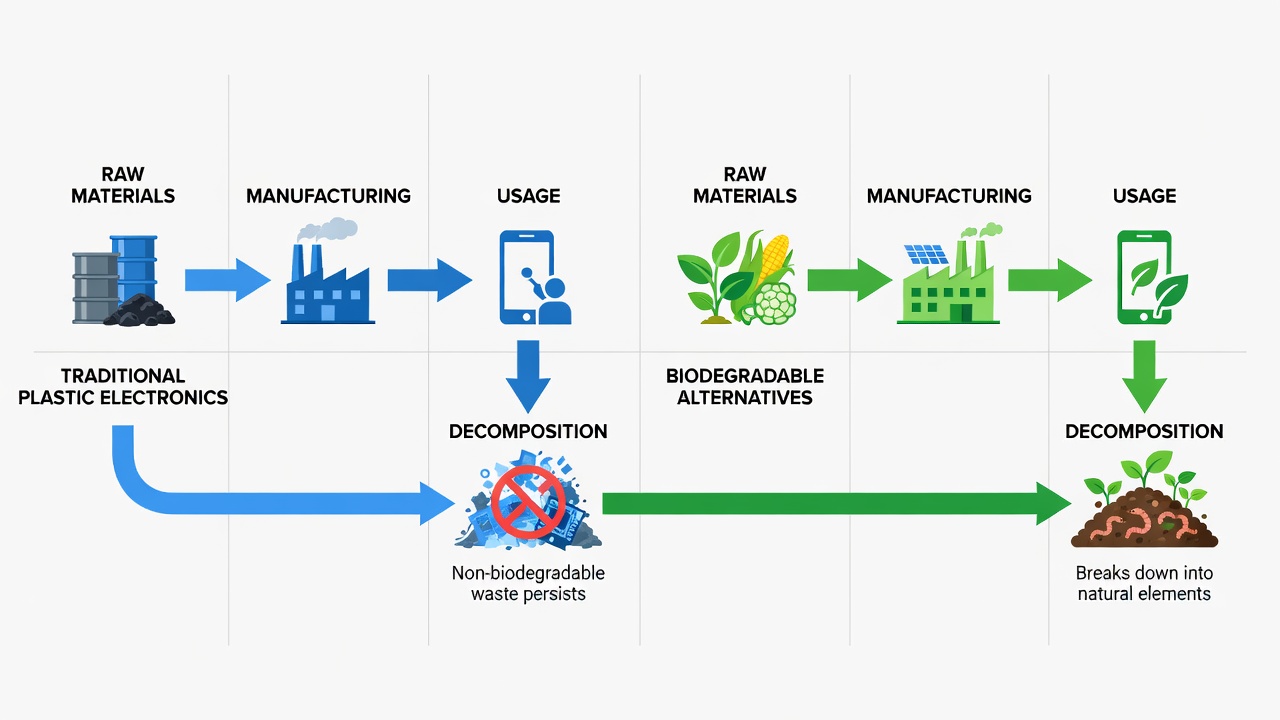
Understanding the full lifecycle of electronic components helps clarify why biodegradable electronics are gaining traction. Conventional devices begin with resource-intensive mining for metals like lithium and cobalt, followed by petrochemical processing for plastic casings and energy-heavy semiconductor fabrication. Their end-of-life typically involves incineration or landfilling, releasing toxins and greenhouse gases. Performance metrics such as conductivity and flexibility often come at the cost of long-term environmental persistence.
Biodegradable electronics follow a markedly different path. Raw materials are sourced from renewable biomass, processed using lower-energy methods like solution-based printing, and designed for controlled decomposition. Recent advancements show that many biodegradable circuits achieve comparable conductivity levels to traditional copper traces, with degradation timelines ranging from three to twelve months. Key examples include flexible displays using silk fibroin substrates and sensors built on paper-like cellulose that retain functionality during use but break down safely afterward. These differences highlight substantial environmental advantages while preserving or even enhancing usability for everyday applications like fitness trackers and smart packaging.
- Manufacturing emissions reduced significantly in pilot programs through renewable feedstocks
- Decomposition time: three to twelve months versus five hundred or more years for conventional plastics
- End-of-life recovery rates improved through natural microbial breakdown and metal reclamation
- Water and energy usage during production lowered by utilizing agricultural waste streams
These lifecycle improvements position biodegradable materials as viable replacements across multiple device categories.
Case Studies from Startups and Manufacturers
Several pioneering companies are already demonstrating the commercial potential of biodegradable electronics. A European startup has commercialized fully compostable circuit boards integrated into wearable fitness trackers, achieving high user adoption in pilot markets by emphasizing both performance and sustainability. In Asia, a major smartphone manufacturer incorporated biodegradable casings made from bamboo-derived polymers into entry-level models, with successful large-scale pilot runs showing no compromise in drop resistance or thermal management.
Further examples include a North American firm specializing in medical sensors that dissolve harmlessly after single-use monitoring periods, addressing disposal challenges in hospitals and reducing biohazard waste. Another innovator in Australia developed biodegradable RFID tags for supply chain tracking that compost alongside organic produce packaging. These projects illustrate scalability across consumer electronics, healthcare, and logistics sectors, proving that the technology extends beyond niche applications into mainstream viability.
Environmental Impact Data and Expert Insights
Recent analyses from environmental agencies indicate that broader adoption of biodegradable electronics could divert millions of tons of persistent waste from landfills each year. EPA resources provide detailed frameworks for evaluating material impacts and highlight how innovation reduces overall ecological footprints. Additional insights from UNEP reports underscore the global urgency, noting connections between e-waste reduction and improved public health outcomes. WHO environmental health guidelines further emphasize minimizing toxic leaching from discarded devices.
Industry experts stress that while performance metrics are rapidly closing gaps with legacy materials, infrastructure for large-scale composting must expand concurrently. One leading materials scientist observed that supply chain standardization remains critical for consistent quality at volume. Another specialist pointed out the importance of third-party verification to substantiate decomposition claims across diverse climate conditions, ensuring consumer trust and regulatory compliance.
Practical Steps for Adoption in Consumer Devices
Individuals and organizations ready to embrace biodegradable electronics can follow these detailed steps to make informed decisions:
- Verify third-party certifications such as ASTM D6400 or EN 13432 to confirm genuine compostability before making purchases.
- Prioritize brands that publish transparent lifecycle assessments and participate in verified take-back or composting programs.
- Integrate devices gradually, starting with lower-risk items like wireless earbuds or environmental sensors to test real-world durability.
- Advocate within communities and workplaces for policy support, including tax incentives for sustainable manufacturing and expanded composting facilities.
- Educate teams on proper end-of-life handling to maximize environmental benefits and avoid contamination of recycling streams.
Businesses should initiate internal pilots with biodegradable IoT components before expanding to customer-facing products. Partnerships with material research institutions can accelerate development while maintaining high standards for reliability and user experience.
Challenges, Scalability, and the Road Ahead
Despite strong momentum, several challenges require ongoing attention. Durability in extreme humidity or temperature fluctuations continues to need refinement through advanced coatings that preserve eventual biodegradability. Recycling infrastructure must adapt to handle hybrid devices containing both organic and metallic elements. Scalability depends on securing consistent raw material supplies and achieving cost competitiveness through increased production volumes. Experts anticipate that 2026 regulatory developments will increasingly favor biodegradable designs, spurring further investment in research that expands applications to areas such as flexible solar cells and smart agricultural sensors.
FAQ: Cost, Durability, and Recycling Processes
How do costs compare to traditional electronics?
Early-generation biodegradable devices may involve a modest premium due to specialized materials and smaller production scales, yet industry trends point toward parity as manufacturing matures. Evaluating total ownership costs, including simplified disposal, provides a more complete picture.
Are these devices as durable as conventional ones?
Many current biodegradable models match or surpass expectations for typical consumer use, with protective bio-based coatings extending operational life while ensuring safe decomposition at the end of the product cycle.
What happens during recycling or composting?
Devices are directed to industrial composting facilities where microorganisms break down organic components into nutrient-rich soil amendments. Any recoverable metals are separated through established reclamation processes, minimizing overall waste.
Can biodegradable electronics handle high-performance tasks?
While some advanced computing applications still rely on hybrid designs, ongoing material science improvements are enabling fully biodegradable solutions for an expanding range of performance-intensive uses.
Conclusion
Biodegradable electronics mark a pivotal advancement in tackling the global e-waste crisis. Through detailed examination of material lifecycles, real-world case studies, environmental data, and practical adoption strategies, stakeholders gain the knowledge needed to drive meaningful change. The 2026 landscape presents substantial opportunities for innovation that delivers both technological excellence and planetary benefits, paving the way for a truly sustainable electronics industry.


No comments yet. Be the first!