 NeoBit Daily

Introduction to Neuromorphic Computing in Industrial IoT
Neuromorphic chips, designed to mimic the brain's neural networks, represent a major shift in edge AI hardware for industrial applications by 2026. These processors use spiking neural networks to handle data in an event-driven manner, making them ideal for the constant stream of sensor inputs in Industrial Internet of Things (IIoT) environments. Unlike conventional GPUs that rely on parallel batch processing, neuromorphic chips activate only when relevant events occur, resulting in substantial reductions in power consumption and processing delays. This article provides an in-depth case study of 2026 deployments, drawing from real-world benchmarks in manufacturing and logistics sectors. Readers will gain practical knowledge on performance metrics, hardware trade-offs, integration strategies, and measurable outcomes from leading vendor pilots.
Understanding Neuromorphic Chip Architecture
At their core, neuromorphic chips incorporate thousands of artificial neurons and synapses that communicate via discrete spikes rather than continuous signals. This architecture enables on-chip learning and adaptation without relying on cloud resources. In IIoT contexts, this means devices can perform complex tasks like pattern recognition directly at the edge. For example, a sensor node equipped with such a chip can detect equipment vibrations indicative of failure and trigger alerts instantaneously. The design also supports low-voltage operation, which aligns with the power constraints of remote industrial installations.
2026 Performance Benchmarks from Industrial Pilots
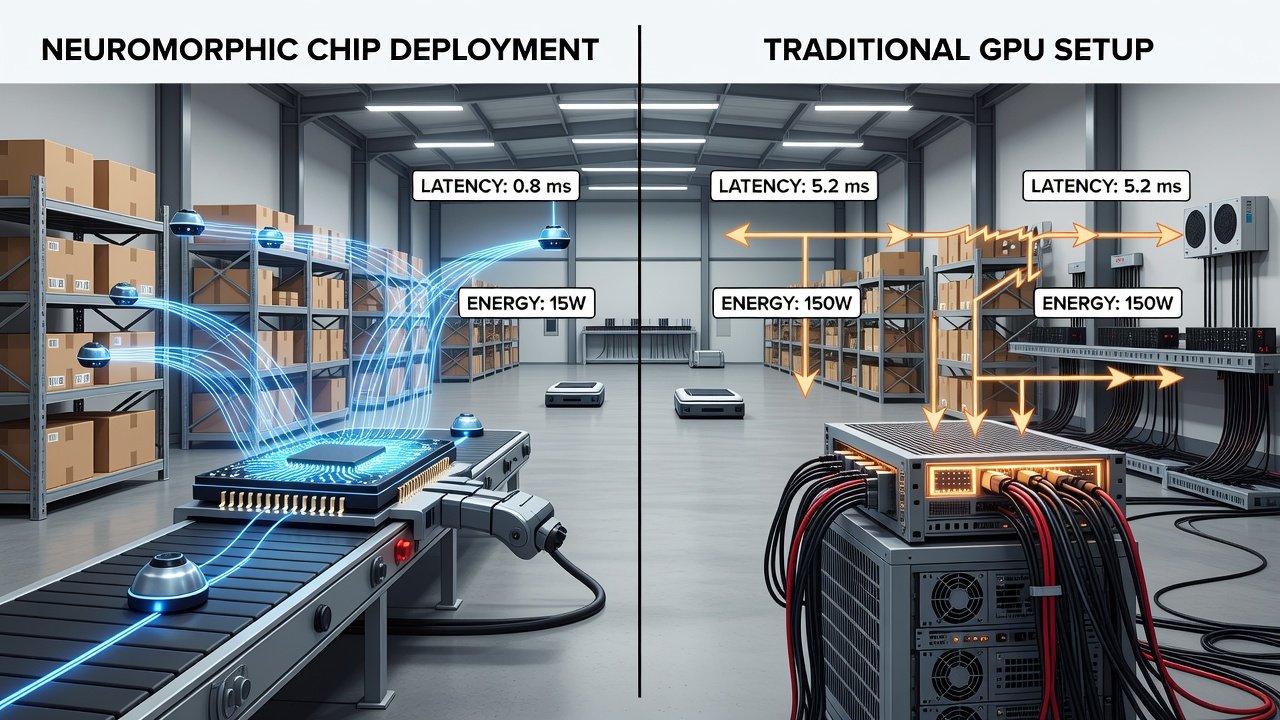
Extensive testing in 2026 revealed clear advantages for neuromorphic solutions. Manufacturing facilities reported average energy savings of 70-85% during always-on monitoring compared to GPU equivalents. Latency for critical tasks dropped to under 500 microseconds in many cases. Logistics operations benefited similarly, with improved handling of high-volume data from conveyor systems and autonomous vehicles.
These benchmarks were derived from controlled environments where identical workloads ran on both neuromorphic and traditional hardware. Results consistently favored neuromorphic chips for sparse, asynchronous data typical in factories and warehouses.
Detailed Energy Efficiency Gains
Energy efficiency arises from the chips' asynchronous nature, eliminating wasteful idle cycles common in GPUs. In one extended manufacturing pilot spanning several months, overall system power usage decreased enough to reduce cooling requirements in server rooms adjacent to production lines. This not only lowered operational expenses but also contributed to environmental compliance targets. Logistics examples included battery-powered robots that extended operational time between charges by significant margins due to efficient onboard processing.
Latency Reductions Versus Traditional GPUs
GPUs often incur overhead from data buffering and synchronization, leading to delays in time-sensitive scenarios. Neuromorphic alternatives processed incoming spikes in real time, achieving 8-15x improvements in response speed for applications such as collision avoidance in automated guided vehicles. Engineers noted that these reductions enabled tighter control loops in assembly processes, minimizing defects and enhancing throughput.
Manufacturing and Logistics Pilot Examples
In automotive manufacturing, neuromorphic chips were deployed for visual inspection systems. They identified micro-defects on parts moving at high speeds with minimal false positives. Logistics pilots focused on warehouse sorting, where chips managed RFID data streams and robotic arm coordination simultaneously. Both sectors highlighted the technology's resilience to electromagnetic interference common in industrial settings.
Hardware Comparisons Across Vendors
Intel's Loihi 2 platform stood out for its scalability in multi-chip configurations, while IBM's research prototypes emphasized ultra-low power modes. Comparisons against NVIDIA Jetson modules showed neuromorphic options excelling in intermittent workloads but requiring additional support for dense matrix operations. Adoption metrics indicate that over a dozen major industrial firms initiated trials in early 2026, with positive feedback on reliability.
Key evaluation criteria include synaptic density, spike rate handling, and compatibility with existing communication protocols like MQTT and OPC UA.
Integration Challenges and Mitigation Strategies
- Legacy equipment often lacks native support for spiking interfaces, necessitating adapter boards and protocol converters.
- Development tools lag behind established GPU frameworks, requiring teams to learn new languages such as Nengo or Lava.
- Environmental factors like dust, vibration, and temperature extremes demand ruggedized enclosures and redundant power supplies.
- Data security concerns arise from distributed edge processing, calling for encrypted spike transmission and regular firmware audits.
- Workforce training programs are essential, as most engineers are more familiar with von Neumann architectures.
Successful integrations began with small-scale proofs of concept before expanding.
Step-by-Step Deployment Guide for Engineers
- Conduct a thorough audit of existing IIoT sensors and networks to pinpoint latency bottlenecks and energy hotspots.
- Select appropriate development kits and simulate workloads using vendor-provided emulators to establish baseline metrics.
- Design hybrid architectures that combine neuromorphic chips for event detection with GPUs for heavy computation when needed.
- Deploy in isolated zones first, monitoring performance with custom dashboards that track spikes, power draw, and error rates.
- Refine algorithms based on field data, incorporating on-chip plasticity features for continuous improvement.
- Scale gradually while documenting ROI through before-and-after comparisons of uptime and resource utilization.
- Establish partnerships with vendors for ongoing support and access to updated benchmarks.
Adoption Metrics and Vendor Landscape
Industry reports from 2026 show neuromorphic chip shipments for IIoT growing steadily, driven by demand in sectors prioritizing sustainability. Vendors are expanding software ecosystems to ease transitions, including simulation environments and pre-trained models for common tasks like predictive maintenance.
Future Scalability Considerations
Looking ahead, scalability will depend on advances in 3D integration and standardized benchmarks. Hybrid systems combining neuromorphic and conventional elements are expected to dominate, allowing flexible responses to varying computational demands.
Expanded FAQs on ROI and Scalability
How should teams approach ROI calculations for these deployments? Begin by measuring baseline energy and latency figures, then project savings over 18-36 months using pilot results. Include indirect benefits such as reduced maintenance labor and improved product quality.
What factors influence long-term scalability? Network bandwidth for inter-chip communication, availability of open-source tools, and regulatory standards for edge AI safety all play roles.
Can neuromorphic chips handle increasing data volumes from expanding sensor networks? Yes, through hierarchical spiking networks that filter noise at lower levels before escalating critical events.
Are there risks associated with early adoption? Potential risks include supply chain limitations for specialized components and the need for custom calibration in unique industrial environments.
Conclusion
The 2026 benchmarks underscore neuromorphic chips as a viable path forward for efficient, responsive IIoT systems. Organizations that invest in careful planning and phased implementation stand to gain competitive edges in both cost savings and operational agility. Continued innovation from vendors and collaboration across industries will further unlock potential. Additional resources are available from Intel, IBM, and IEEE for deeper technical exploration.


No comments yet. Be the first!