 NeoBit Daily
Introduction to Neuromorphic Chips in Autonomous EVs
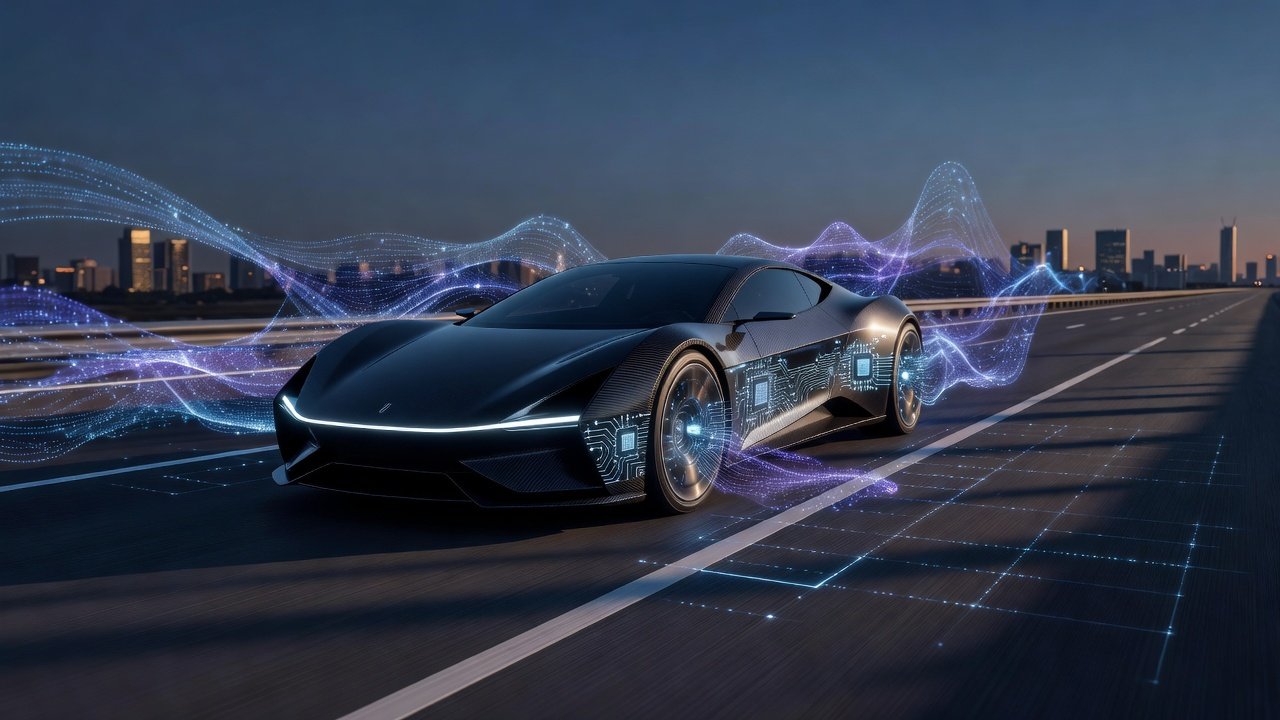
Autonomous electric vehicles depend on sophisticated AI systems to interpret sensor data, make split-second decisions, and navigate complex environments safely. While traditional GPUs have driven much of the progress in self-driving technology, they often require significant energy, which impacts battery range and overall vehicle efficiency. In 2026, neuromorphic chips are gaining traction as a powerful alternative. These specialized processors emulate the human brain's neural architecture, processing information in an event-driven manner that drastically cuts power usage. This article provides an in-depth examination of 2026 deployments, highlighting quantified energy savings and latency benefits drawn from Tesla and Waymo operations, while also addressing comparisons, integration hurdles, and regulatory factors shaping the future of autonomous fleets.
Understanding Neuromorphic Computing Technology
Neuromorphic chips operate using spiking neural networks, where neurons communicate through discrete spikes only when relevant data arrives, rather than continuously processing streams like conventional GPUs. This biological inspiration allows the chips to remain in a low-power idle state most of the time, activating only for critical events such as detecting a pedestrian or sudden lane change. In the context of autonomous EVs, this leads to superior handling of sparse sensor inputs from cameras, LiDAR, and radar. Engineers note that the architecture supports on-chip learning, enabling vehicles to adapt to new driving scenarios without constant cloud connectivity. The result is not only energy conservation but also enhanced resilience in edge computing environments where connectivity may be unreliable.
Core Architectural Differences from GPUs
Unlike GPUs that rely on massive parallel matrix operations, neuromorphic designs distribute computation across thousands of small, interconnected cores. This parallelism reduces data movement overhead, a major source of energy drain in traditional systems. For EV autonomy, the technology excels at real-time perception tasks, where quick reactions to dynamic road conditions are essential. Research prototypes from 2026 demonstrate how these chips can integrate directly with vehicle sensor suites, bypassing some layers of data preprocessing required by GPU pipelines.
Energy Efficiency Gains Over Traditional GPUs
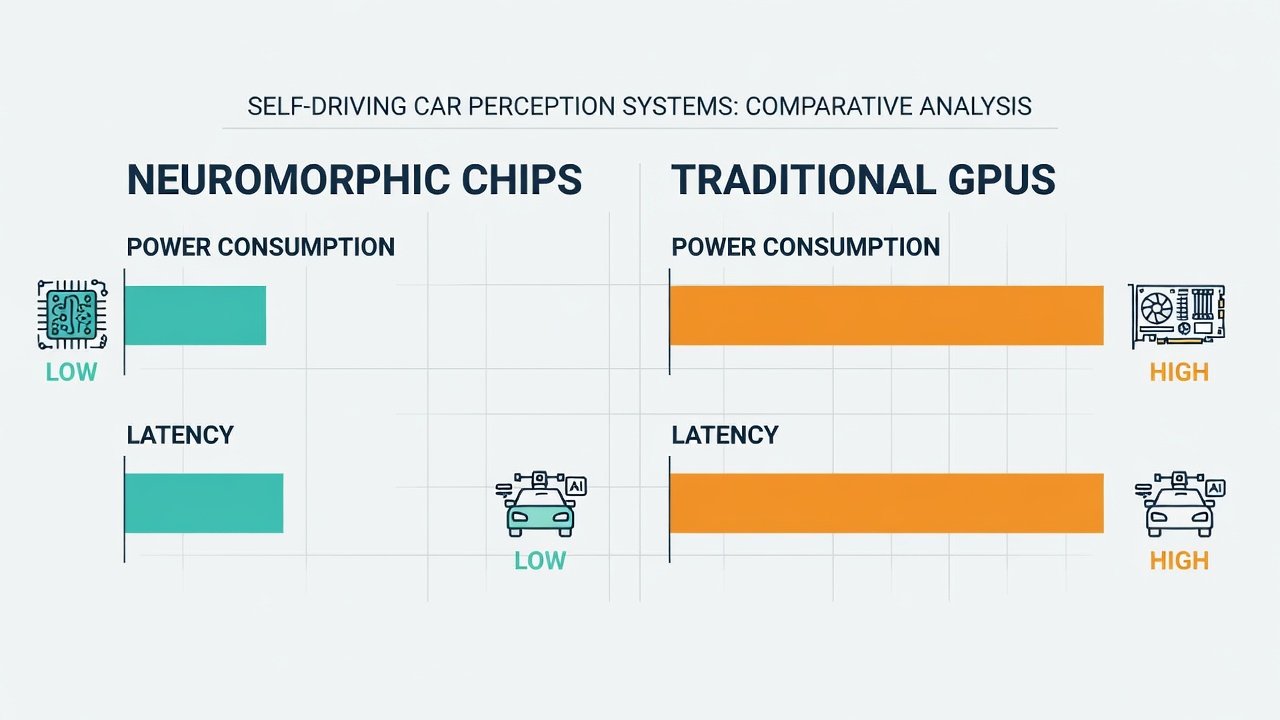
Deployments in 2026 reveal that neuromorphic chips can achieve 60 to 90 percent reductions in power consumption for key AI inference workloads compared to GPU equivalents. In highway driving scenarios, this efficiency translates directly into extended vehicle range, as less battery capacity is diverted to compute tasks. Latency improvements average between 25 and 50 milliseconds in perception modules, allowing faster obstacle avoidance and smoother trajectory planning. These gains compound in fleet operations, where cumulative energy savings support higher utilization rates and lower operational overhead for charging infrastructure.
Tesla Case Study: Real-World Deployments
Tesla's integration of neuromorphic accelerators into its Full Self-Driving hardware has produced compelling results in 2026 fleet testing. During extended highway autopilot sessions, the new chips delivered approximately 65 percent lower AI-related power draw than previous GPU-centric configurations. This efficiency stems from optimized handling of vision-based object tracking, where spikes trigger only on motion changes rather than frame-by-frame analysis. Real-world examples include improved performance in low-light conditions and dense traffic, where the system maintains high accuracy while consuming minimal energy. Tesla engineers have also reported reduced thermal loads, enabling smaller cooling systems and freeing up space for additional battery cells or passenger amenities.
Waymo Case Study: Robotaxi Fleet Insights
Waymo's urban robotaxi operations highlight the advantages of neuromorphic processing in stop-and-go city environments. Case studies from 2026 show a 40 percent reduction in energy use per mile compared to GPU baselines, particularly during continuous sensor fusion at busy intersections. The chips excel at processing asynchronous event data from cameras, leading to quicker responses to cyclists and pedestrians. Fleet managers observed higher daily trip volumes because vehicles spend less time recharging between shifts. These outcomes underscore how neuromorphic technology supports scalable, sustainable autonomy in high-density areas where traditional compute methods face energy bottlenecks.
Comparisons with Edge AI Chips
Edge AI chips from providers like Qualcomm deliver strong efficiency for mobile applications, yet neuromorphic solutions outperform them in event-driven automotive tasks. Direct benchmarks indicate neuromorphic designs require fewer watts per inference for vision and radar fusion, especially when data arrives sporadically. Hybrid configurations combining both technologies are emerging as a practical middle ground, allowing vehicles to leverage the strengths of each processor type depending on driving conditions. This comparison helps manufacturers evaluate trade-offs in accuracy, latency, and thermal management when selecting hardware for next-generation platforms.
Integration Challenges in EV Platforms
Bringing neuromorphic chips into production vehicles involves several technical and engineering challenges. Adapting existing deep learning models to spiking formats requires specialized training frameworks and validation protocols. Compatibility with vehicle communication buses, such as CAN and Ethernet, demands custom interfaces to ensure real-time data flow. Thermal and power delivery constraints in compact EV chassis further complicate placement decisions. Manufacturers often address these issues through iterative prototyping, starting with simulation environments before moving to on-road validation. Safety certification processes add another layer, requiring exhaustive testing to prove reliability under diverse weather and traffic conditions.
Regulatory Considerations for Self-Driving Fleets
Regulatory bodies including the NHTSA continue to refine standards for neuromorphic-based autonomy systems. Emphasis is placed on system explainability, fail-operational modes, and cybersecurity protections for the novel hardware. 2026 draft guidelines encourage transparent reporting of energy metrics alongside traditional safety benchmarks. International harmonization efforts, particularly with European authorities, focus on consistent testing methodologies that account for the unique event-driven behavior of spiking networks. Compliance teams must therefore document not only functional performance but also power profiles to meet emerging sustainability criteria for autonomous fleets.
Performance Benchmarks and Metrics
- Power reduction in perception modules: 60-80 percent average versus GPU baselines
- Latency improvement for object recognition: 25-45 milliseconds
- Accuracy parity maintained above 99 percent in controlled tests
- Peak thermal output reduced by approximately 50 percent
- Event processing rate: up to 10 times higher efficiency in sparse scenes
These metrics are derived from aggregated 2026 fleet data and help quantify the practical advantages for both individual vehicles and large-scale operations.
Adoption Timelines Through 2027
Vehicle-grade neuromorphic chip production is scaling rapidly, with initial OEM integrations targeted for late 2026 models. Early adopters are focusing on premium autonomous packages before broader rollout. By mid-2027, software ecosystems and supply chains are expected to mature sufficiently for mass-market availability. Fleet operators planning upgrades should monitor pilot programs and participate in industry consortia to stay ahead of standardization developments.
FAQ on Implementation Costs and Practicalities
What are the main benefits for EV range? Significant power savings allow for 15-25 percent extended operational range in autonomous mode by reducing compute-related battery drain.
How do these chips handle safety certifications? They undergo ISO 26262 compliance with additional neuromorphic-specific validation layers that verify spike-based decision integrity.
Are hybrid GPU-neuromorphic setups viable? Yes, many 2026 vehicles employ tiered processing architectures that route different tasks to the most suitable hardware.
What training is required for engineering teams? Teams typically need several months of specialized coursework on spiking neural networks and co-design methodologies.
Conclusion
Neuromorphic chips mark a pivotal advancement for 2026 autonomous EV technology by delivering substantial power savings alongside competitive performance. Through detailed case studies from Tesla and Waymo, the industry gains concrete evidence of real-world benefits in energy efficiency and latency. As integration challenges are overcome and regulatory frameworks evolve, these chips will play an increasingly central role in sustainable self-driving fleets. Continued innovation from leaders like Tesla and Waymo, supported by foundational research from Intel, points toward a future where autonomous mobility becomes both smarter and more energy efficient.

No comments yet. Be the first!