 NeoBit Daily
Introduction to Multi-Cloud Software Updates in 2026
Managing software updates across multi-cloud environments has become essential for enterprises seeking scalability and resilience. In 2026, organizations increasingly rely on hybrid infrastructures combining platforms like AWS and Azure to distribute workloads, reduce vendor lock-in, and enhance disaster recovery. However, coordinating updates while minimizing downtime requires careful planning around patch notes, release notes, and cross-platform compatibility. Enterprises face growing pressure to maintain continuous operations as digital transformation accelerates, making robust update strategies a competitive necessity rather than an optional practice.
Proactive monitoring of 2026 patch notes helps IT teams predict conflicts before they arise. This approach supports risk reduction and ensures seamless integration across diverse infrastructures. Readers will find actionable checklists, real-world AWS-Azure examples, and step-by-step workflows throughout this guide. The focus remains on enterprise scalability, where even minor disruptions can cascade into significant revenue impacts.
Understanding Key Challenges in Multi-Cloud Update Management
Vendor-specific challenges often emerge when applying updates simultaneously on AWS, Azure, and other providers. Differences in update cadences, dependency management, and API behaviors can lead to compatibility issues that surface only after deployment. Automated rollout sequencing addresses these by staging updates in controlled phases, allowing teams to isolate problems quickly.
Cross-platform compatibility checks form the foundation of any successful strategy. Teams must validate that updates on one cloud do not break applications running on another. Incorporating insights from release notes allows for early identification of breaking changes, such as deprecated APIs or altered security protocols. Common pitfalls include mismatched kernel versions in containerized workloads and inconsistent handling of network security groups across providers.
Proactive Monitoring of 2026 Patch Notes
Staying ahead of updates means establishing a monitoring routine for official patch announcements. Subscribe to vendor feeds and use tools that aggregate release notes across clouds. This practice enables teams to forecast potential conflicts and adjust deployment timelines accordingly. In practice, many organizations set up automated alerts that flag critical security patches within hours of release, enabling same-day triage meetings.
Practical tip: Create internal dashboards that pull from sources such as AWS and Microsoft Azure documentation pages. Review notes weekly to align with enterprise change management processes. Adding a third provider like Google Cloud requires extending these dashboards with additional API integrations to maintain a unified view.
Cross-Platform Compatibility Checks
Before any rollout, perform rigorous testing in staging environments that mirror production multi-cloud setups. Key steps include validating OS-level dependencies across Linux distributions and Windows variants, testing application APIs for behavioral consistency post-update, and simulating network latency between cloud regions. Teams should also evaluate storage replication delays and identity federation behaviors, as these often cause silent failures during updates.
Document findings in a shared repository to build institutional knowledge. Real-world example: A financial services firm discovered that an Azure security patch altered TLS handshake timings, breaking their AWS-hosted microservices until they adjusted connection pooling parameters. Such insights become invaluable when scaling to additional clouds.
Automated Rollout Sequencing Strategies
Automated sequencing reduces human error and accelerates safe deployments. A typical workflow involves pre-deployment validation using compatibility scripts, canary releases starting in the least critical region, progressive traffic shifting with real-time monitoring, and rollback triggers based on predefined health metrics. Tools like Kubernetes operators or cloud-native orchestration services can enforce these sequences across providers.
Real-world example: An enterprise running workloads on AWS and Azure used Terraform and Azure DevOps pipelines to sequence updates, achieving zero-downtime during a major OS patch cycle. They incorporated feature flags to toggle new functionality only after full validation, further reducing risk.
Step-by-Step Deployment Workflow for AWS-Azure Hybrids
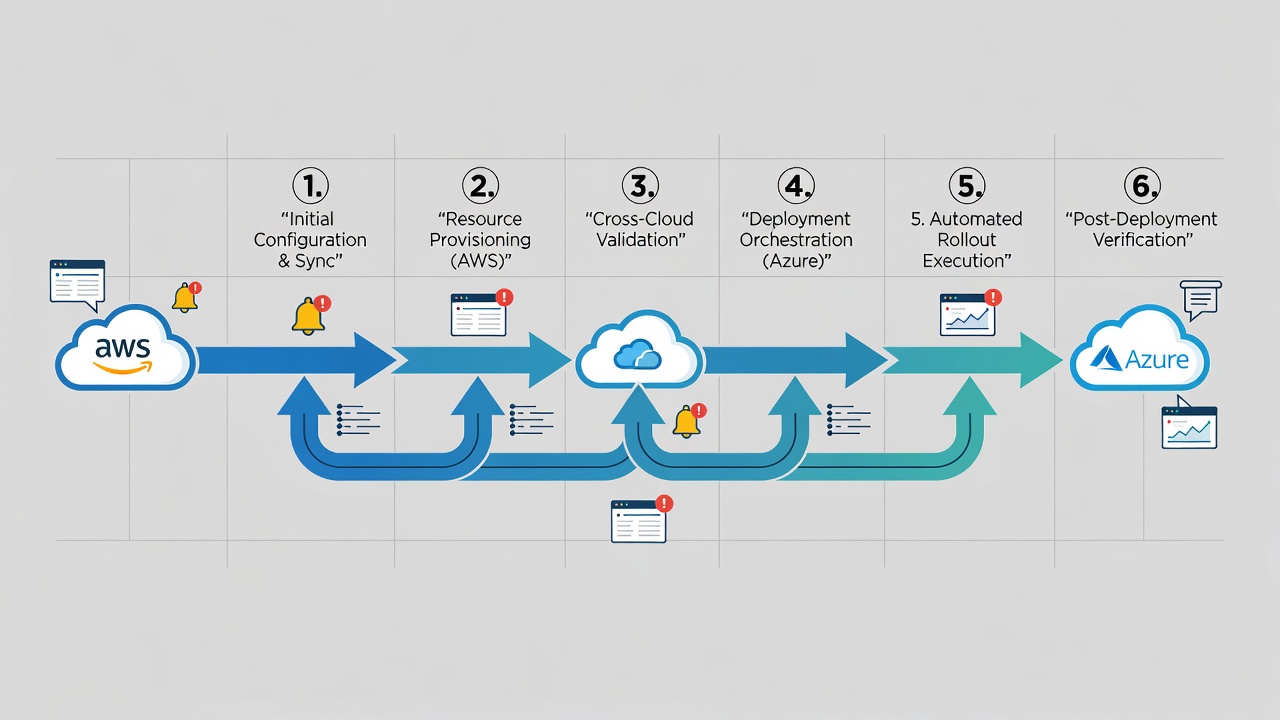
Follow this workflow for reliable updates. First, review patch notes from both providers and assess impact on existing workloads. Next, update infrastructure-as-code templates to reflect new configurations. Then execute compatibility tests in isolated accounts or resource groups. Initiate automated rollout with monitoring alerts configured for CPU, memory, and error rate thresholds. Finally, conduct post-deployment verification and compliance audits to confirm all regulatory requirements remain satisfied.
Expand this process by including blue-green deployment patterns where possible. Maintain parallel environments so traffic can shift instantly if issues arise. Incorporate logging aggregation tools that span both clouds for unified observability during the transition.
Comparison of Tools for Multi-Cloud Update Management
| Tool | Strengths | Best For |
|---|---|---|
| Ansible | Agentless, broad cloud support | Configuration consistency across regions |
| Terraform | Infrastructure as code with state management | Provisioning and updating resources |
| Azure Arc + AWS Systems Manager | Native hybrid management capabilities | Centralized patching and compliance reporting |
| Red Hat Ansible Automation Platform | Enterprise support and policy enforcement | Large-scale, regulated environments |
Risk Reduction and Compliance Strategies
Beyond basic sequencing, implement layered risk reduction through automated compliance scanning integrated into CI/CD pipelines. Map every update against frameworks such as NIST or ISO standards and maintain immutable audit logs. Schedule quarterly tabletop exercises where teams simulate failed rollouts to refine response playbooks.
Actionable Checklist for IT Teams
- Establish a patch monitoring calendar with daily review of critical feeds
- Implement automated compatibility testing in mirrored environments
- Define rollback procedures for each cloud with tested runbooks
- Train teams on vendor-specific nuances and API differences
- Schedule quarterly compliance reviews with external auditors
- Maintain an inventory of all inter-cloud dependencies
- Conduct load testing after every major update cycle
FAQ: Addressing Common Compliance Hurdles
How do we maintain compliance during multi-cloud updates?
Map updates against frameworks like NIST or ISO 27001 and log all changes centrally using a single source of truth for audit trails.
What if a patch introduces a security regression?
Use staged rollouts and maintain isolated environments for rapid testing and rollback, ensuring fallback images remain available for at least 30 days.
How should we handle conflicting patch schedules between providers?
Prioritize based on severity scores and business impact, then negotiate maintenance windows that accommodate the most critical patches first.
Conclusion
Optimizing software updates for multi-cloud environments in 2026 demands a blend of proactive monitoring, automated processes, and thorough compatibility validation. By following the strategies and checklists outlined above, IT teams can achieve greater scalability while significantly reducing operational risks. Continuous refinement of these practices will remain vital as cloud ecosystems evolve throughout the year.


No comments yet. Be the first!