 NeoBit Daily

Introduction to Embedded Systems Software Updates in 2026
Embedded systems powering IoT devices and hardware-constrained hardware face unique challenges when deploying software updates in 2026. Unlike traditional operating systems, these environments operate under strict limits on memory, processing power, and energy consumption. IT and engineering teams must balance security, reliability, and efficiency while managing patch deployment across fleets of devices. This article explores advanced techniques for secure delivery, validation, and recovery, drawing on real-world applications in automotive and medical sectors. Organizations managing thousands of edge nodes need strategies that account for intermittent connectivity, regulatory compliance, and long device lifecycles that often exceed a decade.
Understanding Unique Constraints: Memory, Power, and OS Updates
Embedded devices often run on microcontrollers with as little as 256 KB of flash memory and milliwatt-level power budgets. Applying OS updates or patch notes requires careful delta compression techniques to minimize payload size. Power constraints further complicate matters, as devices in remote locations may rely on batteries or energy harvesting, making lengthy update windows impractical. Teams must prioritize lightweight protocols that avoid draining resources during transmission and installation. Additional constraints include limited RAM for buffering update packages, absence of virtual memory, and real-time operating system requirements that cannot tolerate extended downtime. In practice, engineers frequently partition storage into active and inactive slots to enable atomic updates without risking corruption of the running image.
Secure Over-the-Air Delivery Methods
Secure OTA delivery forms the backbone of modern embedded update strategies. Implement end-to-end encryption using AES-256 combined with digital signatures verified against a hardware root of trust. Protocols like MQTT over TLS or CoAP with DTLS provide reliable transport while resisting man-in-the-middle attacks. For constrained networks, consider LwM2M standards that support firmware updates with built-in authentication. Always segment update channels from operational data traffic to reduce attack surfaces. Key best practices include using signed manifests that list file hashes and version numbers, enabling devices to reject tampered packages before installation begins. In large deployments, incorporate bandwidth throttling and scheduling based on device location or time-of-day patterns to avoid network congestion. NIST provides foundational guidance on IoT device security that directly applies to these OTA mechanisms.
Rigorous Testing Protocols for Release Notes Validation
Before rollout, validate release notes through multi-stage testing. Begin with unit tests on emulated hardware, followed by integration tests on representative device samples. Simulate network interruptions, power failures, and partial downloads to confirm resilience. Automated frameworks can execute regression suites covering compatibility across firmware variants. Document all test results alongside release notes to provide traceability for compliance audits. Expand testing to include environmental stress such as temperature cycling, vibration, and electromagnetic interference that mimic field conditions. Incorporate fuzz testing on update parsers to uncover edge-case vulnerabilities. A practical checklist includes verifying that update packages decompress correctly within available RAM and that cryptographic verification completes within acceptable time limits on the target microcontroller.
- Emulation testing on virtual hardware replicas
- Hardware-in-the-loop validation under extreme temperatures
- Security penetration testing by third-party auditors
- Staged canary deployments to 5% of the device fleet
- Long-term soak testing for memory leaks after update
Real-World Examples from Automotive and Medical Sectors
In the automotive industry, over-the-air updates for ECUs must comply with stringent safety standards. Manufacturers use phased rollouts where vehicles receive updates only when parked and connected to Wi-Fi, minimizing driver distraction risks. Medical devices, such as pacemakers and infusion pumps, demand even higher reliability. Updates undergo FDA premarket review equivalents and extensive clinical simulation before deployment. The FDA offers detailed resources on medical device cybersecurity. Automotive teams additionally coordinate with suppliers using AUTOSAR standards to ensure that updated software maintains functional safety certification. A recent case involved a major automaker rolling back a navigation module update after discovering a compatibility issue with legacy sensor firmware, highlighting the value of robust rollback mechanisms. In healthcare, infusion pump vendors maintain detailed audit trails of every update attempt to satisfy regulatory reporting requirements.
Step-by-Step Rollback Procedures
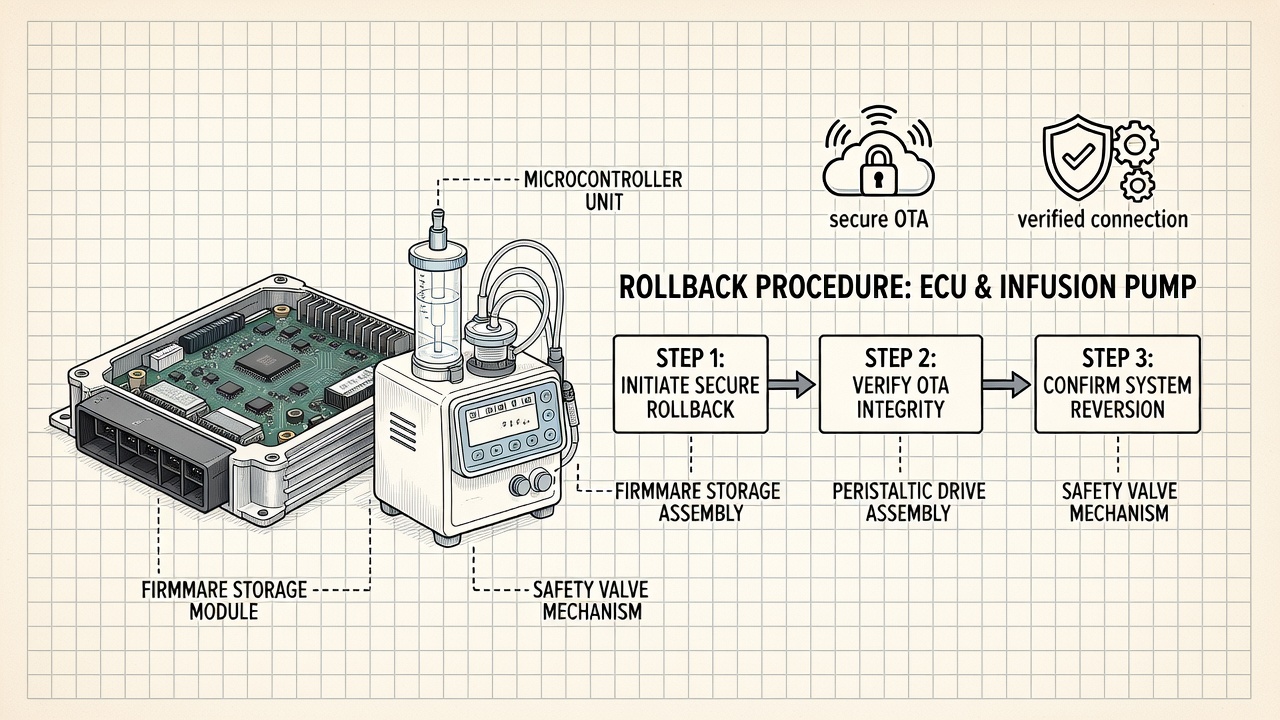
When updates fail, rapid rollback prevents device bricking. Follow this sequence: detect failure via watchdog timer or checksum mismatch within 30 seconds of boot; revert to the previous partition using A/B slot switching if supported by the bootloader; log the incident with telemetry data for root-cause analysis; notify the management platform and trigger a support ticket; schedule a retry only after confirming compatibility fixes. Always maintain at least two bootable images on the device to enable seamless recovery. In more advanced setups, implement a tertiary recovery image stored in read-only memory that can restore factory firmware if both primary slots become corrupted. Teams should also define clear escalation paths so field technicians can trigger manual rollbacks via local interfaces when remote connectivity is unavailable.
Tool Comparisons: Embedded Environments vs Standard OS Updates
Standard OS tools like Windows Update or apt rely on abundant resources and always-on connectivity. Embedded solutions differ significantly. Mender and Balena provide lightweight OTA frameworks optimized for Linux-based devices with delta updates that reduce bandwidth by up to 90%. In contrast, full-image tools like RAUC suit systems without dual-partition support. For ultra-constrained microcontrollers, MCUboot offers minimal-footprint secure boot and recovery. Choose based on memory availability: devices under 1 MB flash benefit most from MCUboot, while those with 8 MB or more can leverage richer frameworks like Mender. Additional considerations include licensing costs, community support, and integration with existing CI/CD pipelines. Many organizations combine multiple tools, using MCUboot for the bootloader layer and a higher-level manager for application-level patches. IETF specifications for constrained environments help teams evaluate protocol-level compatibility across these tools.
Common Mistakes to Avoid in Embedded Update Projects
Many teams underestimate the complexity of version skew across heterogeneous device populations. Another frequent error is neglecting to test updates under realistic power conditions, leading to mid-installation failures. Overly aggressive update frequencies can also drain batteries faster than anticipated. Always conduct pilot programs with devices that mirror the oldest hardware revisions still in the field. Finally, insufficient logging makes post-mortem analysis nearly impossible when incidents occur.
FAQ: Addressing Common Pitfalls Like Compatibility Failures
Q: How do I prevent compatibility failures during updates?
A: Maintain a device capability matrix and enforce version gating in the update server. Test against all supported hardware revisions before release.
Q: What causes partial update failures in low-power devices?
A: Insufficient power budgeting or network drops. Mitigate by implementing resume-capable transfers and power monitoring before starting installation.
Q: Are there standards for embedded update security?
A: Yes. Reference guidelines from recognized bodies such as NIST cybersecurity frameworks for IoT device updates.
Q: How often should rollback procedures be tested?
A: Perform rollback drills at least quarterly and after every major firmware release to ensure the mechanism remains functional on aging hardware.
Conclusion
Successfully managing 2026 software updates for embedded systems demands attention to resource constraints, robust security, thorough testing, and reliable recovery mechanisms. By adopting the strategies outlined above and learning from automotive and medical deployments, teams can minimize downtime and maintain device integrity across large-scale IoT deployments. Continuous monitoring and iterative improvement of update processes will remain essential as device fleets grow and regulatory expectations evolve.


No comments yet. Be the first!