 NeoBit Daily
Introduction to AI-Powered Patch Note Analysis
In 2026, software updates are arriving at an unprecedented pace across operating systems, applications, and cloud services. IT professionals no longer have time to manually scan thousands of lines of release notes. Instead, AI-driven techniques are transforming how teams extract actionable intelligence from patch notes. This article explores advanced analytics methods that go far beyond surface-level reading, helping professionals uncover hidden patterns and forecast software trends with precision. The shift toward AI analysis addresses the growing complexity of modern software ecosystems where updates often include interdependent changes that affect security, performance, and compatibility across multiple platforms simultaneously.
Why AI Excels at Processing 2026 Patch Notes
Modern patch notes contain structured and unstructured data: version numbers, security fixes, performance improvements, and deprecations. Natural language processing models can parse this content at scale, identifying correlations between changes across vendors. Machine learning algorithms detect subtle language shifts that signal upcoming architectural shifts, such as the gradual move toward zero-trust security models in enterprise operating systems. These capabilities enable proactive decision-making rather than reactive responses after deployment issues arise. By leveraging embeddings and attention mechanisms, AI systems can contextualize references to prior updates, creating a longitudinal view of software evolution that manual review simply cannot achieve efficiently.
Machine Learning Applications for OS Updates
Supervised learning models trained on historical patch data can classify update types automatically. Unsupervised clustering reveals groups of related changes across Windows, macOS, and Linux distributions. Reinforcement learning agents simulate update deployment scenarios to predict compatibility risks before rollout. These applications allow teams to prioritize critical security patches while forecasting long-term platform stability. For instance, models can be trained to recognize patterns in kernel modifications that historically led to driver incompatibilities. Integration with monitoring tools further enhances value by feeding parsed insights into dashboards that track metrics over time. Professionals can extend these models using frameworks documented at Mozilla Developer Network for custom text processing pipelines tailored to release note formats.
Real-world implementations often integrate with existing monitoring stacks. For example, organizations feed parsed notes into time-series databases to track how frequently certain vulnerability classes appear in quarterly releases. This approach supports compliance reporting and helps teams allocate resources more effectively during patch cycles.
Real-World Examples of AI Parsing Release Notes
Leading technology companies already demonstrate the value of these techniques. One financial services firm used transformer-based models to analyze Linux kernel patches, identifying a recurring pattern in memory management changes that preceded major performance regressions. Another enterprise applied topic modeling to Microsoft and Apple release notes simultaneously, revealing coordinated shifts in API deprecation timelines that informed their multi-platform strategy. A third case involved a healthcare provider leveraging clustering algorithms on Android security bulletins to anticipate mobile device policy updates months in advance. These examples illustrate how AI moves beyond keyword searches to deliver predictive insights that influence infrastructure planning and vendor negotiations.
Step-by-Step Implementation Guide
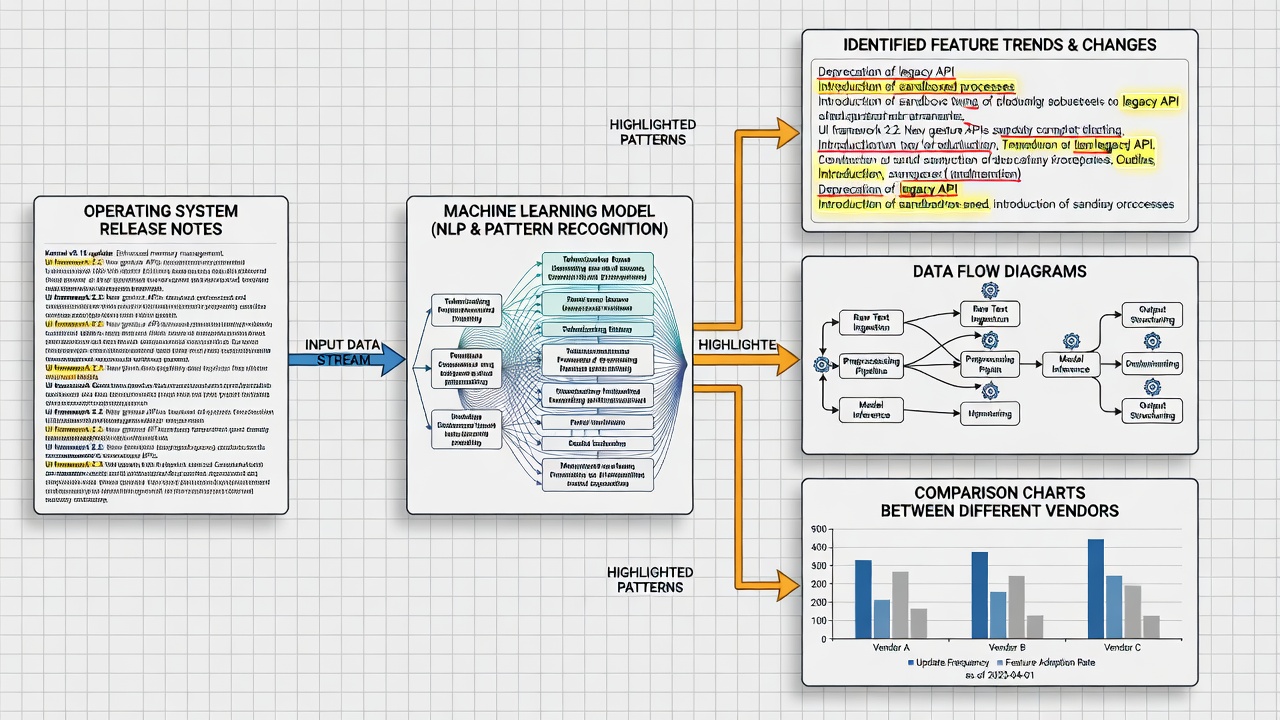
Follow these steps to build your own AI pipeline for patch note analysis:
- Collect raw release notes from official vendor feeds using automated scripts that poll repositories daily and store data in a centralized database for versioning control.
- Preprocess text with tokenization and entity recognition to extract version numbers and CVE references, while handling formatting variations across different vendors through custom regex patterns and normalization rules.
- Fine-tune a language model on labeled historical data for classification tasks, incorporating domain-specific vocabularies related to software engineering terms and security nomenclature.
- Deploy the model via an inference API that outputs structured JSON for downstream dashboards, ensuring scalability through containerization and load balancing mechanisms.
- Continuously retrain using feedback from your operations team on prediction accuracy, establishing automated evaluation loops that compare model outputs against actual post-deployment incidents.
Sample Workflows for Daily Operations
A typical daily workflow begins with automated ingestion of new patch notes at 6 AM UTC. The AI model runs inference within minutes and flags high-risk updates for human review. Weekly reports aggregate trend data, highlighting rising categories such as supply-chain security or AI accelerator support. Teams integrate these outputs directly into ticketing systems for seamless prioritization. Advanced workflows may include automated alert generation when predicted compatibility scores fall below predefined thresholds, allowing engineers to prepare mitigation strategies in advance. Documentation of each workflow step ensures reproducibility and facilitates onboarding of new team members.
Free vs Enterprise AI Tools Comparison
Open-source options like Hugging Face Transformers and spaCy provide strong foundations for custom model development. Enterprise platforms offer managed infrastructure, compliance certifications, and pre-built connectors to major software vendors. The choice depends on data sensitivity requirements and the need for dedicated support. Qualitative differences include scalability guarantees and audit logging depth rather than specific pricing tiers. Teams evaluating options should consider factors such as integration ease with existing DevOps pipelines and the availability of community-driven extensions versus proprietary feature roadmaps.
Potential Pitfalls in AI Interpretation
Common challenges include hallucinated CVE mappings and context loss when notes reference external documents. Overfitting to past vendor language can miss novel update patterns. Privacy risks arise when feeding sensitive internal notes into third-party APIs. Mitigation strategies involve human-in-the-loop validation, local model deployment, and strict data retention policies. Additional pitfalls encompass bias in training datasets that overemphasize certain vendors and difficulties handling multilingual release notes from global development teams. Regular audits of model decisions help maintain reliability and build trust among stakeholders who rely on these insights for critical infrastructure decisions. Organizations following guidelines from National Institute of Standards and Technology can strengthen their governance frameworks around AI-assisted analysis.
Frequently Asked Questions
How accurate are AI predictions on patch note trends?
Accuracy depends on training data quality and model architecture. Well-tuned systems achieve over 85% precision on classification tasks when validated against historical outcomes, though edge cases always require expert review. Continuous monitoring and retraining cycles further improve performance over successive update seasons.
What data privacy measures should be considered?
Process notes on-premises when possible or use providers with strong encryption and zero-retention policies. Always anonymize any proprietary references before external processing. Compliance with regional data regulations remains essential for multinational organizations handling cross-border patch information.
Can small teams implement these techniques without massive resources?
Yes. Start with pre-trained open models and lightweight scripting. Incremental improvements through feedback loops often yield strong results within weeks. Leveraging community resources from Linux Foundation can accelerate development of domain-specific adaptations.
Conclusion
AI-driven analysis of 2026 patch notes empowers IT professionals to move from reactive maintenance to proactive strategy. By combining machine learning techniques with disciplined workflows, teams gain clearer visibility into software evolution while avoiding common interpretation pitfalls. The future belongs to organizations that treat release notes not as static documents but as rich data sources for continuous intelligence. Implementing these methods positions teams to anticipate changes, reduce downtime, and optimize resource allocation across increasingly complex technology landscapes.


No comments yet. Be the first!