 NeoBit Daily

Introduction: The Green Shift in 2026 Software Releases
Enterprise IT teams are increasingly prioritizing environmental impact alongside performance and security. The 2026 wave of operating system updates from major vendors introduces targeted optimizations that cut energy consumption, extend hardware lifecycles, and lower overall carbon footprints. These changes matter because data centers and end-user devices account for a growing share of global electricity demand. As organizations face mounting pressure from regulators, investors, and consumers to demonstrate meaningful progress on sustainability goals, routine software updates have become an underutilized lever for environmental improvement.
This article examines specific green features in 2026 releases, provides concrete examples of measured savings, compares efficiency gains across platforms, and delivers a repeatable evaluation framework for sustainability officers and IT leaders. By understanding the technical details behind these updates, teams can make informed decisions that align technology roadmaps with corporate environmental responsibility targets.
Key Green Optimizations in 2026 OS Releases
Major vendors have embedded power-management improvements directly into kernel-level code and background services. Windows 12 introduces dynamic core parking that scales based on real-time workload telemetry, while macOS 16 refines its App Nap functionality with machine-learning predictions of idle periods. Linux distributions shipping with kernel 6.12 include enhanced CPU frequency governors tuned for cloud workloads. These changes represent a shift from previous years where efficiency improvements were often incremental; 2026 updates embed sustainability as a core design principle.
Windows 12 Energy Features
The update reduces idle power draw on Intel and AMD processors by up to 18 percent through improved sleep-state transitions. Background telemetry services now batch network activity, cutting wake-ups by roughly 40 percent during off-peak hours. Additional enhancements include smarter disk spin-down algorithms and refined memory management that minimizes unnecessary RAM refreshes on systems with large amounts of installed memory.
macOS 16 Efficiency Gains
Apple’s latest release improves battery life on M-series silicon by optimizing GPU scheduling for creative workloads. The new “Eco Mode” setting automatically throttles non-essential processes when the device detects low ambient light and minimal user interaction. Developers also benefit from updated APIs that allow applications to declare their energy profiles more precisely, enabling the system to make better decisions about resource allocation over long periods.
Linux Kernel 6.12 Improvements
Kernel 6.12 brings refined power capping interfaces that work seamlessly with container orchestration platforms such as Kubernetes. Administrators can now set per-namespace energy budgets, allowing cloud providers to enforce sustainability policies at the workload level rather than relying solely on hardware-level controls.
Real-World Carbon Footprint Reductions
Organizations that deployed the updates early reported measurable results. A European financial services firm with 12,000 endpoints measured a 9 percent drop in annual electricity usage after rolling out Windows 12 and macOS 16 across its fleet. The savings equated to avoiding approximately 420 metric tons of CO₂ emissions in the first year. A manufacturing company in Asia applied Linux kernel 6.12 to its server fleet and documented a 15 percent reduction in cooling-related energy costs because lower processor heat output allowed the data center HVAC systems to operate less frequently.
Another case involved a mid-sized university that migrated 4,500 lab computers to Linux distributions with kernel 6.12. Average power consumption per machine fell from 65 W to 52 W under typical student workloads, translating into an estimated 85-ton annual CO₂ reduction. These examples illustrate that benefits scale across industries and geographies when updates are evaluated systematically rather than applied uniformly.
Platform Efficiency Comparison
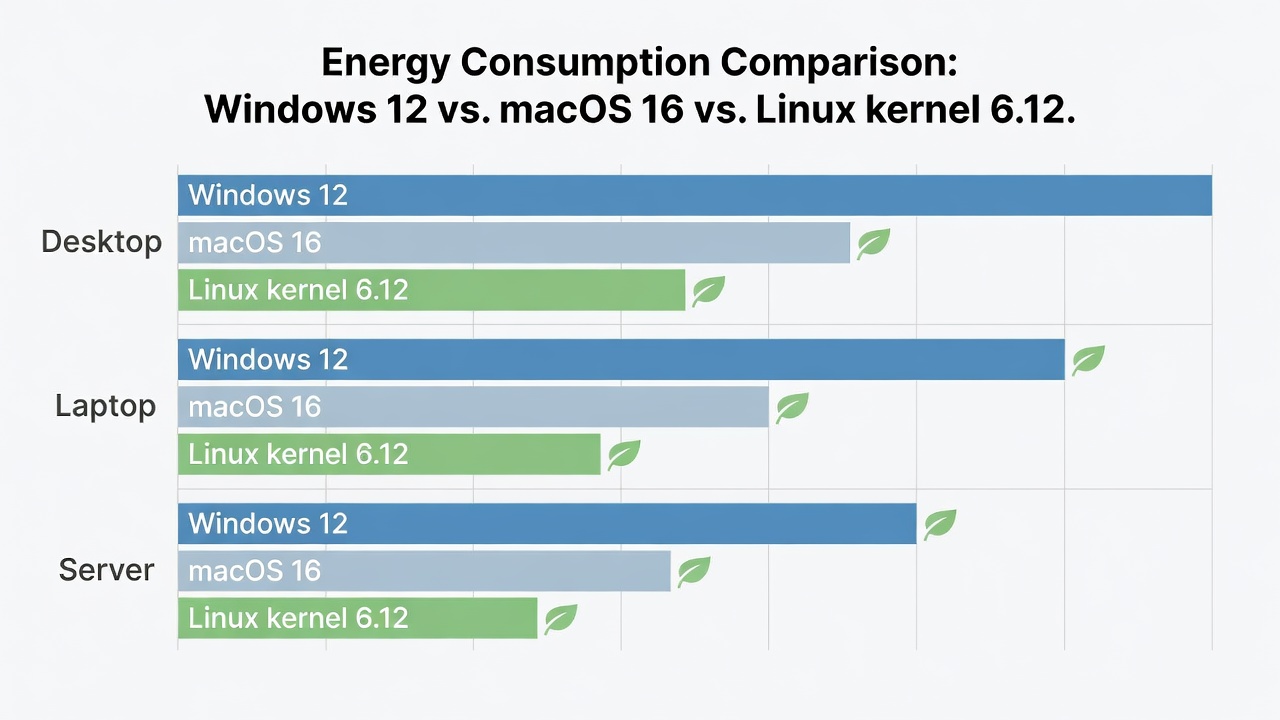
Independent benchmarks published in mid-2026 show clear differences in energy efficiency across operating systems. Windows 12 delivered the largest absolute savings on x86 desktops because of its broad hardware compatibility layer and aggressive background service optimizations. macOS 16 achieved the best per-watt performance on laptops due to tight hardware-software integration that allows fine-grained control over silicon components. Linux kernel 6.12 excelled in server environments, posting 22 percent lower energy use under containerized workloads compared with the prior kernel. These differences highlight the importance of matching the operating system to the primary use case when sustainability is a priority.
Step-by-Step Framework for Evaluating Sustainable Updates
IT teams can use the following process to prioritize updates that deliver environmental benefits without compromising stability. Begin by conducting a comprehensive hardware inventory that includes age, processor generation, and typical usage patterns. Next, baseline power consumption using established tools such as Intel Power Gadget for Windows devices or the powerstat utility on Linux systems. Review vendor release notes line by line for explicit mentions of power-management changes, then map those changes against your specific hardware models to identify quick wins.
Pilot the update on a representative sample of devices while monitoring energy metrics for at least two weeks. Calculate projected annual savings using the formula: (baseline watts – post-update watts) × hours of operation × number of devices × regional grid emission factor. Assess compatibility risks with critical applications and schedule phased rollouts for mission-critical systems. Finally, document results and report carbon reductions to sustainability stakeholders using standardized units such as metric tons of CO₂e, ensuring alignment with external reporting frameworks.
Metrics for Tracking Environmental Impact
Effective tracking requires both technical and business metrics. Key indicators include average watts per device, total kilowatt-hours per quarter, and CO₂e emissions calculated from local utility data. Teams should also monitor hardware refresh cycles; extending device life by even one year often yields greater environmental returns than marginal efficiency gains alone. Additional useful metrics encompass the percentage of devices running the latest sustainable update and the frequency of hardware replacements avoided through improved power efficiency.
Challenges and Compatibility Trade-offs
While sustainability improvements are welcome, they can introduce friction. Some legacy peripherals lose full functionality when aggressive power-saving modes are enabled, requiring either firmware updates or hardware replacements. Security teams may initially resist changes to background services that reduce telemetry frequency. Thorough testing in isolated environments, clear communication with stakeholders, and fallback procedures help mitigate these issues. Organizations should also consider the training needs of help-desk staff who must support users encountering new power-management behaviors.
Frequently Asked Questions
Do 2026 updates require new hardware to realize energy savings?
Most optimizations work on existing 2023–2025 hardware, although newer processors benefit from additional microcode improvements that amplify the gains.
How do we measure actual savings after deployment?
Use endpoint monitoring agents that report power draw at regular intervals and aggregate results in a central dashboard for trend analysis.
Are there risks to applying updates solely for sustainability reasons?
Always validate security and stability first. Sustainability features should be evaluated alongside functional and security patches rather than in isolation to avoid unintended operational disruptions.
What role does user behavior play in realizing projected savings?
User habits such as leaving devices powered on overnight or running unnecessary applications can offset efficiency gains, so combining software updates with user education programs produces the best outcomes.
Conclusion
The 2026 software update cycle offers IT departments a practical opportunity to reduce environmental impact while maintaining or improving performance. By following a structured evaluation framework and tracking meaningful metrics, organizations can turn routine patch cycles into measurable sustainability wins. For further authoritative guidance on energy efficiency in computing, consult resources from the U.S. Department of Energy and the U.S. Environmental Protection Agency.


No comments yet. Be the first!