 NeoBit Daily

Introduction
ERP systems serve as the central nervous system for enterprise operations, integrating finance, supply chain, manufacturing, and human resources into a unified platform. As organizations enter 2026, major vendors have released substantial updates that promise enhanced automation, deeper AI integration, and improved cloud performance. For IT leaders and operations managers, the challenge lies not in simply applying every patch but in strategically selecting those that deliver clear return on investment. This comprehensive guide examines how to dissect release notes from SAP, Oracle, and Microsoft Dynamics, identify high-value opportunities, and implement changes that boost efficiency while minimizing operational risk. Readers will gain a repeatable framework, real-world examples, platform comparisons, and actionable checklists designed to convert technical documentation into measurable business outcomes.
Understanding 2026 ERP Updates Across Major Platforms
Each leading ERP provider has tailored its 2026 releases to address evolving business needs such as real-time decision-making, sustainability tracking, and seamless third-party integrations. SAP continues to refine its S/4HANA suite with stronger emphasis on intelligent automation and ESG reporting capabilities. Oracle has enhanced its Fusion Cloud applications with advanced predictive analytics for complex global supply chains. Microsoft Dynamics 365 focuses on tighter connectivity with the broader Microsoft ecosystem, including Power Automate and Azure AI services. Understanding the scope of these updates requires reviewing not only feature lists but also the underlying architectural improvements that affect performance and scalability.
SAP S/4HANA 2026 Highlights
The latest SAP release introduces refined real-time analytics engines and expanded support for carbon accounting modules. These changes allow operations teams to monitor resource consumption more precisely and comply with emerging environmental regulations without separate reporting tools.
Oracle Fusion Applications 2026 Highlights
Oracle emphasizes machine learning-driven demand sensing and automated supplier risk assessment. These features help reduce stockouts and improve procurement efficiency in volatile markets.
Microsoft Dynamics 365 2026 Highlights
Dynamics updates center on low-code extensibility and improved mobile access, enabling field teams to interact with core ERP data more effectively. Learn more about SAP enterprise solutions.
Step-by-Step Framework for Prioritizing Updates
Effective prioritization prevents teams from becoming overwhelmed by hundreds of individual changes. Begin by creating a cross-functional review team that includes operations, finance, IT, and end-user representatives. Next, categorize every update according to its primary impact area: performance, compliance, cost reduction, or user experience. Assign quantitative scores using a weighted matrix that considers implementation effort, expected time savings, and risk level. For example, an update that reduces batch processing time by 30 percent but requires minimal testing might receive a high priority score, while a cosmetic interface change scores lower. Document assumptions and revisit scores after sandbox testing. This disciplined approach ensures resources focus on changes that align with strategic objectives rather than chasing novelty.
- Map updates to existing pain points identified in quarterly operations reviews.
- Estimate financial impact using current transaction volumes and labor rates.
- Assess compatibility with custom code and third-party integrations.
- Establish success metrics before any deployment begins.
- Schedule regular checkpoint meetings during the evaluation phase.
Following this framework consistently turns lengthy patch notes into a manageable shortlist of high-ROI candidates.
Real-World Case Examples of ROI Gains
Consider a mid-sized automotive parts manufacturer that evaluated its SAP environment against 2026 release notes. By prioritizing updates to the production planning module, the company reduced unplanned downtime by 22 percent within six months. The operations team tracked this improvement through their existing OEE dashboard and attributed the gains directly to enhanced scheduling algorithms. Another example comes from a global logistics provider running Oracle Fusion. Implementation of new route optimization and carrier scoring features led to a measurable decrease in freight spend and improved on-time delivery rates across multiple regions. In the retail sector, a Dynamics 365 user adopted the 2026 AI-powered inventory forecasting tools. This change helped the organization lower excess inventory holdings while maintaining service levels during seasonal peaks. These cases illustrate that ROI emerges when organizations treat patch notes as strategic intelligence rather than routine maintenance tasks.
Comparisons of Update Impacts Across Platforms
Choosing the right platform updates depends on industry, company size, and existing technology stack. SAP updates generally excel in industries requiring rigorous financial consolidation and sustainability reporting. Oracle provides robust support for organizations managing intricate, multi-tier supply networks. Microsoft Dynamics stands out for companies already invested in the Microsoft 365 and Azure ecosystems, offering faster time-to-value for custom workflows. 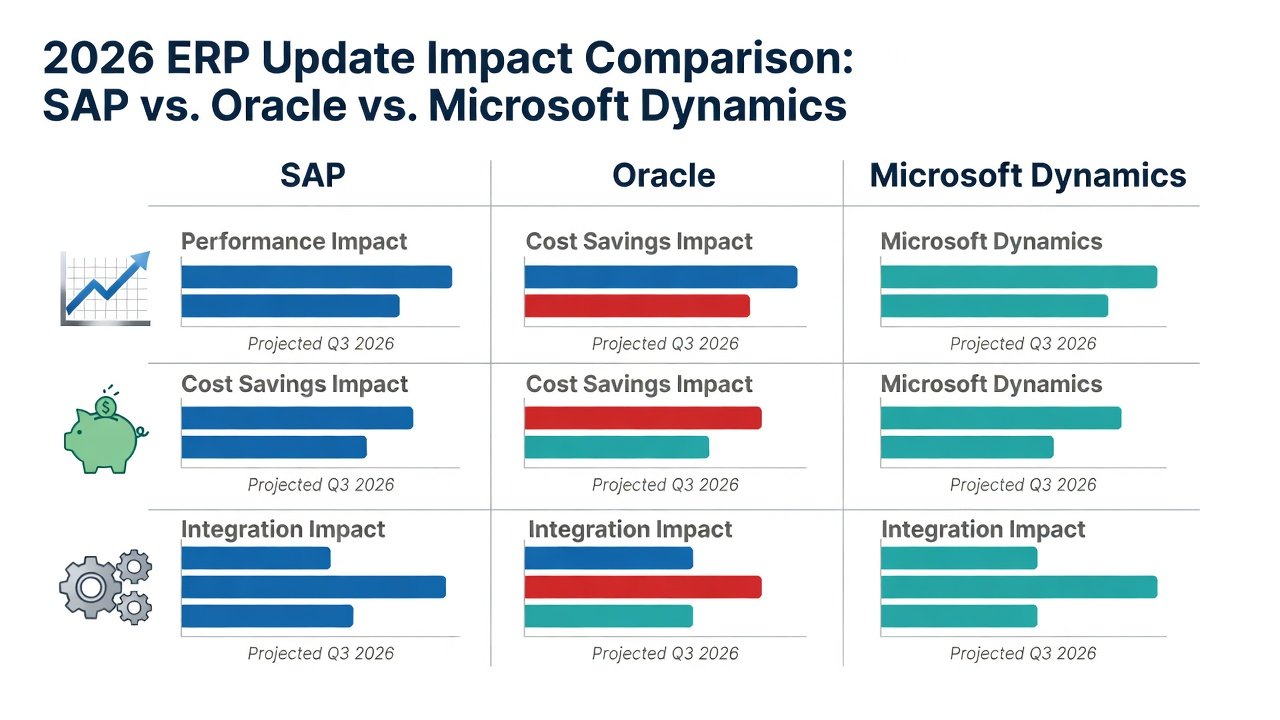
Common Mistakes to Avoid When Implementing ERP Patches
Many organizations fall into predictable traps during update cycles. One frequent error involves applying all available patches without testing their cumulative effect on custom developments. Another is neglecting change management, which leads to low user adoption and unrealized benefits. Teams also sometimes overlook the need to update training materials and standard operating procedures, resulting in inconsistent processes after go-live. Finally, failing to establish baseline metrics before deployment makes it impossible to prove ROI. Avoiding these pitfalls requires dedicated project governance and clear communication across departments.
Measuring and Tracking ROI After Updates
Quantifying success demands both leading and lagging indicators. Track leading indicators such as system response times and error rates immediately after deployment. Monitor lagging indicators including cost per transaction, cycle time reductions, and inventory turnover ratios over the subsequent 90 to 180 days. Create a simple dashboard that compares pre- and post-update performance. When possible, isolate the contribution of specific patches by running controlled pilots in selected business units. This data-driven approach provides the evidence needed to justify future investments in ERP optimization.
Implementation Checklists and Best Practices
Pre-update checklist: Review all release notes line by line, conduct impact analysis on custom objects, prepare sandbox environments, and develop rollback plans. Go-live checklist: Communicate timelines to all stakeholders, monitor system health in real time, and provide on-site support for the first 48 hours. Post-go-live checklist: Collect user feedback weekly, measure KPI movement against baselines, and document any required fine-tuning. Incorporate these practices into your standard operating procedures for every future release cycle.
Aligning ERP Updates with Key Business KPIs
Successful operations managers connect every technical change to tangible business metrics. For instance, automation features that accelerate order-to-cash processes directly influence the cash conversion cycle. Updates that improve demand forecasting accuracy affect both inventory carrying costs and customer fill rates. Schedule quarterly alignment sessions with finance and executive leadership to ensure technical priorities remain synchronized with corporate objectives.
Frequently Asked Questions
How often should teams review ERP patch notes?
Establish a monthly review cadence, with deeper analysis triggered whenever a major release occurs.
What is the typical timeline for realizing ROI from updates?
Most organizations observe initial performance improvements within 60 to 90 days, with full financial benefits materializing after six months of stable operation.
Can small and mid-sized businesses benefit from these strategies?
Yes. The prioritization framework scales effectively regardless of company size, although resource constraints may require focusing on fewer high-impact updates.
How do customizations affect update adoption?
Extensive custom code increases testing requirements and may delay rollout. Organizations should evaluate the long-term maintenance cost of customizations versus adopting standard vendor functionality.
Conclusion
Navigating 2026 ERP patch notes with a structured, ROI-focused mindset transforms routine maintenance into a competitive advantage. By applying the prioritization framework, studying platform differences, avoiding common implementation mistakes, and rigorously measuring outcomes, operations managers and IT leaders can extract substantial value from SAP, Oracle, and Microsoft Dynamics updates. Begin your next review cycle with a clear mapping of business KPIs to available patches, and treat every release as an opportunity to drive efficiency and cost savings across the enterprise.


No comments yet. Be the first!