 NeoBit Daily

Introduction to Quantum Threats in Immersive and Distributed Technologies
As quantum computing advances rapidly toward practical applications by 2026, developers and security teams must prioritize quantum-proofing strategies for VR, AR, and blockchain ecosystems. Quantum computers threaten current public-key cryptography like RSA and ECC, potentially exposing sensitive data in immersive environments and decentralized ledgers. This guide provides a comprehensive, step-by-step approach to adopting post-quantum cryptography (PQC) while maintaining seamless user experiences in virtual training sessions, augmented navigation tools, and secure transaction networks. Quantum-resistant measures are no longer theoretical; organizations need proactive implementation to safeguard against future attacks. The focus here is on practical tactics including algorithm selection, frameworks, testing, and real-world timelines tailored for 2026 deployments, with emphasis on minimizing disruption to frame rates in VR headsets or consensus speeds in blockchain nodes.
By the end of this article, readers will have a clear roadmap for assessment, selection, integration, and ongoing maintenance of quantum-safe systems. Real-world examples from enterprise pilots illustrate how these changes play out in production environments.
Understanding the Quantum Risk Landscape
Quantum algorithms such as Shor's can break traditional encryption, putting at risk everything from AR overlay data streams to blockchain transaction signatures. In VR/AR, this could compromise user authentication and spatial mapping data, allowing malicious actors to intercept or alter immersive content in real time. Blockchain networks face even greater exposure since their immutability relies on cryptographic strength; a sufficiently powerful quantum computer could forge signatures and rewrite transaction histories. Preparing now prevents costly retrofits later. Consider a medical VR platform where patient records are stored on a permissioned blockchain: without PQC, quantum attacks could expose private health data. Developers should evaluate threat models specific to their hardware, such as standalone headsets with limited processing power versus cloud-rendered AR experiences.
Selecting Post-Quantum Cryptography Algorithms
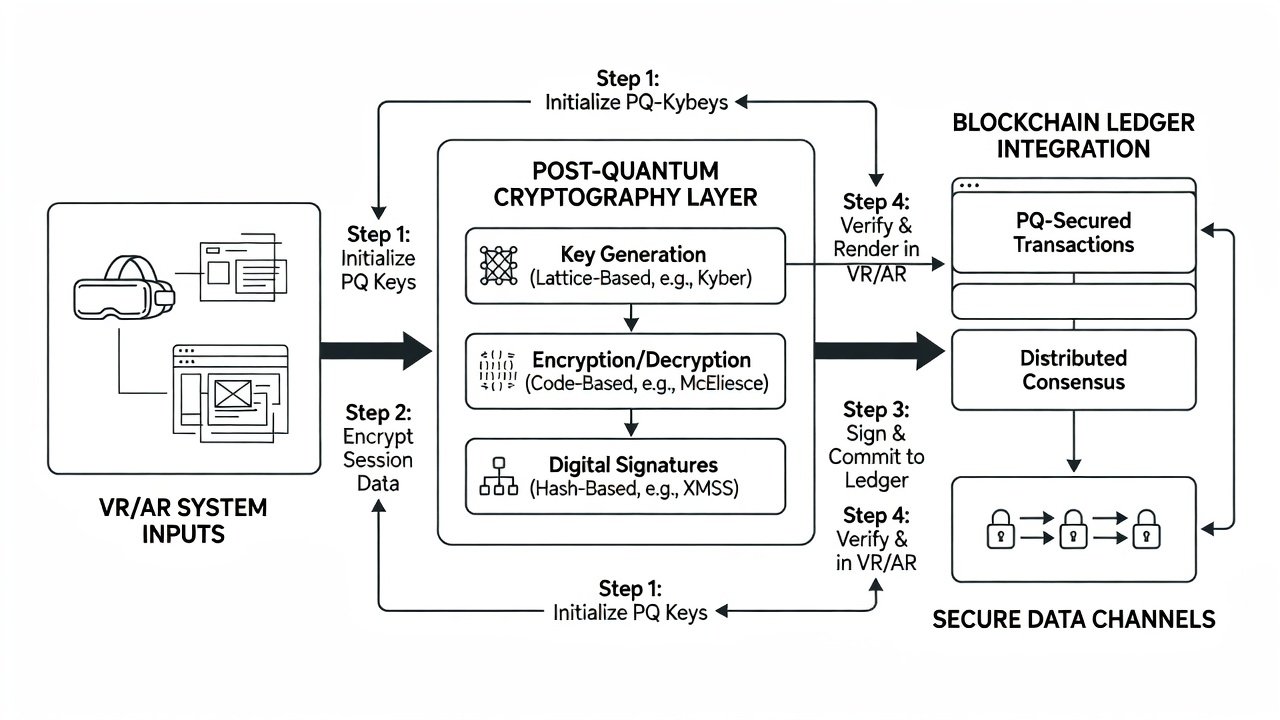
Key PQC candidates standardized by NIST include lattice-based schemes like CRYSTALS-Kyber for key encapsulation and CRYSTALS-Dilithium for digital signatures. These offer strong security against both classical and quantum threats with reasonable key sizes. Hash-based options such as SPHINCS+ provide strong security but with larger signatures that may impact bandwidth in AR streaming. Code-based and multivariate approaches provide alternatives but vary in performance; for example, Classic McEliece offers excellent security margins yet requires substantial memory, making it less ideal for mobile AR devices. Developers should compare these based on key size, speed, and hardware compatibility for immersive tech stacks. For VR and AR, prioritize algorithms with low latency to avoid disrupting real-time rendering—lattice-based methods typically add only milliseconds to handshake times. Blockchain implementations benefit from hybrid models combining classical and PQC methods during transition periods, allowing gradual migration without breaking existing smart contracts. Practical example: A Unity-based VR application might integrate Kyber for session keys while retaining Dilithium for asset signing, tested across Oculus and HTC Vive platforms.
Integration Frameworks for VR, AR, and Blockchain
Begin by auditing existing systems for cryptographic dependencies using tools like dependency scanners in development pipelines. Use established libraries such as the Open Quantum Safe project to integrate PQC into Unity or Unreal Engine environments common in VR/AR development. For blockchain, consider upgrades to platforms like Ethereum via quantum-safe signature schemes in smart contracts. Step 1: Map all encryption touchpoints across rendering engines, network layers, and ledger nodes. Step 2: Select hybrid implementations that support fallback to classical crypto during testing. Step 3: Update key management systems with quantum-safe random number generators. Step 4: Ensure cross-platform compatibility across headsets and nodes by validating on multiple operating systems. In practice, a team building an AR navigation app for logistics might wrap existing TLS connections with Kyber key exchange, then deploy updated firmware to field devices over six weeks. For blockchain, Ethereum Improvement Proposals provide guidance on incorporating Dilithium signatures into wallet software.
Testing Protocols and Performance Optimization
Implement rigorous testing using quantum simulation tools to validate resistance. Measure impacts on frame rates in VR and transaction throughput in blockchain. Performance benchmarks indicate minimal overhead when using optimized lattice-based methods on modern GPUs. Run unit tests for signature verification under simulated high-load conditions, followed by end-to-end latency trials in AR overlays that include real user interactions like gesture recognition. Stress-test blockchain consensus under simulated quantum attacks to ensure no forks occur. Additional checks include side-channel analysis for timing leaks and compatibility verification with legacy devices. A recommended testing sequence starts with isolated component tests, moves to integrated staging environments, and concludes with production shadow deployments. Teams should monitor metrics such as CPU utilization spikes and battery drain on portable AR glasses throughout the process.
- Conduct unit tests for signature verification with varying key lengths
- Run end-to-end latency trials in AR overlays using real-world network conditions
- Stress-test blockchain consensus under simulated quantum attacks with thousands of concurrent transactions
- Validate against compliance standards from NIST
- Perform user experience studies measuring immersion disruption from added cryptographic overhead
Real Company Case Studies
Leading firms like IBM have piloted PQC in enterprise blockchain solutions, demonstrating successful integration without major performance hits on Hyperledger networks. VR companies are exploring similar upgrades in enterprise training platforms to protect proprietary spatial data, with one aerospace firm reporting seamless rollout across 500 headsets. Another example comes from a fintech blockchain provider that adopted hybrid Dilithium signatures, achieving full migration within four months while maintaining 99.9% uptime. These cases highlight the importance of phased approaches and collaboration with hardware vendors.
Risk Mitigation Checklists and Timelines
Follow this checklist for structured implementation: inventory all cryptographic assets and dependencies; prioritize high-risk components such as user authentication modules; pilot PQC in staging environments by Q2 2026; conduct full security audits; and complete rollout by Q4 2026. Monitor for side-channel vulnerabilities throughout and maintain rollback procedures. A sample timeline includes month one for assessment, months two through four for integration and testing, and months five through six for optimization and training. Regular reviews every quarter help adapt to new NIST updates or hardware improvements.
Performance Impacts on Immersive Experiences
Quantum-proofing can affect rendering pipelines and network latency, yet careful selection keeps impacts below noticeable thresholds for most users. In VR, added signature sizes might increase initial load times by a few hundred milliseconds, but optimized implementations on 2026 GPUs mitigate this. AR applications see similar results when offloading heavy computations to edge servers. Blockchain transaction confirmation times remain stable with hybrid schemes. Developers should profile applications before and after changes using built-in analytics tools.
Frequently Asked Questions
How does PQC affect compatibility with legacy VR headsets?
Hybrid approaches allow backward compatibility while gradually phasing in quantum-safe protocols, often through software updates that detect device capabilities.
What are typical implementation costs?
Costs vary by scale; focus on qualitative planning rather than fixed figures to accommodate rapid changes in 2026 hardware pricing.
Can small teams handle blockchain PQC upgrades?
Yes, leveraging open-source tools and phased rollouts makes it feasible for teams of any size, starting with non-critical ledgers.
What common mistakes should teams avoid?
Avoid rushing full replacement without hybrid testing, neglecting performance profiling, or ignoring firmware update pathways on AR devices.
Conclusion
Quantum-proofing VR, AR, and blockchain systems in 2026 requires methodical planning but delivers long-term resilience. By following these steps, security teams can protect immersive and decentralized technologies against emerging threats while preserving performance and user trust. Continuous education through resources like IBM and Ethereum ensures teams stay ahead of evolving standards.


No comments yet. Be the first!