 NeoBit Daily
Quantum Cybersecurity Tactics for VR, AR & Blockchain 2026
The rapid evolution of quantum computing poses existential risks to current encryption standards, particularly as virtual reality, augmented reality, and blockchain technologies become mainstream in enterprise and consumer applications. In 2026, organizations deploying immersive and decentralized systems must prioritize quantum cybersecurity tactics that go beyond traditional measures. This comprehensive guide explores proactive defenses, including quantum-resistant encryption, specialized threat modeling for immersive environments, and secure integration frameworks for decentralized applications. By focusing on actionable steps and real-world examples, readers can build resilient tech stacks capable of withstanding future quantum attacks.
Understanding the Quantum Threat Landscape
Quantum computers leverage principles like superposition and entanglement to solve complex mathematical problems exponentially faster than classical machines. Algorithms such as Shor's can factor large integers and solve discrete logarithms, directly breaking RSA, ECC, and Diffie-Hellman schemes that underpin most VR/AR authentication and blockchain consensus mechanisms. By 2026, quantum hardware milestones have made "harvest now, decrypt later" attacks a tangible concern for long-lived data in immersive platforms, where user biometrics and spatial mapping information require decades-long protection. Blockchain networks face similar exposure because transaction records must remain immutable indefinitely. Organizations must therefore shift to post-quantum cryptography (PQC) while maintaining performance in latency-sensitive VR and AR scenarios.
Quantum-Resistant Encryption Methods
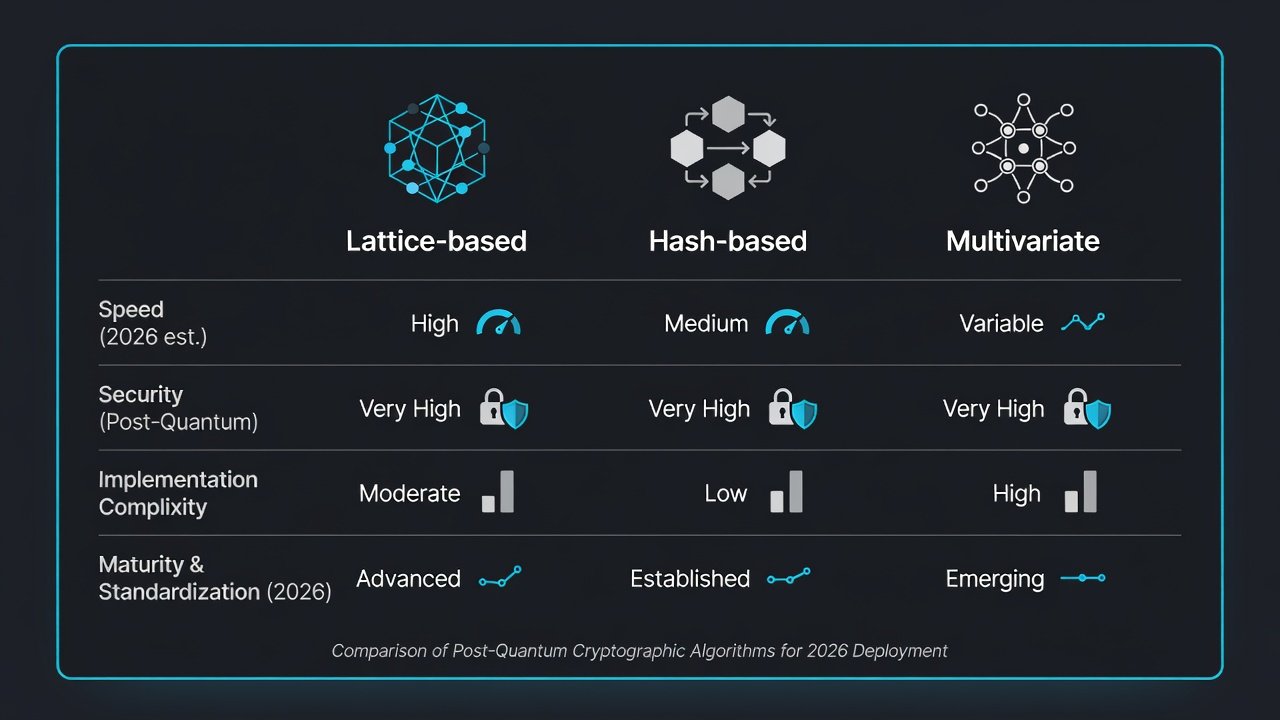
Post-quantum algorithms fall into several families, each with distinct trade-offs in security, key size, and computational overhead. Lattice-based schemes like CRYSTALS-Kyber and CRYSTALS-Dilithium provide efficient key encapsulation and digital signatures, making them ideal for VR headset authentication flows. Hash-based signatures such as SPHINCS+ offer stateless security suitable for blockchain transaction signing, though they produce larger signatures. Code-based methods like Classic McEliece deliver strong security but require substantial key storage, limiting their use in resource-constrained AR devices. Multivariate polynomial schemes add another layer for specialized applications. Practical 2026 comparisons reveal Kyber-1024 achieves key exchange in under 0.5 milliseconds on modern mobile GPUs while maintaining 256-bit security levels. Hybrid implementations combining classical ECDH with Kyber have been deployed in enterprise VR platforms to ensure backward compatibility during transition periods. NIST continues to standardize these algorithms, guiding global adoption.
NIST Post-Quantum Cryptography Standardization provides detailed specifications and reference implementations that developers can integrate directly.
Threat Modeling for Immersive VR and AR Environments
Effective threat modeling for VR and AR begins with asset identification, including user eye-tracking data, hand-gesture biometrics, real-time environmental meshes, and overlay content. Attack surfaces expand dramatically in shared virtual spaces where malicious actors could inject falsified spatial data or intercept encrypted streams. Applying the STRIDE methodology adapted for immersive systems helps categorize threats: spoofing of avatar identities, tampering with AR annotations, repudiation of virtual transactions, information disclosure via side-channel headset sensors, denial-of-service on low-latency rendering pipelines, and elevation of privilege through compromised rendering engines. Real-world examples from 2026 enterprise deployments show that incorporating quantum-resistant key exchanges in WebXR sessions prevented potential man-in-the-middle attacks during multi-user collaboration. Practical steps include mapping data flows with tools like Microsoft Threat Modeling Tool, prioritizing high-impact assets, and simulating quantum-assisted attacks in controlled test environments. Regular red-team exercises focusing on biometric spoofing have proven essential for maintaining trust in AR training simulations used by healthcare and manufacturing sectors.
Secure Integration Steps for Decentralized Applications
Integrating PQC into decentralized applications requires a phased approach. First, audit all cryptographic dependencies in smart contracts and wallet software to locate vulnerable elliptic curve usage. Second, replace or wrap existing signatures with hybrid Dilithium-ED25519 implementations that maintain compatibility while adding quantum resistance. Third, update key management systems to support larger PQC key sizes without exceeding gas limits on popular blockchains. Fourth, conduct extensive testing on public testnets to measure transaction throughput impacts. Fifth, deploy monitoring dashboards that track algorithm performance metrics. 2026 pilot projects in supply-chain blockchain networks successfully migrated to lattice-based signatures, achieving full compliance without increasing average confirmation times beyond 2 seconds. Developers should leverage open-source libraries such as liboqs for rapid prototyping and ensure firmware updates on AR devices include PQC-enabled TLS stacks.
Actionable Frameworks for Resilient Emerging Tech Stacks
Building quantum-resilient systems demands repeatable frameworks. Begin with a quarterly quantum risk assessment that evaluates data longevity and exposure. Next, prioritize PQC adoption for high-value flows such as identity verification in VR social platforms. Implement algorithm agility through standardized APIs so future algorithm swaps require minimal code changes. Establish cross-functional teams combining cryptographers, VR/AR engineers, and blockchain developers. Maintain an inventory of all cryptographic assets with clear ownership and migration timelines. Finally, participate in industry consortia to share best practices and benchmark performance. These steps create layered defenses that protect against both current and emerging quantum threats.
Common Mistakes to Avoid
- Delaying PQC pilots until quantum hardware reaches full maturity, leaving historical data exposed.
- Selecting algorithms solely on speed without evaluating long-term security margins against evolving quantum attacks.
- Ignoring hardware constraints in AR glasses, resulting in unacceptable battery drain or frame-rate drops.
- Failing to test hybrid schemes thoroughly, which can introduce subtle interoperability bugs during blockchain upgrades.
- Overlooking user experience impacts such as increased handshake latency in real-time VR sessions.
FAQ
How soon should organizations adopt PQC for VR and AR projects?
Begin risk assessments and small-scale pilots immediately, targeting production deployment for critical user data by late 2027.
What performance overhead do post-quantum algorithms introduce in blockchain networks?
Hybrid schemes typically add 10-25% to signature sizes, but optimized implementations keep confirmation delays under acceptable thresholds for most use cases.
Are there proven 2026 case studies of successful migrations?
Yes, multiple enterprise blockchain consortia and VR training platforms have integrated NIST-selected algorithms with measurable security gains and minimal user disruption.
How can teams address hardware limitations in AR devices?
Adopt lightweight lattice-based variants and offload heavy computations to edge servers while maintaining end-to-end quantum-resistant encryption.
Conclusion
Quantum cybersecurity for VR, AR, and blockchain in 2026 requires deliberate planning, algorithm comparisons, and structured integration frameworks. By applying the tactics outlined above, organizations can safeguard immersive experiences and decentralized systems against future quantum threats while preserving performance and usability. Continuous monitoring and iterative improvements will ensure long-term resilience in this rapidly advancing technological landscape.

No comments yet. Be the first!