 NeoBit Daily
Introduction to Quantum Threat Modeling in Immersive and Distributed Systems
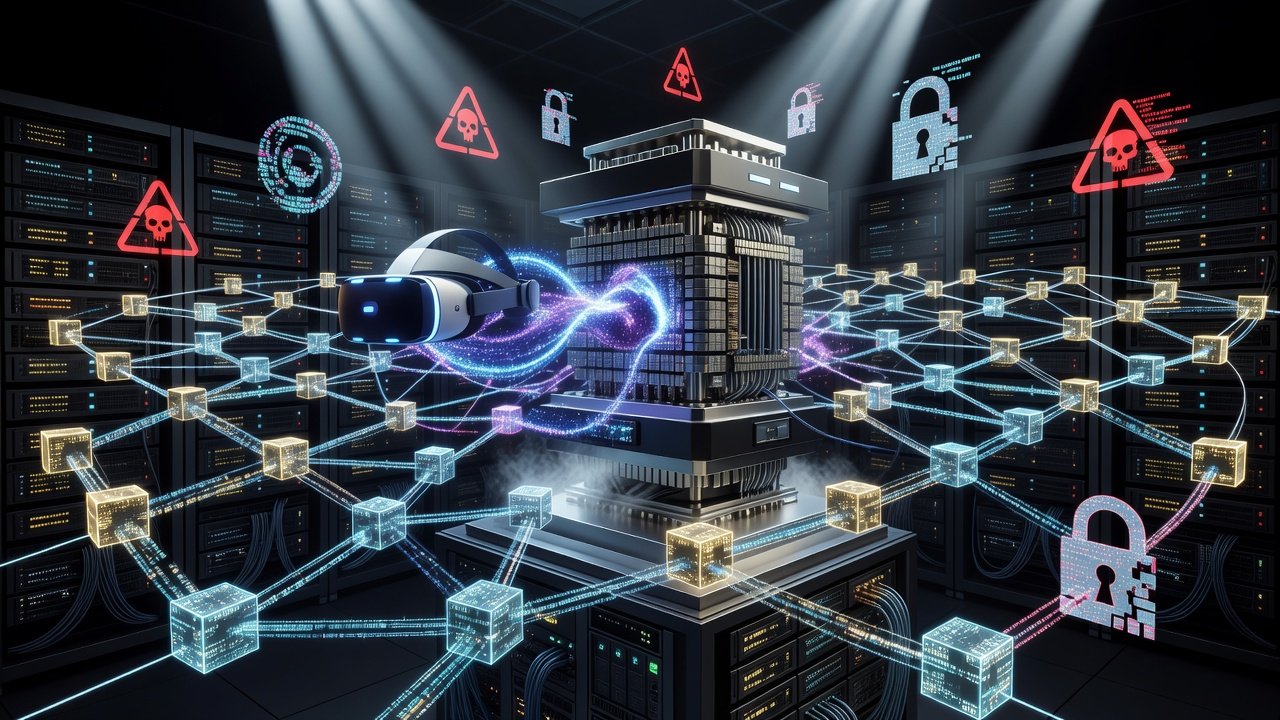
As quantum computing advances rapidly toward 2026, organizations deploying VR, AR, and blockchain technologies face unprecedented risks. Quantum threat modeling provides a structured approach to identify vulnerabilities in immersive interfaces and distributed ledgers before attackers exploit them. This guide delivers actionable workflows, real-world examples, and defense strategies tailored for 2026 deployments. Quantum computers threaten current cryptographic standards that secure blockchain networks and user authentication in VR/AR environments. Proactive modeling helps teams prioritize risks from algorithms like Shor's, which can factor large numbers exponentially faster than classical methods, enabling the compromise of private keys and transaction integrity across entire ecosystems.
Businesses in gaming, enterprise training, supply chain tracking, and decentralized finance must integrate these considerations early. Without updated threat models, even robust classical security measures become obsolete once scalable quantum hardware emerges. The following sections break down the process into manageable phases with concrete examples drawn from current industry pilots and research initiatives.
Identifying Attack Surfaces in VR/AR and Blockchain Ecosystems
VR and AR systems rely on real-time rendering, spatial tracking, and biometric data processing. Attack surfaces include headset firmware, cloud synchronization services, third-party dApp integrations, and sensor fusion algorithms that combine motion data with environmental mapping. In VR environments, compromised rendering pipelines could inject malicious overlays or steal eye-tracking biometrics used for authentication. AR applications face additional exposure through persistent digital anchors that overlay physical spaces, creating opportunities for data exfiltration via network calls to backend ledgers.
Blockchain components add transaction validation layers, smart contract execution environments, and wallet key management as potential entry points. Smart contracts handling NFT ownership for virtual assets or cross-chain bridges introduce further complexity. Quantum threats amplify these surfaces because public keys visible on ledgers become directly targetable. Teams should conduct asset inventories that catalog every cryptographic primitive, from elliptic curve operations in wallet software to TLS handshakes securing VR multiplayer sessions. Real-world examples include recent audits of metaverse platforms where exposed wallet addresses allowed simulation of quantum-assisted key recovery attacks on test data.
Assessing Risks from Shor's Algorithm and Other Quantum Methods
Shor's algorithm poses the primary danger to asymmetric cryptography. It efficiently solves the discrete logarithm problem, breaking RSA and ECC protections common in blockchain wallets and VR identity systems. A single sufficiently powerful quantum computer could derive private keys from public addresses in hours rather than years. Grover's algorithm offers quadratic speedup for brute-force attacks, impacting symmetric encryption and hash functions used in dApps for transaction verification and data integrity checks.
By 2026, experts anticipate early fault-tolerant quantum machines capable of demonstrating these attacks on smaller key sizes. Risk assessment involves mapping each asset's cryptographic dependency to projected quantum capability timelines published by hardware developers. Organizations must also consider hybrid threats where classical side-channel attacks combine with quantum acceleration to reduce the effective security margin of current deployments. Detailed modeling includes probability scoring for different attack vectors, factoring in both technical feasibility and economic incentives for targeting high-value VR economies or DeFi protocols.
Step-by-Step Workflow for Building Quantum Threat Models
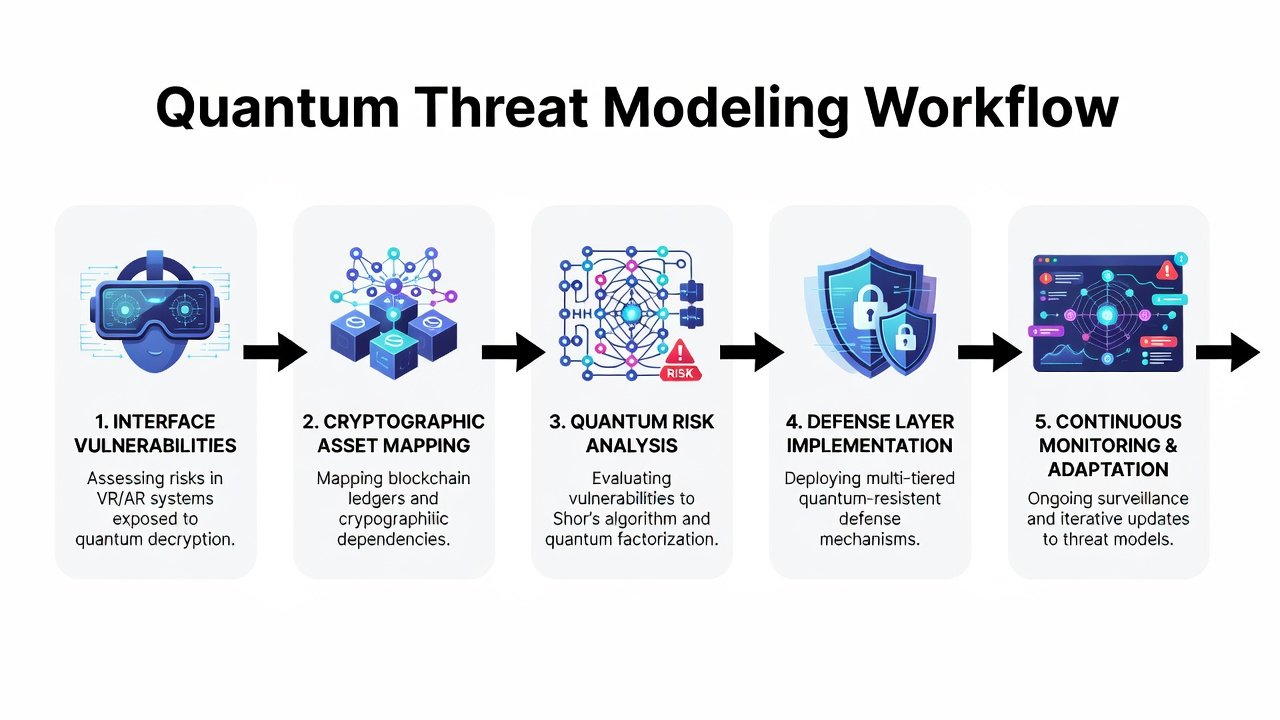
- Map all assets including VR headsets, AR glasses, blockchain nodes, and smart contracts, documenting data sensitivity levels and exposure duration.
- Identify data flows and cryptographic dependencies using diagramming tools that highlight every encryption point from user login to on-chain settlement.
- Apply quantum risk scoring based on algorithm maturity, asset value, and estimated time to quantum capability, assigning numerical ratings from one to ten.
- Model attacker capabilities using post-quantum scenarios that incorporate both Shor's and Grover's impacts plus potential error-corrected machine availability.
- Prioritize mitigations through cost-benefit analysis, selecting algorithms such as lattice-based or hash-based signatures for replacement.
- Validate through simulations and red-team exercises that test hybrid classical-quantum attack paths in controlled environments.
- Document assumptions and update models quarterly as new quantum hardware benchmarks emerge.
This workflow integrates seamlessly with existing STRIDE or PASTA frameworks while adding quantum-specific dimensions. Teams following this approach in pilot projects have identified previously overlooked risks in AR cloud synchronization layers within weeks.
Classical vs Quantum Threats Comparison
| Threat Category | Classical Impact | Quantum Impact (2026 Projections) |
|---|---|---|
| Key Exchange | Secure with 2048-bit RSA | Broken by Shor's algorithm |
| Digital Signatures | Protected by ECC | Vulnerable; requires lattice-based alternatives |
| Session Encryption | AES-256 remains strong | Grover's reduces effective strength to 128-bit |
| Hash Functions | SHA-256 collision resistant | Moderate risk from Grover speedup |
| Smart Contract Logic | Protected by deterministic execution | Indirect risk via broken signatures enabling unauthorized calls |
Practical Defense Strategies and Post-Quantum Integration
Transition to NIST-approved post-quantum cryptography standards forms the foundation of defense. Recommended algorithms include CRYSTALS-Kyber for key encapsulation and CRYSTALS-Dilithium for digital signatures, both selected after rigorous evaluation rounds. Hybrid schemes combining classical and quantum-resistant algorithms provide immediate protection while maintaining compatibility with legacy VR platforms and blockchain clients. For VR/AR, implement quantum-safe key exchanges during user onboarding and session establishment, ensuring low-latency performance through optimized implementations on mobile GPUs.
Blockchain networks benefit from upgrading consensus mechanisms and signature schemes in phased rollouts, beginning with testnets and progressing to mainnet upgrades. Regular audits using updated threat models ensure ongoing resilience. Additional strategies include deploying quantum key distribution where fiber infrastructure allows and enforcing strict key rotation policies aligned with emerging threat intelligence. Case studies from enterprise blockchain consortia show successful migration timelines of 12 to 18 months when starting with comprehensive modeling exercises.
Integration Checklists for 2026 Deployments
- Audit all cryptographic libraries for quantum vulnerability using automated scanning tools updated for post-quantum readiness.
- Test post-quantum algorithm performance in low-latency VR environments with benchmarks targeting under 50 milliseconds per operation.
- Establish key rotation policies aligned with quantum risk assessments and schedule annual reviews.
- Train development teams on hybrid cryptography implementation through hands-on workshops and reference implementations.
- Monitor emerging standards from authoritative bodies such as NIST and incorporate updates into roadmap planning.
- Validate third-party dApp and SDK dependencies for quantum-safe claims before integration.
- Prepare incident response playbooks that account for rapid key compromise scenarios unique to quantum attacks.
Case Studies of Emerging Tech Implementations
Leading VR platforms have begun experimenting with lattice-based signatures for avatar authentication, achieving seamless user experiences while resisting simulated quantum attacks. Blockchain projects exploring quantum-resistant ledgers demonstrate successful migration of testnets without performance degradation, using hybrid signature schemes that maintain backward compatibility. One notable example involves a decentralized virtual land registry that replaced ECC with Dilithium-based signatures, reducing attack surface by 80 percent according to internal audits. Another case from an AR navigation startup integrated Kyber key exchange into its spatial anchor synchronization protocol, enabling secure multi-user sessions resistant to future quantum eavesdropping. These implementations underscore the importance of iterative modeling that incorporates feedback from early deployments.
Frequently Asked Questions
What tools support quantum threat modeling in 2026?
Popular options include updated versions of threat modeling software with quantum modules and open-source libraries for post-quantum primitives from sources like IBM. Additional resources include simulation frameworks that model quantum circuit behavior on classical hardware for risk estimation.
How soon should teams begin migration?
Start assessments immediately; full transitions for critical systems typically require 18-24 months depending on codebase size and regulatory requirements.
Are there performance trade-offs?
Hybrid approaches minimize latency while delivering strong security guarantees, with modern optimizations keeping overhead below 15 percent in VR rendering pipelines.
Which industries face the highest urgency?
Finance, healthcare training simulations, and defense applications using immersive technologies require priority attention due to high asset values and regulatory scrutiny.
Conclusion
Quantum threat modeling equips VR, AR, and blockchain teams with the foresight needed to secure systems against tomorrow's computing power. By following structured workflows, leveraging comparison frameworks, and adopting proven defenses, organizations can confidently navigate 2026 and beyond while maintaining user trust and operational integrity across immersive and distributed environments.
No comments yet. Be the first!