 NeoBit Daily

Introduction to Quantum Threats in Immersive and Decentralized Systems
Quantum computing advances pose existential risks to current cryptographic standards used in VR, AR, and blockchain ecosystems. As quantum processors scale toward practical cryptanalysis capabilities by 2026, organizations must prepare for the day when Shor's algorithm renders RSA and elliptic curve cryptography obsolete. This threatens private keys protecting user identities in virtual worlds, transaction integrity in decentralized applications, and spatial data streams shared across augmented reality sessions. Developers and tech leads need more than high-level warnings; they require detailed migration blueprints that integrate post-quantum algorithms without disrupting real-time performance or existing dApp logic. This comprehensive guide outlines threat modeling frameworks, algorithm selection criteria, phased workflows, and performance tuning techniques drawn from enterprise pilots in automotive design and financial metaverses.
Understanding Quantum Computing Threats
Current blockchain networks rely heavily on elliptic curve digital signature algorithm (ECDSA) for transaction validation, while VR and AR platforms use similar asymmetric schemes for secure WebSocket connections and asset ownership proofs. A sufficiently powerful quantum computer could derive private keys from public ones in polynomial time, enabling forgery of signatures and theft of digital assets. Harvest-now-decrypt-later attacks already target encrypted VR session recordings today, anticipating future decryption. In blockchain contexts, this means immutable ledgers could be retroactively compromised if quantum capabilities emerge sooner than expected. Mitigation requires shifting to lattice-based cryptography that resists both classical and quantum attacks, with algorithms like Kyber for key exchange and Dilithium for signatures providing the foundation.
Threat Modeling for VR/AR and Blockchain Platforms
Effective migration starts with asset-centric threat modeling. Catalog all cryptographic dependencies: avatar authentication tokens in VR engines, NFT ownership records on-chain, real-time pose data exchanges in collaborative AR, and smart contract execution environments. Assign risk scores based on data sensitivity and exposure duration. For instance, long-lived identity keys in metaverse economies warrant higher priority than ephemeral session keys. Map attack surfaces including headset firmware updates, cross-platform dApp bridges, and consensus nodes handling spatial asset transfers. Incorporate quantum readiness metrics such as estimated time to quantum supremacy and current key lengths. Enterprise examples include automotive companies modeling risks to proprietary AR maintenance manuals stored on permissioned blockchains, where compromised signatures could leak trade secrets. Document assumptions about attacker resources and update models quarterly as quantum hardware news emerges.
Selecting Post-Quantum Algorithms: Kyber and Dilithium
NIST's standardization of ML-KEM (formerly Kyber) and ML-DSA (formerly Dilithium) provides clear choices for 2026 implementations. Kyber-512 delivers 128-bit security with ciphertext sizes around 768 bytes, ideal for bandwidth-constrained AR data streams. Higher parameter sets like Kyber-768 increase security margins for blockchain key encapsulation at modest size cost. Dilithium2 offers efficient signature generation and verification suitable for high-frequency VR interactions, with signatures approximately 2.4 KB. Compare these against alternatives such as Falcon for smaller signatures in constrained environments or SPHINCS+ for hash-based stateless security when side-channel resistance is paramount. Hybrid schemes combining Kyber with X25519 ensure compatibility during transition periods. Evaluate based on target platform constraints: mobile AR headsets favor lower memory footprints, while GPU-accelerated VR servers can handle larger Dilithium variants. Detailed parameter recommendations and security proofs are available from authoritative standardization bodies.
NIST post-quantum cryptography resources provide the latest parameter sets and implementation guidance for developers.
Side-by-Side Comparison of Migration Tools
- liboqs: Comprehensive C library supporting Kyber and Dilithium with bindings for Unity and Unreal Engine; excels in cross-platform VR projects due to minimal dependencies and active community maintenance.
- Open Quantum Safe project: Enables hybrid classical-post-quantum modes for gradual dApp upgrades, particularly useful when integrating with existing Ethereum testnets.
- Hyperledger Fabric extensions: Tailored for enterprise permissioned ledgers managing AR asset provenance, with built-in support for quantum-safe transaction endorsement policies.
- Custom Rust implementations targeting Solana: Optimized for low-latency environments with hardware acceleration hooks for real-time rendering pipelines.
Selection depends on ecosystem: liboqs suits rapid prototyping while Hyperledger tools provide audit-ready enterprise features.
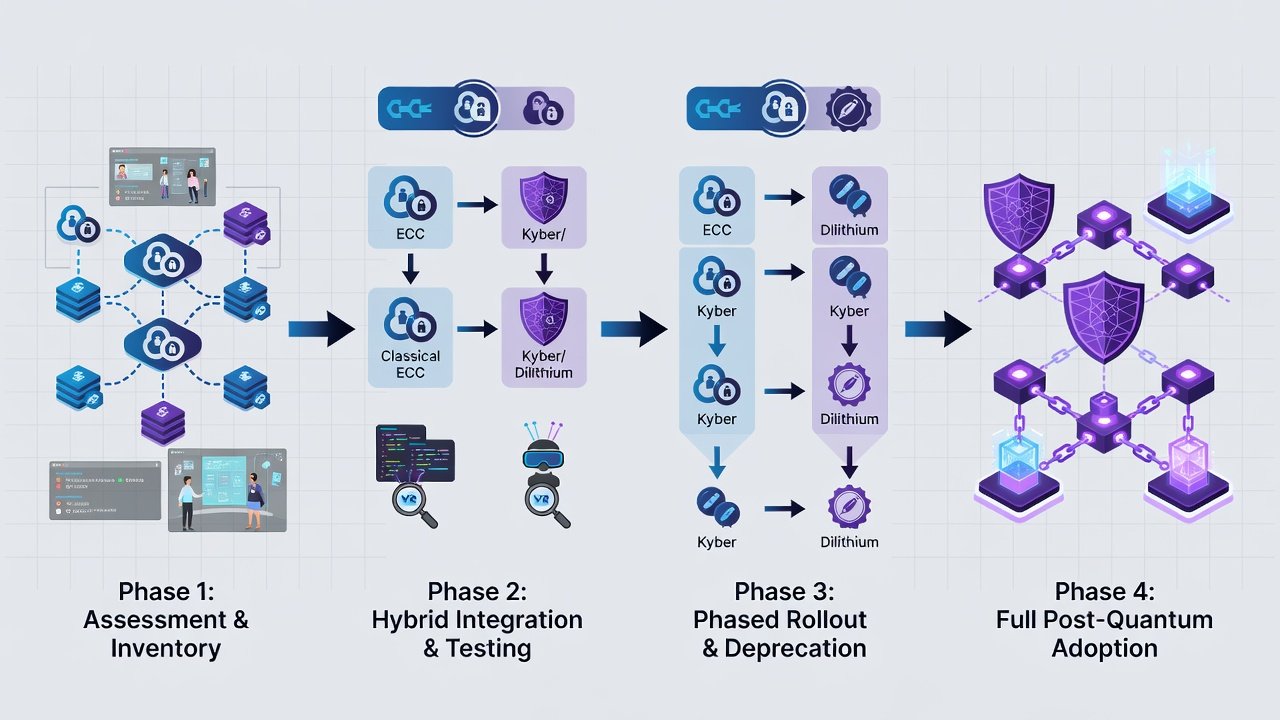
Phased Implementation Checklists
- Conduct comprehensive crypto audits using static analysis tools to locate all ECDSA and RSA usages across VR rendering code, smart contracts, and network layers.
- Prototype hybrid implementations in isolated staging environments, testing Kyber key exchanges alongside existing TLS configurations.
- Benchmark performance impacts on target hardware, measuring frame times in 90 FPS VR scenarios and gas costs for blockchain operations.
- Update key management infrastructure to support lattice-based key generation and rotation policies aligned with 2026 compliance frameworks.
- Deploy pilot migrations on non-production networks, validating end-to-end workflows for user authentication in shared AR spaces.
- Execute full regression suites including interoperability tests with legacy clients before production rollout.
Integration Workflows with dApps and Immersive Environments
Begin integration by replacing ECDSA signing modules in Web3.js or ethers.js libraries with Dilithium equivalents for transaction authorization. Wrap spatial coordinate exchanges in Kyber-secured channels using updated WebXR polyfills that negotiate post-quantum cipher suites during session establishment. For blockchain layers, deploy modified consensus clients on testnets that verify both classical and lattice signatures during the transition window. Real-world enterprise pilots demonstrate success: one automotive manufacturer migrated its AR-assisted assembly dApp to a quantum-safe Hyperledger network, achieving secure multi-user model synchronization with only minor increases in payload size. Another example involves financial metaverse platforms updating NFT minting contracts to embed Dilithium signatures, ensuring future-proof ownership transfers. Code-level changes typically involve swapping cryptographic provider classes and adjusting buffer sizes for larger signatures.
Addressing Performance Overhead in Real-Time VR Rendering
Larger post-quantum signatures and ciphertexts introduce measurable latency that can disrupt immersion. Profile rendering loops to identify bottlenecks, then apply targeted optimizations such as asynchronous key operations off the main thread and GPU-accelerated lattice math via CUDA or Metal shaders. Choose parameter sets conservatively: Kyber-512 for most AR overlays reduces overhead to acceptable levels under 5 milliseconds per operation on modern hardware. Implement caching strategies for frequently used public keys and batch signature verifications in multi-user blockchain environments. Enterprise testing shows that careful tuning keeps total frame-time impact below human perception thresholds even during complex collaborative sessions.
Common Pitfalls and How to Avoid Them
Teams often underestimate hybrid transition complexity, leading to broken legacy client compatibility. Always maintain fallback paths during initial rollouts. Another frequent issue involves insufficient side-channel protections in new implementations; conduct thorough timing and power analysis testing on target devices. Overlooking bandwidth constraints in mobile AR scenarios can degrade user experience, so simulate network conditions during validation. Finally, skipping hardware-specific profiling results in unexpected frame drops when deploying to varied headset models.
Compliance Timelines and Expanded FAQs
Regulatory momentum points toward mandatory quantum-safe requirements in critical infrastructure by late 2027, making 2026 the ideal window for proactive upgrades. How long does a typical migration take? Audits and prototyping require 4-8 weeks, followed by 3-6 months of phased testing depending on system complexity. Will existing NFT standards require changes? Metadata signing and provenance proofs need algorithm updates, but core token logic remains compatible via wrapper contracts. What resources are needed for small teams? Open-source libraries lower barriers, though specialized cryptographic review may require external consultants. How do performance benchmarks compare across headsets? Oculus Quest-class devices show 3-7% overhead after optimization, while high-end PC VR setups absorb larger signatures more easily.
Conclusion
Quantum-safe migration is no longer optional for forward-looking VR, AR, and blockchain projects. By following structured threat modeling, selecting appropriate algorithms such as Kyber and Dilithium, and executing phased integrations with performance monitoring, teams can safeguard systems against emerging quantum risks while preserving immersive experiences and decentralized trust. Start planning audits today to stay ahead of both technological and regulatory timelines.

No comments yet. Be the first!