 NeoBit Daily

Introduction to Quantum-Safe Security in Immersive dApps
Virtual reality blockchain decentralized applications (dApps) are evolving rapidly in 2026, merging immersive neural interfaces with decentralized ledgers. This convergence introduces unique cybersecurity challenges that demand quantum-resistant encryption. Traditional cryptographic methods face obsolescence from quantum computing advances, making post-quantum cryptography essential for protecting user data, transactions, and neural feedback loops. As VR hardware incorporates brain-computer interfaces, the attack surface expands dramatically, requiring developers to rethink every layer of security from sensor data capture to on-chain settlement.
Developers and tech leads must adopt proactive tactics now. This guide covers threat modeling for neural interfaces, integration workflows, code samples using liboqs, scheme comparisons, and audit preparation to deliver secure VR experiences. By addressing these elements in depth, teams can build systems resilient to both current and emerging quantum threats while maintaining the low-latency performance users expect in immersive environments.
Threat Modeling for Neural Interfaces in VR dApps
Neural interfaces in VR collect brainwave data and biometric signals, transmitting them through blockchain networks. Quantum threats include Shor's algorithm breaking RSA and ECC, exposing private keys and session data. Attack vectors range from side-channel leaks in VR headsets to smart contract exploits that manipulate quantum-vulnerable signatures. Additional risks arise from quantum computers potentially reversing hash functions used in transaction verification or forging digital identities tied to biometric profiles.
Key risks involve man-in-the-middle attacks on real-time neural streams and quantum-enabled forgery of blockchain transactions. Model these by mapping data flows from headset sensors to smart contracts, identifying quantum-vulnerable points like key exchanges and signature verifications. Consider adversarial scenarios where an attacker uses quantum resources to intercept and decrypt historical VR session recordings stored on distributed ledgers. Incorporate zero-trust principles by assuming every node and interface could be compromised, then layer defenses accordingly with quantum-safe primitives at each hop.
Post-Quantum Algorithms and Blockchain Integration
Post-quantum cryptography relies on mathematical problems resistant to quantum attacks, such as lattice problems and hash functions. Integration with smart contracts requires wrapping these algorithms in Solidity or Rust environments for chains like Ethereum or Solana. Teams should evaluate algorithm families early in the design phase to match specific use cases, such as frequent small signatures for avatar movements versus larger key encapsulations for secure asset transfers.
Step-by-step workflow begins with selecting standardized parameters from NIST recommendations. Next, generate keys using quantum-safe libraries in an offline secure environment. Serialize outputs into contract-compatible formats before embedding signatures in function calls. Deploy verification logic either through precompiled contracts or external oracles that attest to quantum-safe operations. Finally, conduct iterative testing on testnets to measure gas consumption and latency before scaling to production environments.
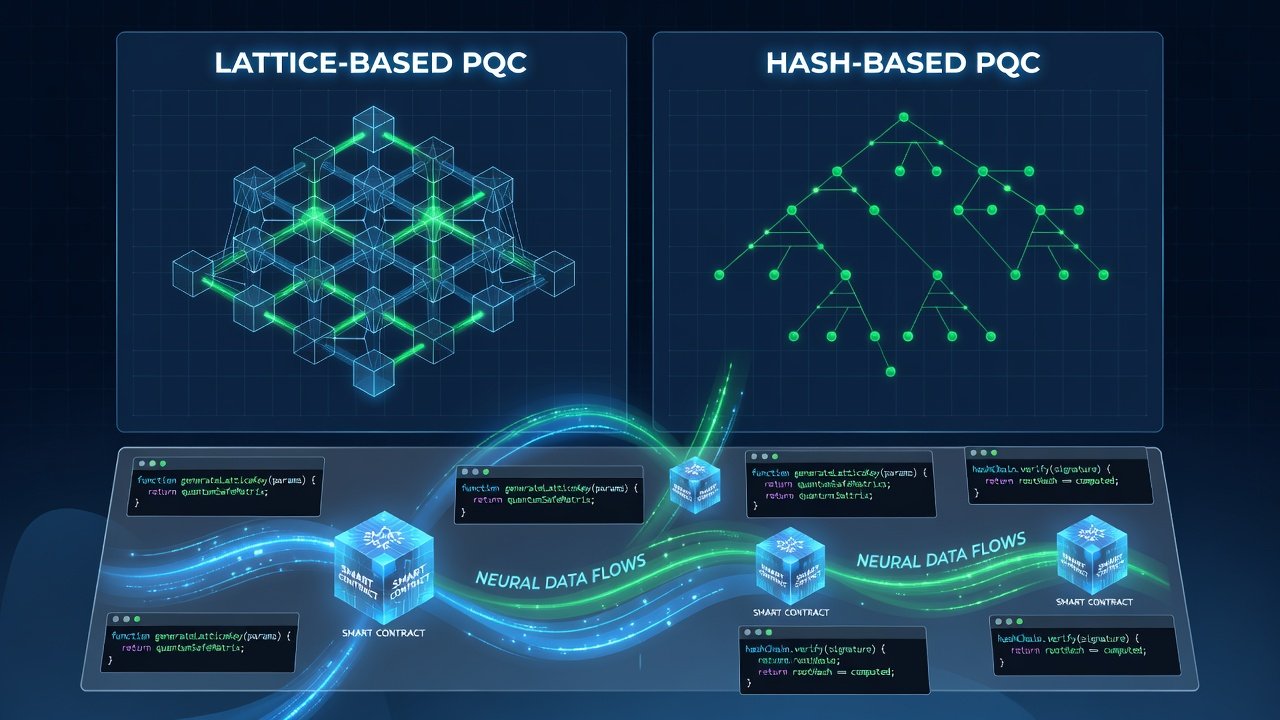
Comparing Lattice-Based vs Hash-Based Schemes
- Lattice-Based (e.g., Kyber, Dilithium): Strong security from shortest vector problems; efficient for key encapsulation in VR sessions; larger key sizes but fast operations suitable for real-time interactions. Kyber offers multiple security levels allowing developers to balance protection against computational overhead in bandwidth-constrained VR networks.
- Hash-Based (e.g., SPHINCS+): Stateless and proven security; suitable for long-term signatures in immutable ledgers; slower verification impacting real-time VR interactions but providing strong resistance without relying on unproven hardness assumptions. These schemes excel in scenarios requiring forward security without state management.
Lattice schemes excel in performance for immersive environments, while hash-based offer simplicity for audit-heavy deployments. Choose based on latency requirements under 50ms for VR fluidity. In practice, many projects adopt hybrid approaches that combine both families to hedge against future cryptanalytic breakthroughs.
Step-by-Step Integration with Smart Contracts
Begin by installing liboqs bindings for your development stack and verifying compatibility with target blockchain runtimes. Generate post-quantum keys offline using recommended parameter sets such as Dilithium3 or Kyber768. Serialize keys and signatures into ABI-compatible structures for seamless contract interaction. Implement wrapper functions in Solidity that accept quantum-safe signatures and delegate verification to trusted oracles or on-chain libraries when available. Use hybrid modes combining classical and quantum-safe signatures during transition periods to maintain backward compatibility. Test thoroughly on testnets, profiling gas costs for each signature verification operation and optimizing storage patterns to reduce on-chain footprint. Monitor network conditions and adjust parameters dynamically where possible. Document every decision for compliance reviews.
Real Code Examples Using liboqs
Here is a sample in Python for key generation and signing, adaptable to blockchain oracles:
from liboqs import KeyEncapsulation, Signature
sig = Signature('Dilithium3')
public_key, secret_key = sig.generate_keypair()
signature = sig.sign(secret_key, b'VR session data')
assert sig.verify(public_key, b'VR session data', signature)
For smart contracts, wrap outputs in ABI-compatible formats and deploy verification logic on-chain. A second example demonstrates key encapsulation for securing neural data streams before they reach the ledger:
kem = KeyEncapsulation('Kyber768')
ciphertext, shared_secret = kem.encap_secret(public_key)
# Use shared_secret to encrypt VR biometric payload before blockchain submission
These snippets illustrate core operations that developers can extend with error handling, parameter validation, and integration hooks for popular frameworks like Hardhat or Foundry.
Audit Readiness Checklist
- Document all algorithm choices and parameter sets with references to current NIST publications.
- Perform side-channel resistance testing on neural data handlers using established tools and methodologies.
- Simulate quantum attacks using available frameworks to validate resilience assumptions.
- Verify hybrid crypto fallback mechanisms function correctly under failure conditions.
- Ensure compliance with emerging NIST standards via NIST resources.
- Review smart contract gas usage for post-quantum operations and optimize where thresholds are exceeded.
- Conduct third-party code audits focusing on library integration points and oracle dependencies.
- Validate key management procedures including secure generation, storage, and rotation policies.
- Test end-to-end latency in simulated VR environments to confirm user experience remains acceptable.
- Maintain comprehensive logs of all cryptographic operations for forensic analysis if incidents occur.
Performance Trade-offs in Immersive Environments
Post-quantum schemes introduce measurable overhead compared with classical cryptography, particularly in CPU cycles and memory usage. Lattice-based methods generally preserve acceptable frame rates in VR headsets, whereas hash-based signatures may require offloading verification to edge servers. Developers should benchmark specific implementations against target hardware to identify bottlenecks early.
FAQs on Performance Trade-offs in Immersive Environments
How do post-quantum schemes affect VR latency? Lattice-based options add minimal overhead, maintaining sub-30ms responses critical for presence, though key sizes increase network payload slightly.
Are hash-based signatures viable for blockchain dApps? Yes, but reserve them for non-real-time functions like asset ownership proofs where verification speed is less critical than long-term security guarantees.
What libraries support 2026 deployments? liboqs remains leading; integrate via official project site for up-to-date implementations and community-supported bindings.
Can hybrid cryptography reduce migration risks? Hybrid modes allow gradual transition while preserving compatibility, though they double signature sizes and require careful contract design.
How should teams measure success in VR quantum-safe deployments? Track metrics including motion-to-photon latency, transaction finality times, and user-reported comfort levels alongside security audit results.
Conclusion
Implementing quantum encryption in VR blockchain dApps requires deliberate planning around neural threats, algorithm selection, and rigorous testing. By following these tactics, developers can future-proof applications against quantum risks while preserving immersive performance. Start with small pilots on test networks and scale based on audit findings for robust 2026 deployments. Continuous monitoring of NIST updates and library advancements will further strengthen long-term resilience in this fast-moving field.


No comments yet. Be the first!