 NeoBit Daily

Introduction to Zero-Day Threats in 2026
Zero-day vulnerabilities continue to pose severe risks to organizations worldwide as attackers increasingly target undisclosed software flaws. In 2026, the threat landscape has evolved with sophisticated nation-state actors and ransomware groups exploiting these gaps before vendors can respond. Security teams must move beyond reactive patching to proactive strategies that combine behavioral analytics, curated threat intelligence feeds, and rigorous tabletop exercises. This comprehensive guide delivers practical, step-by-step instructions tailored for security professionals aiming to safeguard sensitive data and minimize the operational and privacy fallout from potential breaches.
Organizations that fail to prepare often face extended downtime, regulatory fines, and loss of customer trust. By focusing on privacy-preserving techniques throughout the defense process, teams can achieve strong security without compromising compliance obligations such as GDPR or emerging data protection standards.
Understanding Behavioral Analytics Integration
Behavioral analytics forms the cornerstone of modern zero-day defense by establishing dynamic baselines of normal activity across users, endpoints, and networks. Unlike signature-based tools, these systems detect anomalies that may indicate an attacker leveraging an unknown vulnerability. Implementation begins with deploying agents on endpoints and sensors throughout the infrastructure to collect telemetry on login patterns, file access, and process execution.
Privacy considerations are paramount. Teams should configure analytics platforms to hash personally identifiable information and limit data retention periods. Integration with existing identity providers allows correlation of user behavior without exposing raw personal data. Real-world testing shows that organizations using advanced behavioral models reduced dwell time for zero-day intrusions by up to 60 percent in simulated 2025 scenarios.
Key practical steps include selecting platforms with explainable AI outputs so analysts can quickly validate alerts. Regular tuning of baselines prevents alert fatigue while maintaining sensitivity to subtle deviations common in zero-day campaigns.
Leveraging Threat Intelligence Feeds
Threat intelligence feeds supply real-time indicators such as malicious IP addresses, file hashes, and domain names associated with emerging attacks. In 2026, effective programs combine commercial feeds with open-source and government-provided data. Security teams should automate ingestion into SIEM and SOAR platforms for rapid blocking and investigation.
Authoritative sources like CISA and NIST offer frameworks for evaluating feed quality and relevance. Best practices involve cross-referencing multiple feeds to reduce false positives and prioritizing context-rich intelligence that includes attack tactics and potential targets. Privacy outcomes improve when feeds are filtered to exclude unnecessary personal data before storage.
Conducting Effective Tabletop Exercises
Tabletop exercises allow teams to rehearse responses to zero-day incidents in a controlled environment. Begin by defining realistic scenarios drawn from recent supply-chain compromises and cloud misconfigurations. Participants from IT, legal, communications, and executive leadership should walk through detection, containment, eradication, and recovery phases while documenting decisions and communication flows.
Schedule exercises quarterly and incorporate lessons from prior sessions. Include privacy impact assessments during the exercise to ensure response actions respect data minimization principles. Post-exercise debriefs help refine playbooks and identify training gaps. Organizations that conduct regular drills report faster incident response times and better coordination when real events occur.
Comparison of Detection Tools
Choosing the right detection tools requires evaluating capabilities against organizational needs. Endpoint Detection and Response (EDR) solutions excel at host-level behavioral monitoring and offer strong forensic capabilities. Extended Detection and Response (XDR) platforms extend visibility to email, cloud, and network layers, providing unified correlation across the attack surface.
Open-source alternatives such as OSSEC and Wazuh deliver customizable options suitable for budget-conscious teams but demand significant in-house expertise for maintenance. Commercial tools often include managed threat hunting services that accelerate zero-day identification. When comparing options, assess integration ease with existing infrastructure, privacy controls, and support for emerging 2026 attack vectors like AI-generated phishing and container escapes.
- EDR: Strong endpoint focus, rapid containment features, moderate privacy configuration options.
- XDR: Broad visibility, automated response playbooks, higher implementation complexity.
- Open-source: Flexible and free core functionality, requires dedicated staff for tuning and updates.
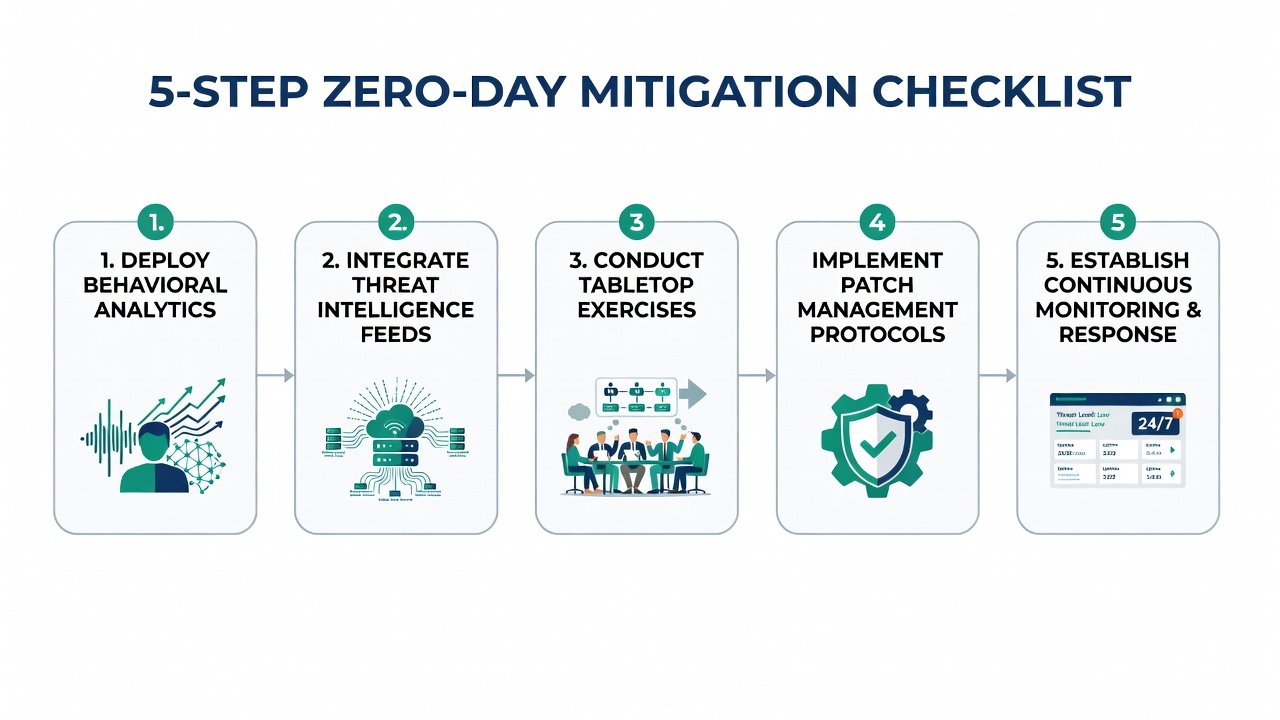
5-Step Mitigation Checklist
- Conduct a thorough asset inventory and classify systems by data sensitivity to prioritize monitoring and protection efforts.
- Deploy and continuously tune behavioral analytics platforms with privacy-preserving settings such as data anonymization and strict access controls.
- Integrate diverse threat intelligence feeds, validate indicators daily, and automate blocking rules while maintaining audit logs for compliance.
- Execute quarterly tabletop exercises that simulate zero-day scenarios, include privacy impact reviews, and update incident response playbooks accordingly.
- Establish clear patching timelines, network segmentation strategies, and escalation procedures to isolate compromised assets quickly during an active incident.
Real-World Examples from Recent Incidents
The 2025 MOVEit-related supply-chain attacks illustrated how behavioral anomalies in file transfer patterns allowed early detection in prepared organizations. Teams using integrated analytics isolated affected servers within hours, limiting data exposure. Similarly, cloud environment breaches involving zero-day exploits in container orchestration tools highlighted the value of XDR correlation when threat intelligence feeds flagged suspicious domain activity beforehand. Privacy outcomes were stronger in organizations that had pre-defined data-handling protocols during containment.
FAQs on Emerging Attack Vectors
How do zero-day attacks differ from known exploits in 2026?
Zero-day attacks exploit vulnerabilities unknown to vendors, rendering traditional antivirus ineffective until signatures are developed. Behavioral and intelligence-driven approaches become essential for early detection.
What privacy considerations apply when implementing behavioral analytics?
Organizations must apply data minimization, obtain appropriate consents, and implement encryption and access logging to remain compliant while gathering necessary telemetry for threat detection.
Are tabletop exercises alone sufficient for zero-day preparedness?
While valuable, they should be combined with continuous monitoring, red-team assessments, and regular updates to threat intelligence integration for comprehensive readiness.
How can small security teams adopt these practices effectively?
Start with open-source analytics tools, leverage free government feeds, and conduct simplified tabletop sessions focused on the most critical assets before scaling.
What role does cloud security play in 2026 zero-day defense?
Cloud providers offer native behavioral monitoring services that complement on-premises tools; teams should enable these features and correlate alerts centrally.
Conclusion
Zero-day defense in 2026 demands a layered approach centered on behavioral analytics, threat intelligence, and validated response procedures. Security teams that follow the outlined steps can substantially reduce breach impact while upholding strong privacy standards. Continuous refinement of these practices, informed by sources such as OWASP and SANS Institute, positions organizations to stay ahead of evolving threats and protect both systems and user data effectively.

No comments yet. Be the first!