 NeoBit Daily

Introduction to Proactive Threat Hunting in 2026
In an era where cyber threats evolve rapidly, organizations must shift from reactive defenses to proactive threat hunting. This guide explores advanced techniques tailored for 2026 cybersecurity challenges, with a strong emphasis on data privacy protection. Intermediate security professionals will learn how to implement hypothesis-driven hunting, leverage behavioral analytics, and integrate these practices with existing security tools for comprehensive coverage across hybrid environments.
Threat hunting involves actively searching for undetected threats within networks before they cause damage. As hybrid environments become standard, hunters must adapt to cloud, on-premises, and edge infrastructures while safeguarding sensitive data. The rise of sophisticated attacks, including AI-assisted intrusions and supply chain compromises, demands a mindset that anticipates attacker movements rather than simply responding to alerts. Data privacy regulations such as GDPR and emerging global standards further require hunters to minimize data exposure during investigations, making privacy-by-design a core principle.
Core Methodologies for Effective Threat Hunting
Hypothesis-Driven Hunting
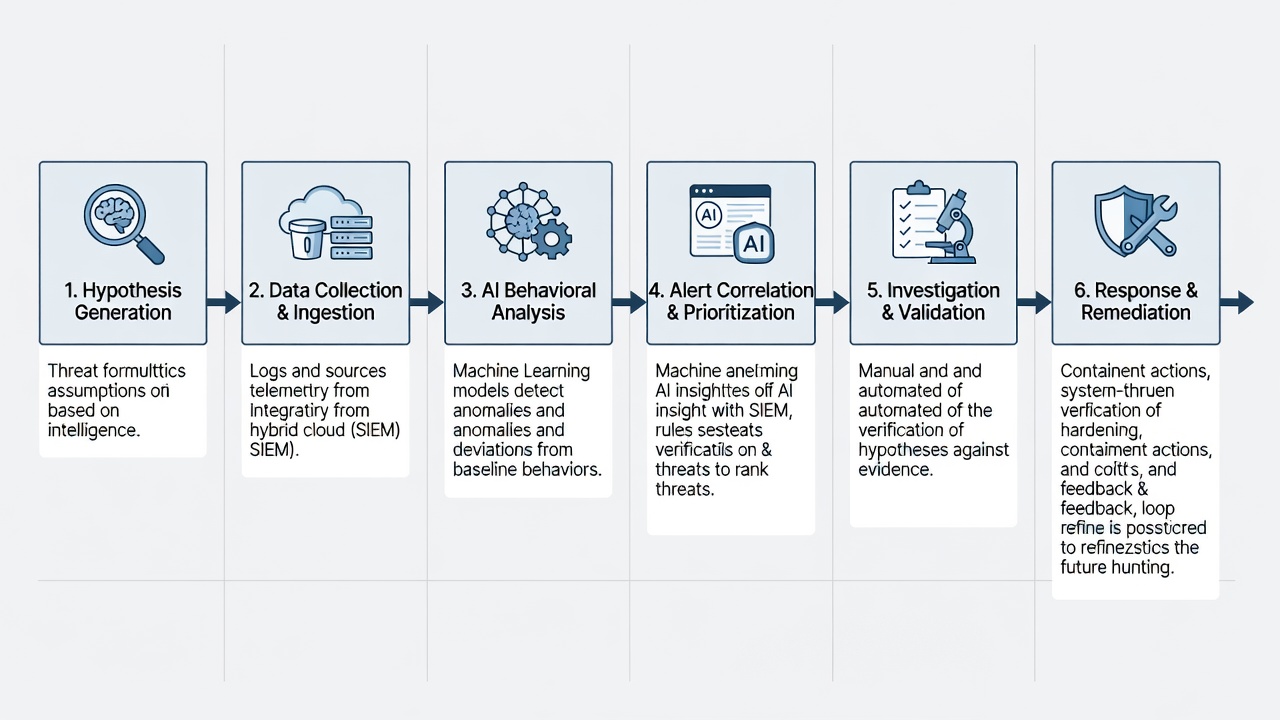
Hypothesis-driven hunting starts with assumptions based on threat intelligence. Analysts form testable hypotheses about potential attacker behaviors and then search for evidence. This structured approach reduces random searching and focuses efforts on high-probability scenarios. For example, assuming an adversary will use living-off-the-land techniques leads hunters to examine PowerShell and WMI logs for anomalous command executions.
Behavioral Analytics
Behavioral analytics complements this by using machine learning to detect anomalies in user and entity activities. By establishing baselines of normal behavior, systems can flag deviations such as unusual login times, data exfiltration volumes, or access to sensitive files. In 2026, advancements in AI allow for more accurate models that account for seasonal business patterns and remote work variations.
Integration with Existing Tools
Integration with tools like SIEM platforms, EDR solutions, and XDR systems allows hunters to correlate data across environments. This unified approach enhances visibility and speeds up investigations. Effective integration requires API connections, custom scripts for data normalization, and regular tuning to avoid alert overload.
Real-World Examples from Recent Incidents
Consider the 2025 supply chain attacks where adversaries exploited third-party vendors. Hunters using hypothesis-driven approaches identified lateral movement patterns early by assuming compromised credentials would trigger unusual access to critical data stores. In one documented case, a manufacturing firm detected anomalies in vendor portal access logs within hours, preventing widespread ransomware deployment.
Another case involved ransomware groups targeting healthcare. Behavioral analytics flagged deviations in file access patterns, enabling teams to isolate threats and protect patient privacy before encryption occurred. A European hospital network used these techniques to contain an attack that could have exposed millions of records. These examples highlight how proactive hunting turns potential disasters into manageable incidents.
Step-by-Step Implementation Process
Implementing threat hunting requires careful planning and iteration. Begin by defining the scope of assets, data flows, and privacy requirements in hybrid setups. This includes mapping all cloud instances, on-premises servers, and remote endpoints to ensure no blind spots exist.
Next, gather intelligence from trusted feeds to build hypotheses. Analysts should review reports from government agencies and industry groups to stay current on tactics. Deploy analytics by configuring behavioral models on existing tools, ensuring they respect data minimization principles for privacy compliance.
Execute hunts by searching logs and endpoints systematically, documenting every query and finding. After execution, create detailed reports for continuous improvement and share them with relevant teams. Finally, remediate issues and refine detection rules based on outcomes to build institutional knowledge.
Comparing Popular Threat Hunting Platforms
Platforms differ in analytics depth, integration ease, and scalability. Some excel in real-time behavioral detection with advanced machine learning, while others prioritize seamless SIEM connectivity and customizable dashboards. Evaluate based on your environment's complexity and privacy compliance needs rather than marketing claims. Consider factors like deployment time, support for multi-cloud visibility, and the ability to handle encrypted traffic without decryption.
Common Pitfalls to Avoid
- Over-relying on automation without human oversight, leading to missed contextual threats that require nuanced judgment.
- Ignoring data privacy regulations during hunts, risking compliance violations and potential fines.
- Failing to baseline normal behavior in hybrid clouds, causing alert fatigue and reduced team effectiveness.
- Neglecting regular hypothesis updates as threats evolve, resulting in outdated detection capabilities.
- Underinvesting in training, which leaves teams unprepared for novel attack vectors seen in 2026.
Practical Checklists for Threat Hunters
Pre-Hunt Checklist
- Review latest threat intelligence reports from authoritative sources.
- Validate tool integrations and data access permissions across all environments.
- Ensure privacy controls are active on sensitive datasets before any queries run.
- Assemble cross-functional teams including privacy officers and system administrators.
Post-Hunt Checklist
- Log all hypotheses, queries, and results in a centralized repository.
- Measure time to detection and response for each hunt conducted.
- Update playbooks and share learnings with the broader security team.
- Conduct a privacy impact review of any data accessed during the process.
Measuring Hunting Effectiveness in Hybrid Environments
Track metrics such as mean time to detect (MTTD), false positive rates, and coverage of critical assets. Use privacy-focused KPIs like data exposure incidents prevented. Regular audits help refine processes for 2026 challenges. Tools that provide visual dashboards can help quantify improvements over time, allowing teams to demonstrate ROI to leadership.
FAQ: Tool Selection for Threat Hunting
How do I choose between open-source and commercial tools?
Assess your team's expertise and budget. Open-source options offer flexibility for custom integrations, while commercial platforms provide support and advanced analytics out of the box.
What features matter most for data privacy?
Prioritize tools with built-in encryption, access controls, and compliance reporting aligned with standards from organizations like NIST.
Can threat hunting work in fully hybrid setups?
Yes, by selecting platforms with multi-cloud support and centralized dashboards for unified visibility across on-premises and cloud resources.
How often should hypotheses be updated?
Review and refresh hypotheses at least quarterly or immediately after major threat landscape changes to maintain relevance.
Conclusion
Mastering threat hunting in 2026 requires a blend of structured methodologies, advanced analytics, and careful tool integration. By focusing on data privacy and avoiding common pitfalls, security teams can stay ahead of threats. Start small, measure results, and scale your program for lasting protection. For foundational guidance, refer to resources from CISA and OWASP.


No comments yet. Be the first!