 NeoBit Daily

Satellite Constellation Attacks: 2026 Orbital Defense Tactics
In 2026, satellite constellations form the backbone of global communications, navigation, and data services. As operators expand networks with hundreds or thousands of interconnected satellites, cyber threats have evolved to target both ground infrastructure and orbital links. This article examines emerging risks, analyzes recent incidents, and outlines practical defenses for operators seeking robust orbital security. The rapid proliferation of low-Earth orbit constellations has created an attack surface unlike any previous era in space technology, requiring a fundamental shift in how security is designed, deployed, and maintained.
The 2026 Threat Landscape for Multi-Satellite Constellations
Modern constellations rely on dense networks for low-latency coverage across continents and oceans. Attackers now focus on disrupting synchronization between satellites rather than single assets, aiming to create cascading failures that affect entire regions. Ground stations remain prime entry points due to legacy protocols and remote access requirements. Inter-satellite links introduce additional vectors through unencrypted or weakly authenticated communications. State-sponsored actors and sophisticated criminal groups have demonstrated capabilities to intercept signals from thousands of kilometers away, exploiting the inherent openness of space-based transmissions. The convergence of commercial and government use of the same orbital infrastructure further amplifies risks, as a breach in one segment can expose sensitive data from multiple stakeholders simultaneously.
Ground Station Vulnerabilities
Ground stations manage telemetry, tracking, and command functions essential for constellation health. Common weaknesses include outdated authentication mechanisms, insufficient network segmentation, and exposure to supply-chain attacks on hardware components. In 2026, many facilities still use protocols developed decades ago, creating opportunities for spoofing and command injection. Remote maintenance access often lacks multi-factor authentication or real-time monitoring, allowing attackers to dwell undetected for extended periods. Physical security at remote sites can also be compromised through social engineering or insider threats, providing direct access to control systems. Operators must recognize that even the most advanced orbital assets remain vulnerable if their terrestrial control points are not hardened to contemporary standards.
Inter-Satellite Link Exploits
Inter-satellite links enable autonomous coordination but can be targeted via signal interception or jamming. Attackers may inject false positioning data or exploit firmware flaws to reroute traffic across the mesh. These exploits often remain undetected until downstream services degrade, leading to widespread outages in broadband, navigation, or emergency communications. Firmware update channels present another attack vector when not properly authenticated, allowing malicious code to propagate across dozens of satellites in a single operation. The dynamic nature of these links, which constantly adjust for orbital mechanics, makes traditional signature-based detection ineffective and demands behavioral analysis instead.
Real-World Case Studies from Recent Orbital Incidents
Analysts have documented several incidents involving constellation interference. One event affected a commercial broadband network when ground station credentials were compromised, leading to temporary service loss across multiple regions and exposing user traffic for several hours. Another case involved manipulation of inter-satellite authentication, causing cascading routing errors that disrupted financial transactions and logistics tracking for global enterprises. A third incident saw a research constellation targeted through a compromised third-party software supplier, resulting in altered data streams that affected scientific observations. These examples highlight how single-point breaches can impact thousands of users simultaneously and underscore the need for end-to-end visibility across both ground and orbital segments.
Impact on Data Privacy for Global Communications
Compromised constellations expose vast amounts of personal and enterprise data. Intercepted links can reveal location information, financial transactions, and confidential corporate communications. Regulatory bodies emphasize that privacy breaches in orbital systems affect users worldwide, prompting stricter compliance expectations under frameworks that treat satellite data flows with the same rigor as terrestrial networks. The scale of data traversing these systems means that even brief compromises can result in massive leaks, affecting everything from individual mobile users to critical infrastructure operators who depend on satellite backhaul.
Advanced Mitigation Strategies
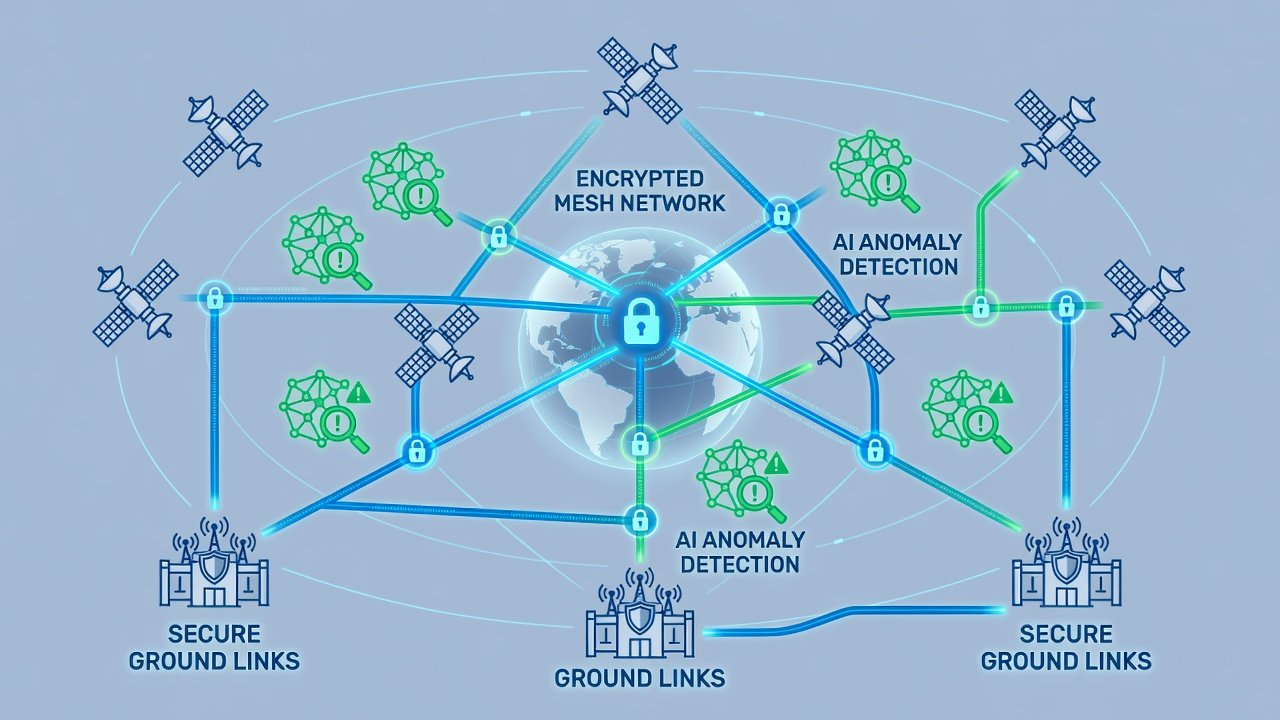
Encrypted Mesh Networking
Next-generation constellations implement end-to-end encryption across mesh topologies. This approach ensures that even if one link is breached, data remains protected. Operators should prioritize quantum-resistant algorithms to future-proof systems against emerging computational threats. Implementation requires careful key management distributed across the constellation, with regular rotation schedules that do not disrupt service continuity.
AI-Driven Anomaly Detection
Machine learning models continuously monitor link behavior and command patterns. These systems flag deviations in real time, enabling rapid isolation of suspicious activity before widespread damage occurs. Training datasets must incorporate both historical attack patterns and simulated future threats to maintain effectiveness as attacker tactics evolve.
Regulatory Compliance Steps
Adherence to international standards helps operators demonstrate due diligence. Key frameworks include guidelines from NASA and ESA. Regular audits and reporting mechanisms strengthen overall posture while fostering collaboration across the industry.
Traditional Satellite Security vs Next-Gen Constellation Approaches
Legacy single-satellite systems relied primarily on physical isolation and basic encryption. In contrast, modern constellations demand dynamic, distributed defenses. Traditional methods struggle with scale, while next-gen solutions leverage redundancy and intelligent routing for resilience. The shift also introduces new operational complexities, such as managing security policies across rapidly changing orbital geometries and handling the volume of telemetry data generated by hundreds of satellites.
Practical Implementation Checklist for Operators
- Conduct comprehensive vulnerability assessments of all ground stations quarterly, including penetration testing of both physical and network perimeters.
- Deploy encrypted mesh protocols with regular key rotation and automated key distribution mechanisms.
- Integrate AI anomaly detection tools across inter-satellite links and establish baseline behavioral profiles for each satellite.
- Establish incident response playbooks tailored to orbital scenarios, including procedures for isolating compromised nodes without disrupting the broader network.
- Align security practices with evolving regulatory requirements from bodies such as NIST and conduct annual third-party audits.
- Perform third-party penetration testing on both hardware and software components, focusing on supply-chain risks.
- Train staff on emerging threat vectors specific to satellite environments through simulated attack exercises.
- Implement continuous monitoring dashboards that correlate ground station logs with orbital telemetry for holistic situational awareness.
FAQ: Cost-Effective Defenses and Future Privacy Risks
What are the most cost-effective defenses for smaller operators?
Focus on software-based encryption upgrades and open-source anomaly detection frameworks first. Prioritize ground station segmentation over full hardware replacement, and leverage shared threat intelligence communities to reduce individual research burdens.
How might privacy risks evolve by 2030?
With increased constellation density, risks will center on large-scale data aggregation and cross-border regulatory conflicts. Proactive encryption and compliance will remain essential as data volumes grow exponentially.
Are current regulations sufficient for 2026 threats?
Existing frameworks provide a foundation, yet operators must supplement them with constellation-specific controls to address novel attack surfaces that legacy rules did not anticipate.
Conclusion
Satellite constellation security in 2026 requires layered, adaptive strategies. By addressing ground station weaknesses, securing inter-satellite links, and adopting AI-enhanced defenses, operators can protect both infrastructure and user privacy. Continuous vigilance and adherence to authoritative guidelines will define successful orbital defense programs in the years ahead.

No comments yet. Be the first!