 NeoBit Daily

Honeytoken Tactics: 2026 Data Privacy Defense with Deception Tech
In 2026, data breaches continue to evolve with sophisticated attackers targeting sensitive information across enterprises. Honeytokens offer a proactive deception-based defense that lures intruders into revealing themselves early. This approach reduces breach impact by embedding decoy data that triggers alerts without exposing real assets. Organizations facing rising threats from ransomware groups and state-sponsored actors are turning to deception technology as a core component of their data privacy strategies. By planting realistic but fake credentials, documents, and database entries, security teams gain valuable time to respond before actual damage occurs.
What Are Honeytokens and Why They Matter in 2026
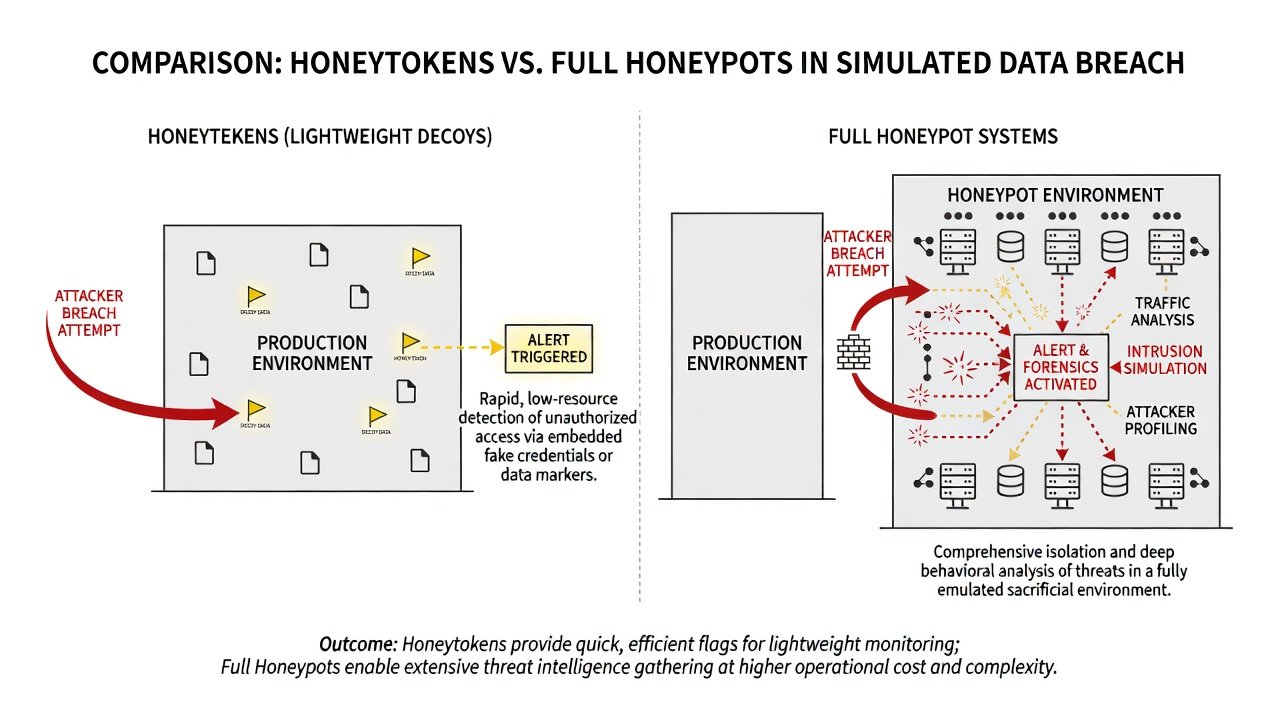
Honeytokens are fabricated credentials, files, or database entries designed to appear legitimate. When accessed, they alert security teams to potential threats. Unlike reactive measures, these tools provide early detection in an era of AI-driven attacks and supply-chain vulnerabilities. In practice, a honeytoken might consist of a fake API key stored in a configuration file or a decoy customer record in a database that no legitimate user would ever access. Their value lies in the fact that any interaction with them signals malicious activity, allowing defenders to study attacker behavior and strengthen defenses accordingly. As cyber threats grow more advanced in 2026, honeytokens help bridge gaps left by traditional perimeter security.
Honeytokens vs Traditional Honeypots: Key Comparisons
Traditional honeypots simulate entire systems to attract attackers, requiring significant resources for maintenance. Honeytokens are lightweight, focusing on specific data points for easier deployment at scale. Honeypots risk exposing broader infrastructure if compromised, while honeytokens limit exposure to isolated decoys. For 2026 environments handling massive datasets, honeytokens integrate more seamlessly with cloud-native tools. Additionally, honeypots often demand dedicated hardware or virtual machines that increase operational overhead, whereas honeytokens can be deployed via simple scripts or existing data management platforms. This makes them particularly suitable for hybrid cloud setups where rapid scaling is essential. Security teams report that combining both approaches yields the best results, using honeypots for broad reconnaissance and honeytokens for targeted data protection.
Practical Implementation Steps for Enterprise Deployment
Start by identifying high-value data assets such as customer records or intellectual property. Generate realistic honeytokens using tools that mimic production formats. Deploy them across databases, file shares, and APIs. Monitor access logs continuously and set up automated alerts via SIEM integration. Test deployments in staging environments to avoid false positives before full rollout. Step one involves conducting a data inventory to locate crown-jewel assets. Next, create tokens that mirror real formats exactly, including metadata and access patterns. For example, embed a fake SSH key in a development repository that appears recently used. Then configure logging to capture every read or copy attempt. Finally, establish escalation procedures so alerts reach incident response teams within minutes. Regular validation ensures tokens remain believable as attacker tactics evolve.
Integration with Existing Security Tools
Combine honeytokens with platforms like NIST cybersecurity frameworks for standardized controls. Link them to SIEM solutions and EDR systems for real-time correlation. In 2026, API-based integrations with cloud providers enable dynamic token rotation, enhancing resilience against evolving threats. Many enterprises also connect honeytoken alerts directly to SOAR platforms for automated containment actions such as isolating affected user accounts. This layered integration ensures that a single token trigger can initiate a full investigation workflow without manual intervention. Organizations using open-source deception frameworks report smoother adoption when they align token deployment with existing identity and access management policies.
Real-World Case Studies from Recent Incidents
A major financial firm in 2025 used honeytokens to detect an insider threat attempting to exfiltrate customer data, limiting damage to zero actual records lost. Another healthcare provider embedded tokens in EHR systems, identifying a ransomware group within hours of initial access. These examples highlight how deception tactics reduce incident response times dramatically. In one documented breach at a retail company, honeytokens placed in payment processing databases revealed a third-party vendor compromise early enough to prevent card data theft. A government contractor similarly thwarted an advanced persistent threat by monitoring access to decoy project files, leading to the identification of previously unknown attack infrastructure. These cases demonstrate measurable reductions in dwell time and data loss when deception is part of the defense stack.
Common Pitfalls to Avoid
- Overly obvious tokens that sophisticated attackers ignore. Teams should ensure tokens blend naturally with surrounding data rather than standing out as obvious traps.
- Lack of monitoring leading to missed alerts. Without proper logging pipelines, even well-placed tokens provide no value.
- Poor token realism causing operational disruptions. Fake entries must pass casual inspection by both humans and automated scripts.
- Failure to rotate tokens regularly in dynamic environments. Stale tokens lose effectiveness as attackers learn patterns over time.
Metrics for Measuring Effectiveness
Track detection time, false positive rates, and attacker dwell time reduction. Aim for metrics showing at least 50% faster breach identification compared to baseline tools. Regular audits ensure tokens remain effective against new attack vectors in 2026 landscapes. Additional useful measurements include the ratio of token-triggered incidents to total alerts and the percentage of attackers who interact with multiple tokens before detection. Organizations that review these metrics quarterly can refine their deception strategy and demonstrate ROI to leadership through reduced breach costs and faster containment.
Actionable Checklist for Scaling Deception Tactics
- Map all sensitive data repositories and prioritize those containing personally identifiable information.
- Create and validate 10-20 honeytokens per critical system, ensuring each matches production formats exactly.
- Integrate alerts with existing SOC workflows and test notification chains monthly.
- Conduct quarterly reviews and updates to keep tokens aligned with changing data structures.
- Train teams on interpreting token-triggered incidents and conducting follow-up forensics.
- Document all token locations in a secure inventory accessible only to authorized personnel.
Emerging Threats in 2026 and How Deception Reduces Breach Impact
Attackers increasingly leverage generative AI to scan environments for anomalies, making realistic honeytokens essential. Deception technology forces adversaries to spend extra time validating every piece of data they encounter, slowing their progress and increasing the chance of detection. By reducing the window between initial access and full compromise, organizations limit lateral movement and data exfiltration. CISA guidance emphasizes that early warning systems like honeytokens form a key part of resilient architectures against these evolving threats.
FAQs on Honeytoken Strategies
How do honeytokens handle emerging threats like AI attacks?
They adapt by incorporating behavioral anomalies that AI tools struggle to distinguish from real data, providing a layer of unpredictability that forces attackers to reveal themselves through interaction.
What is the best way to start with limited resources?
Begin with high-risk areas like authentication databases and expand based on initial detection success while documenting lessons learned for broader rollout.
Can honeytokens replace other security measures?
No, they complement firewalls, encryption, and access controls as part of a layered defense strategy that maximizes overall resilience.
How often should tokens be rotated in large enterprises?
Best practice recommends rotation every 60 to 90 days or whenever major infrastructure changes occur to maintain effectiveness against persistent threats.
Conclusion
Honeytoken tactics represent a critical evolution in 2026 data privacy defense. By focusing on deception, organizations can detect threats early, minimize damage, and strengthen overall resilience. Implement these strategies thoughtfully to stay ahead of sophisticated adversaries and protect valuable data assets in an increasingly hostile digital landscape.

No comments yet. Be the first!