 NeoBit Daily

Introduction to Microservices Security in 2026
As organizations continue to adopt microservices architectures to achieve greater scalability and agility, the security landscape in 2026 presents both opportunities and significant risks. Distributed systems break applications into smaller, independently deployable services that communicate over networks, which expands the attack surface dramatically. Cyber threats have evolved to target these interconnections, making data privacy a top priority for enterprises handling sensitive information. This comprehensive guide addresses the search intent for practical implementation by exploring service mesh adoption, API security hardening, container runtime protections, and encryption in transit. Readers will find actionable strategies, real-world case studies, detailed comparisons, and configuration examples that help maintain security without compromising performance or scalability.
Service Mesh Adoption for Secure Communication
Service meshes have become essential for managing the complexity of microservices security. They act as an infrastructure layer that handles service-to-service communication, providing built-in encryption, authentication, authorization, and observability. By offloading these concerns from application code, teams can focus on business logic while enforcing consistent security policies across the entire system. In 2026, adoption rates are high among enterprises running Kubernetes-based environments because meshes integrate seamlessly with container orchestration platforms.
Istio versus Consul: Detailed Tool Comparison
When evaluating service meshes, Istio and Consul stand out as mature options with distinct strengths. Istio excels in advanced traffic management, fine-grained policy enforcement, and rich telemetry features, making it suitable for large-scale deployments with complex routing needs. It supports automatic sidecar injection and integrates deeply with Kubernetes for zero-trust networking. Consul, on the other hand, offers lightweight service discovery combined with mesh capabilities and performs well in hybrid cloud or multi-platform setups where simplicity and cross-environment consistency matter most. Enterprises often choose Istio for its extensibility via WebAssembly plugins, while Consul appeals to teams seeking faster initial setup and lower operational overhead. A practical recommendation is to pilot both in a non-production cluster before committing to one solution based on your specific workload patterns and existing tooling.
API Security Hardening Techniques
APIs serve as the primary interface between microservices, so hardening them is critical for data privacy. Start by enforcing OAuth 2.0 for authorization and validating JSON Web Tokens at every entry point. Implement mutual TLS (mTLS) to ensure both client and server authenticate each other, preventing man-in-the-middle attacks. Rate limiting and input sanitization further reduce risks of denial-of-service and injection attacks. In practice, organizations layer these controls using API gateways alongside service mesh policies for defense in depth. For example, a payment processing microservice might require signed requests with short-lived tokens and strict schema validation to protect customer financial data.
Container Runtime Protections
Protecting containers at runtime involves monitoring behavior and enforcing least-privilege policies. Tools such as Falco or Sysdig can detect anomalous processes, file changes, or network connections in real time. Combine these with seccomp profiles and AppArmor or SELinux policies to restrict what containers can execute. Regular vulnerability scanning of images before deployment and immutable infrastructure practices help minimize exposure. 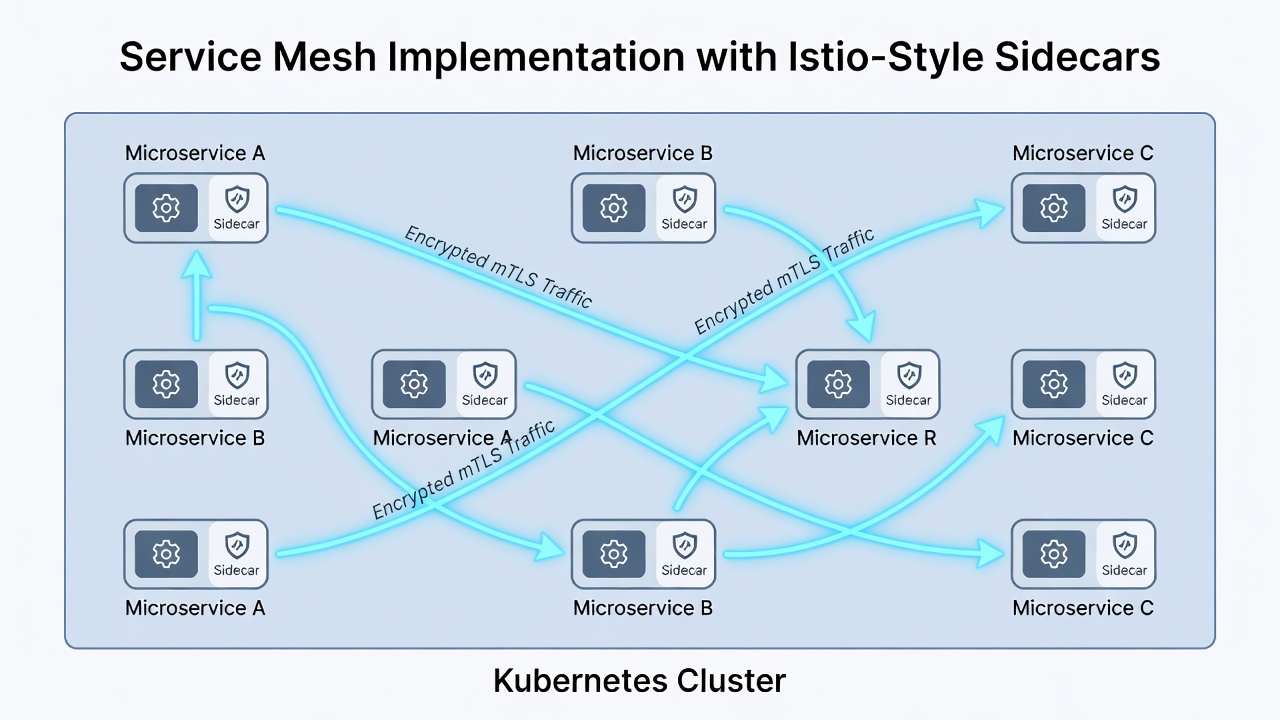
Encryption in Transit Best Practices
All traffic between microservices must use encryption to protect data privacy. TLS 1.3 is the current standard, offering improved handshake efficiency and forward secrecy. Automate certificate provisioning and rotation through the service mesh control plane to avoid manual errors. Organizations should also implement certificate pinning where feasible and monitor for weak cipher usage. This approach ensures confidentiality even if network segments are compromised.
Real-World Enterprise Case Studies
A global financial services company migrated to a service mesh in late 2025 and reported a 40 percent reduction in unauthorized access attempts within six months by enforcing zero-trust policies across more than 500 microservices. Their implementation included automated mTLS and fine-grained authorization that prevented lateral movement during simulated breach exercises. Another large retail enterprise adopted Consul for its hybrid cloud setup, achieving full regulatory compliance for customer data handling by encrypting all inter-service traffic and integrating runtime security monitoring. These examples demonstrate that phased rollouts with clear metrics lead to successful outcomes without disrupting business operations.
Step-by-Step Configuration Example
Follow these detailed steps to implement a basic secure service mesh on Kubernetes. First, install the chosen mesh using official installation scripts and verify the control plane pods are running. Next, label your namespaces for automatic sidecar injection and deploy sample applications. Enable mTLS globally through a PeerAuthentication resource, then create AuthorizationPolicy objects to define which services can communicate. Configure an API gateway with JWT validation rules and test the setup using curl commands that simulate authenticated and unauthenticated requests. Finally, enable observability dashboards to monitor traffic patterns and alert on anomalies. Each step should include validation checks to catch misconfigurations early.
Mistakes to Avoid During Deployment
Common pitfalls include enabling mTLS without testing legacy service compatibility, which can cause connectivity failures, and neglecting certificate rotation schedules that lead to unexpected outages. Overly permissive authorization policies undermine the zero-trust model, while ignoring performance benchmarks during rollout can result in latency issues. Always conduct incremental deployments and maintain rollback plans.
Frequently Asked Questions
How can teams measure the effectiveness of microservices security? Track metrics such as failed authentication attempts, encryption coverage percentage, and mean time to detect anomalies. What strategies work best for legacy services? Introduce sidecar proxies gradually and use protocol translation where needed. How does encryption impact scalability? Modern hardware acceleration and optimized TLS libraries minimize overhead when configured correctly. Addressing these questions early helps avoid deployment delays.
Conclusion
Securing microservices architectures in 2026 requires a layered approach that combines service meshes, hardened APIs, runtime protections, and strong encryption. By following the practical strategies, comparisons, and examples outlined above, organizations can protect data privacy while preserving the scalability benefits of distributed systems. Continued reference to authoritative resources such as OWASP, CNCF, and Istio documentation supports ongoing improvement. Implementing these measures positions enterprises to handle evolving threats effectively.


No comments yet. Be the first!