 NeoBit Daily

Introduction to Honeytokens in Modern Cybersecurity
As data breaches continue to rise in frequency and sophistication throughout 2026, organizations are increasingly relying on deception technologies like honeytokens to strengthen their data privacy defenses. These tools serve as early warning systems that detect unauthorized access attempts before sensitive information leaves the network. Unlike reactive measures that focus on blocking known threats, honeytokens provide proactive intelligence by mimicking valuable data assets that attackers naturally target. This strategy is particularly effective in hybrid cloud environments where traditional perimeter defenses often fall short. Cybersecurity teams benefit from reduced dwell time for intruders and improved visibility into exfiltration paths. In an era of stringent privacy laws, honeytokens also support compliance by allowing organizations to monitor without exposing real user data.
Honeytokens function as lightweight decoys embedded directly into production systems. Common examples include fabricated database records, API keys, or configuration files that appear legitimate but trigger alerts when accessed. Their minimal resource footprint makes them suitable for large-scale deployments across diverse infrastructures.
Key Differences Between Honeytokens and Traditional Honeypots
Traditional honeypots emulate complete systems or network segments to attract and study attackers, often demanding dedicated hardware and ongoing maintenance. Honeytokens, however, are discrete elements such as fake credentials or documents placed within real environments. This distinction reduces operational overhead while delivering precise alerts. Honeytokens excel in environments requiring rapid scaling because they avoid the complexity of managing virtual machines or containers. Attackers are less likely to identify them as decoys since they blend seamlessly with authentic assets. For privacy defense strategies, this approach minimizes the risk of exposing additional infrastructure details during an incident.
Another advantage lies in integration flexibility. Honeytokens can be deployed via scripts or configuration management tools without disrupting existing workflows. Organizations report higher engagement rates with these tokens because they directly target data exfiltration behaviors rather than broad reconnaissance activities.
Setup Across Cloud, Endpoints, and Code Repositories
Cloud Environment Deployment
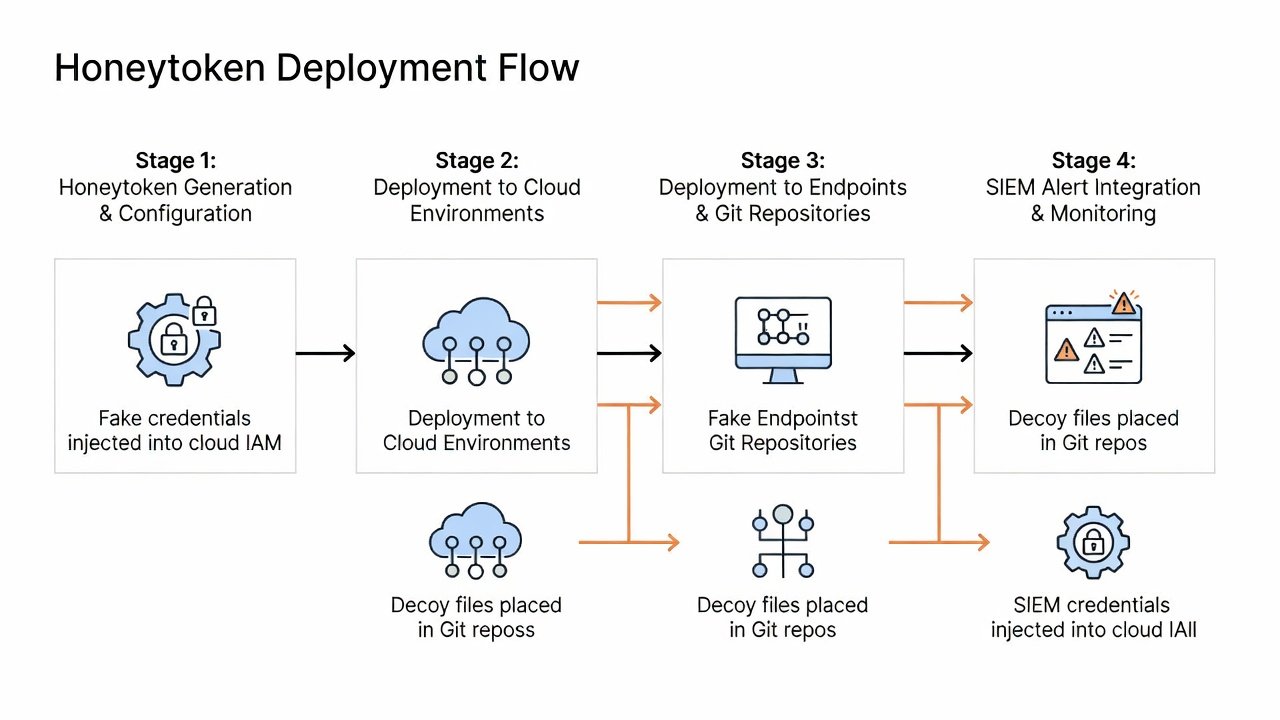
Start by mapping high-value data stores in services such as AWS S3, Azure Blob Storage, or Google Cloud Storage. Generate honeytokens consisting of realistic-looking access keys or connection strings and embed them in application configuration files or environment variables. Enable detailed logging on object access events and forward these logs to a centralized monitoring platform. For instance, a team might place a fake IAM role credential in a development bucket that mirrors production naming conventions, ensuring any attempted use generates an immediate notification.
Endpoint Protection
On workstations and servers, position honeytokens as decoy documents in common directories or as registry entries that mimic authentication tokens. Automation tools can handle placement across fleets of devices while maintaining consistency. Monitor file system events and process launches associated with these tokens. In practice, a healthcare organization might deploy honeytoken spreadsheets containing fabricated patient identifiers on clinician laptops to catch unauthorized copying attempts.
Code Repository Integration
Within version control systems like GitHub or GitLab, insert honeytokens as commented-out secrets in source files or as test data in sample scripts. Separate these from actual secrets using dedicated branches or labels. This method helps identify supply chain compromises or insider exfiltration. Regularly scan repositories for accidental exposure while ensuring the honeytokens themselves remain isolated.
Integrating Honeytokens with SIEM for Real-Time Alerts
Effective SIEM integration transforms honeytoken triggers into actionable intelligence. Connect deployment locations to platforms such as Splunk, Microsoft Sentinel, or the Elastic Stack by defining custom detection rules that monitor for token access patterns. Correlate these events with user activity baselines to distinguish benign errors from malicious intent. For example, configure alerts that escalate when a token is accessed outside normal business hours or from unexpected IP ranges. Automated playbooks can then isolate affected systems or notify response teams. Regular testing of these integrations ensures they remain responsive as environments evolve.
Step-by-Step Deployment Examples
- Conduct a thorough inventory of sensitive assets, categorizing them by risk level and accessibility.
- Generate cryptographically unique honeytokens for each category using established randomness libraries to prevent pattern recognition.
- Automate deployment through CI/CD pipelines for code repositories and configuration management for cloud resources.
- Establish SIEM correlation rules that include context such as source location and access frequency.
- Maintain an internal registry documenting every token's location, purpose, and expected behavior for compliance audits.
- Schedule periodic reviews to rotate or retire tokens that have not triggered alerts within a defined period.
Common Pitfalls to Avoid
- Deploying too many tokens without sufficient monitoring capacity, which leads to alert overload and missed signals.
- Neglecting regular rotation schedules, allowing attackers to recognize static decoys over time.
- Skipping staging environment validation, resulting in unintended production disruptions or false confidence in coverage.
- Failing to provide analysts with sufficient context around alerts, increasing response times and analyst fatigue.
- Overlooking token discoverability by attackers who may search for common deception patterns in code or logs.
Metrics for Measuring Effectiveness Against Data Exfiltration
Evaluate success through quantitative measures including average time from access to alert (targeting sub-five-minute detection), total triggered events per month, and the ratio of actionable alerts to noise. Calculate asset coverage by dividing protected high-value locations by total critical assets. Use these insights to adjust placement density and refine alert thresholds. Teams often combine these metrics with breach simulation exercises to validate real-world performance and demonstrate value during executive reviews.
Privacy Compliance Considerations
Align deployments with frameworks such as GDPR and CCPA by ensuring no real personal data is used in token creation. Maintain detailed logs of all deception assets for audit trails and perform regular data protection impact assessments. This documentation supports regulatory inquiries and reinforces organizational commitment to privacy-by-design principles. In sectors handling regulated information, involve legal teams early to confirm that monitoring practices respect consent and minimization requirements.
Case Studies from Fintech and Healthcare Sectors
A major fintech firm implemented honeytokens across its cloud payment processing infrastructure in late 2025. By embedding decoy transaction records and API credentials, the organization detected an attempted data scraping campaign within hours, allowing rapid containment and preserving customer trust. Post-incident analysis showed a 40 percent improvement in early threat identification compared to prior quarters.
In healthcare, a regional hospital network placed honeytokens on endpoints accessing electronic health records. Integration with their SIEM platform enabled detection of anomalous file transfers during off-hours, leading to identification of a compromised vendor account. The approach helped satisfy HIPAA audit requirements while avoiding exposure of actual patient information.
Conclusion
Honeytoken strategies deliver targeted, efficient protection against data exfiltration in 2026 environments. Through careful planning, SIEM integration, and ongoing measurement, teams can achieve stronger privacy outcomes with manageable effort. Adopting these tactics positions organizations to respond effectively to emerging threats.
FAQ: Scaling Honeytokens in Hybrid Environments and Future Trends for 2027+
How do I scale honeytokens across on-premises and cloud setups?
Begin with centralized orchestration tools that apply consistent policies regardless of location. Pilot in low-risk segments before expanding, and establish feedback loops from alert data to optimize placement density.
What trends will shape honeytoken use beyond 2027?
Advancements will include AI-assisted generation of context-aware tokens and deeper embedding within zero-trust models. Guidance from authoritative sources such as NIST and OWASP will continue to inform secure implementation practices. Additional insights are available via CISA resources on deception technologies.
What challenges arise when scaling in highly regulated industries?
Key issues include maintaining audit trails and ensuring tokens do not inadvertently conflict with data retention policies. Address these through cross-functional governance involving security, legal, and compliance stakeholders.

No comments yet. Be the first!