 NeoBit Daily

Introduction to Honeypot Deployment in 2026
Security teams face escalating challenges in protecting sensitive data as cyber threats evolve rapidly. Honeypots serve as deceptive systems that lure attackers away from real assets, providing valuable intelligence on intrusion attempts. In 2026, the focus shifts toward defending against AI-powered reconnaissance while ensuring compliance with data privacy regulations. This guide delivers practical, actionable tactics for deploying and managing honeypots effectively, going beyond basic setups to address modern operational needs for security professionals.
Organizations increasingly rely on deception technology to gain an edge. By simulating vulnerable systems, honeypots not only divert threats but also collect detailed behavioral data that improves overall security posture. The rise of automated attack tools demands more sophisticated decoy strategies that blend seamlessly into production environments.
Understanding 2026-Specific Threats
AI-driven reconnaissance tools now automate vulnerability scanning and target selection at unprecedented speeds. Attackers leverage machine learning to identify high-value targets and evade traditional defenses. Honeypots counter these by mimicking production environments that attract and log sophisticated probes. Integration with threat intelligence feeds helps adapt decoys to emerging patterns seen in recent breaches involving automated data exfiltration.
These threats often involve generative AI that crafts personalized phishing or probes network perimeters dynamically. Defenders must anticipate adaptive attackers who test multiple vectors simultaneously. Real-world examples from 2025 show how AI reconnaissance bypassed perimeter controls in under 30 minutes in several enterprise incidents.
Step-by-Step Honeypot Deployment Checklists
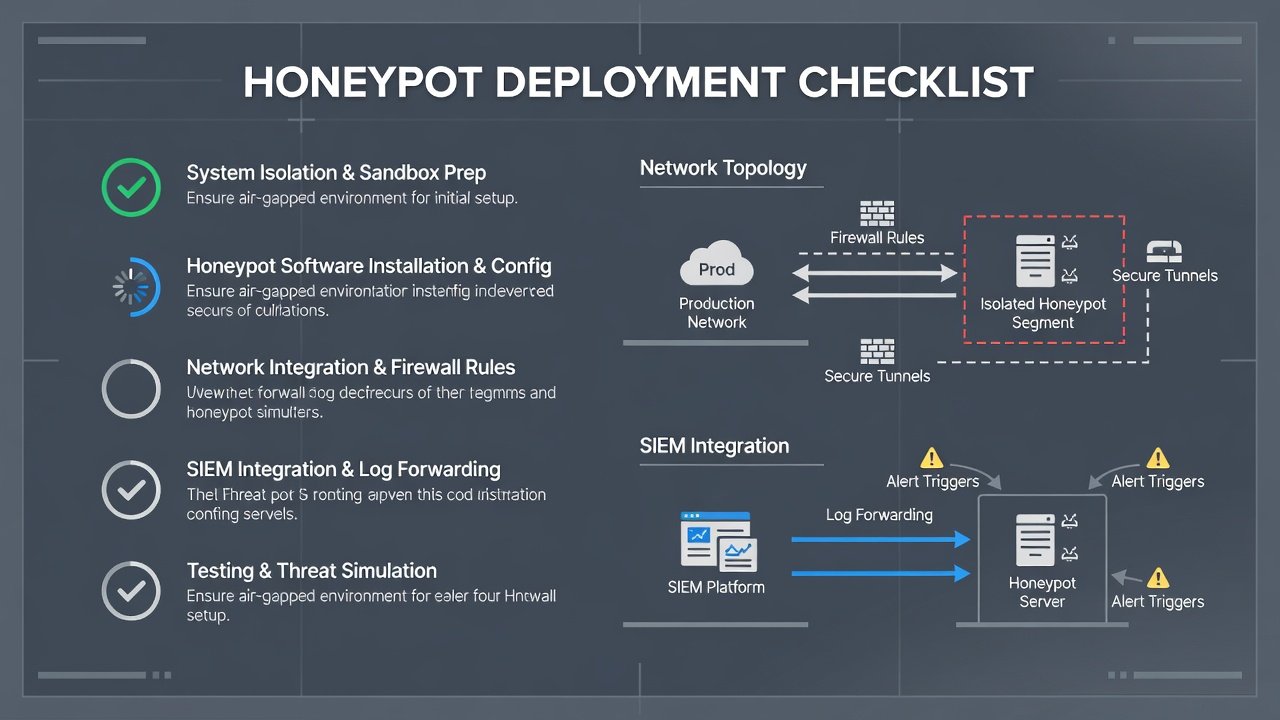
Follow this structured approach for reliable implementation. Begin with a thorough risk assessment of your current infrastructure to determine optimal placement points that minimize exposure while maximizing visibility into attacker behavior.
- Assess network topology and identify low-risk segments for placement, ensuring honeypots sit behind appropriate firewalls but remain reachable by potential intruders.
- Select appropriate honeypot types, such as low-interaction for quick logging or high-interaction for deeper attacker engagement, based on your team's monitoring capacity.
- Configure realistic services and data to avoid easy detection by AI scanners, incorporating elements like plausible user accounts and recent activity timestamps.
- Establish monitoring baselines and alert thresholds that integrate with existing security operations workflows.
- Test isolation to prevent lateral movement risks through simulated attack scenarios before going live.
- Document configurations for audit trails and conduct quarterly reviews to adapt to new threat intelligence.
Each step should include validation testing. For instance, after configuration, run controlled scans to verify that the honeypot appears authentic without revealing its deceptive nature. This checklist ensures deployments remain effective over time.
Integrating Honeypots with SIEM Tools
Seamless SIEM connectivity amplifies honeypot value by correlating logs with broader security events. Map honeypot outputs to SIEM schemas for automated alerting on anomalous interactions. Popular platforms support API-based ingestion, enabling real-time dashboards that highlight reconnaissance patterns. This setup accelerates incident response and enriches threat hunting workflows.
Practical examples include forwarding syslog data from tools like Cowrie to Splunk or ELK Stack instances. Create custom parsers that flag unusual command sequences indicative of AI-driven exploration. Regular tuning of correlation rules prevents alert fatigue while surfacing high-fidelity signals.
Comparing Open-Source and Enterprise Solutions
Open-source options offer flexibility and zero licensing costs, suiting teams with strong in-house expertise. Popular choices include Cowrie for SSH emulation and Honeynet Project frameworks that allow extensive customization. Enterprise platforms provide managed updates, advanced analytics, and vendor support for complex environments. Solutions from vendors like Attivo or TrapX deliver pre-built integrations and scalability features suited for large organizations.
Evaluate based on deployment scale, required customization, and long-term maintenance overhead. Open-source deployments often require dedicated staff for upkeep, while enterprise versions reduce operational burden through automated patching. Hybrid approaches frequently deliver optimal results by combining core open-source engines with enterprise orchestration layers for centralized management.
Metrics for Measuring Honeypot Effectiveness
Track key performance indicators including interaction volume, attacker dwell time, and intelligence yield per deployment. Calculate false positive rates and time-to-detection to quantify defensive impact. Additional metrics such as the ratio of unique attacker IPs logged versus total interactions help assess the quality of gathered intelligence.
Regular reporting against these metrics guides iterative improvements and justifies resource allocation to stakeholders. For example, aim for at least 50 unique interactions per month in high-risk segments as a benchmark for active threat engagement. Review dashboards monthly to identify underperforming decoys that may need reconfiguration.
Real-World Case Studies from Recent Breaches
Analysis of 2025 incidents reveals organizations that deployed layered honeypots successfully diverted AI-driven attacks, gaining early warnings that prevented data leaks. One financial services firm used high-interaction decoys to map attacker infrastructure, leading to proactive blocking across their network. In another case, a healthcare provider identified automated reconnaissance targeting patient records through honeypot alerts, enabling swift isolation of affected systems before any breach occurred.
A manufacturing company integrated honeypots with their SIEM to detect supply-chain related probes, resulting in enhanced vendor security assessments. These examples underscore the value of combining deception with rapid response protocols.
Legal Considerations for Data Privacy
Deployments must respect privacy laws such as GDPR and CCPA. Ensure honeypots do not inadvertently capture or store personal data without proper safeguards. Implement data minimization techniques and obtain necessary approvals for logging activities that might involve third-party interactions.
Transparent documentation helps demonstrate due diligence during audits. Organizations should also consider jurisdictional differences when deploying across borders, consulting with legal teams to align honeypot policies with evolving regulations on deceptive security measures.
FAQs on Common Pitfalls
How do I avoid detection by advanced scanners? Regularly refresh decoy configurations and incorporate realistic traffic patterns to maintain authenticity over time.
What is the best way to scale honeypots? Start with targeted placements and expand based on observed threat density, prioritizing segments with the highest data sensitivity.
Are there risks of honeypots being turned against defenders? Proper network segmentation and continuous monitoring mitigate this concern effectively, especially when combined with strict access controls.
How often should configurations be updated? Align updates with threat intelligence cycles, typically every 30 to 60 days, to stay ahead of AI adaptation techniques.
Conclusion
Strategic honeypot deployment strengthens data privacy defenses amid 2026's sophisticated threat landscape. By combining technical checklists, SIEM integration, and careful legal oversight, security teams gain proactive advantages. Continuous refinement based on metrics ensures sustained effectiveness against evolving attacks. For further authoritative resources, explore guidance from NIST, CISA, OWASP, and SANS Institute.


No comments yet. Be the first!