 NeoBit Daily

Introduction to Homomorphic Encryption in 2026
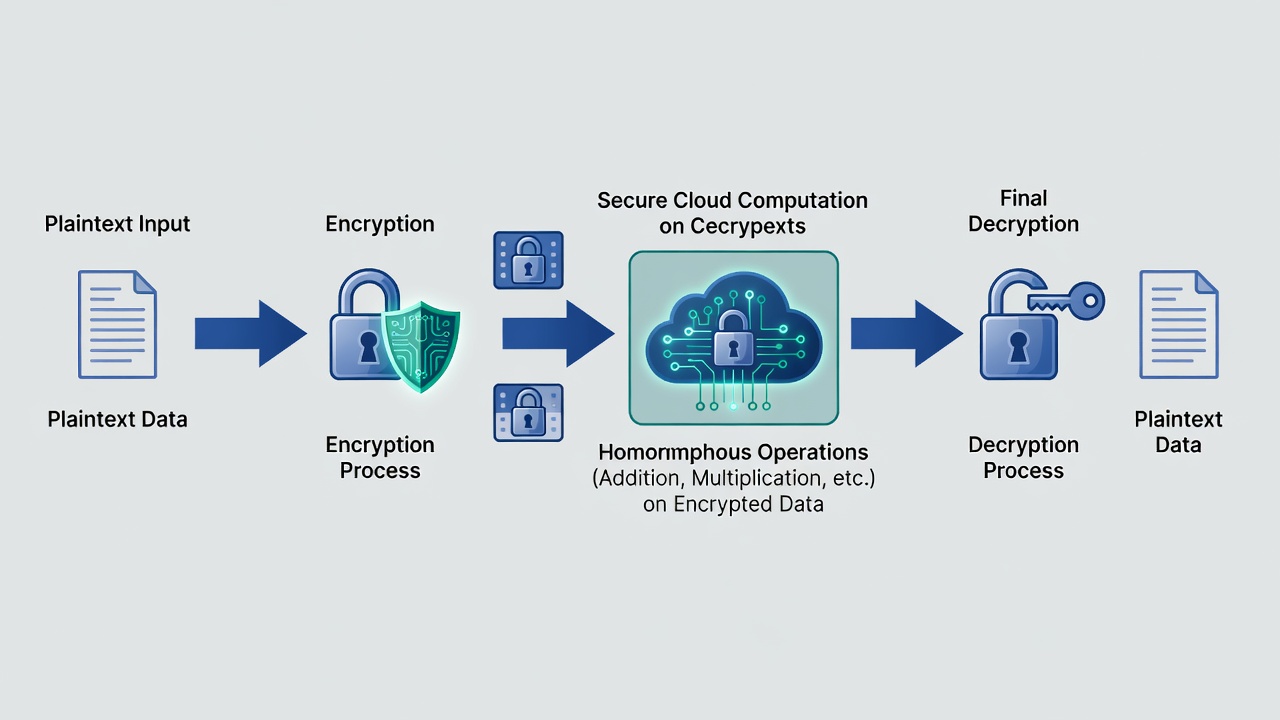
Homomorphic encryption represents a transformative approach in data privacy, allowing computations on encrypted data without ever exposing the underlying information. As organizations increasingly migrate sensitive workloads to the cloud, this technique addresses critical vulnerabilities that traditional encryption methods cannot resolve. In 2026, advancements in performance and standardization have positioned homomorphic encryption as a practical solution for enterprises handling regulated data across industries such as finance, healthcare, and government.
Unlike conventional encryption that requires decryption before processing, homomorphic encryption preserves confidentiality throughout the data lifecycle. This capability proves especially valuable in multi-tenant cloud environments where third-party providers must perform analytics or machine learning tasks on sensitive datasets. The technology has evolved from theoretical constructs into deployable tools, driven by improvements in algorithmic efficiency and hardware acceleration that reduce the historical performance penalties associated with encrypted computation.
Businesses today face mounting pressure from data breach regulations and consumer expectations for privacy. Homomorphic encryption offers a pathway to maintain competitive analytics capabilities while meeting these demands head-on, eliminating the traditional trade-off between utility and security.
Core Concepts of Homomorphic Encryption
At its foundation, homomorphic encryption relies on mathematical structures that support specific operations directly on ciphertexts. There are several variants, including partially homomorphic schemes that permit either addition or multiplication, somewhat homomorphic encryption that supports a limited number of both operations, and fully homomorphic encryption (FHE) that enables arbitrary computations. The latter, while more computationally intensive, offers complete flexibility for complex algorithms including machine learning model training and inference.
Key properties include semantic security, ensuring that ciphertexts reveal no information about plaintexts, and the ability to chain operations indefinitely through techniques like bootstrapping. Researchers have optimized bootstrapping techniques in recent years, reducing overhead and making real-time applications feasible for moderate-sized datasets. Understanding noise growth during operations is essential, as excessive noise can render decryption impossible without careful parameter selection.
Benefits for Data Privacy
Homomorphic encryption delivers unmatched privacy guarantees by eliminating the need for trusted execution environments or data exposure during processing. Organizations can comply with strict regulations such as GDPR and HIPAA while still deriving insights from encrypted datasets. It also mitigates risks associated with insider threats and supply-chain attacks in cloud infrastructures, where providers never access plaintext information.
Additional advantages include enhanced auditability and reduced liability for data custodians, as plaintext never leaves the owner's control. This approach supports secure multi-party computation scenarios, enabling collaborative analytics between competing organizations without revealing proprietary data. The result is stronger customer trust and fewer opportunities for data misuse.
Comparison to Traditional Methods Like AES
AES remains the gold standard for data-at-rest and data-in-transit protection due to its speed and hardware acceleration. However, AES necessitates decryption prior to any meaningful computation, creating exposure windows that homomorphic encryption avoids entirely. Homomorphic encryption extends protection to data-in-use scenarios, though it incurs higher computational costs that have been significantly mitigated by 2026 optimizations.
In practice, many deployments combine both: AES for storage efficiency and homomorphic layers for secure analytics. This hybrid model balances performance with privacy, avoiding the all-or-nothing trade-offs of earlier approaches. Organizations evaluating options should consider factors like data volume, required operation types, and acceptable latency when deciding between pure AES pipelines and layered homomorphic solutions.
Real-World 2026 Use Cases in Cloud Environments
Financial institutions now leverage homomorphic encryption for fraud detection on encrypted transaction records hosted in public clouds, allowing real-time risk scoring without decrypting customer details. Healthcare providers perform collaborative research on patient data without sharing raw records, enabling cross-border studies while maintaining compliance with privacy laws.
Retail platforms analyze encrypted customer behavior to personalize recommendations at scale, and government agencies process census information securely for policy modeling. These implementations demonstrate measurable reductions in breach impact compared to legacy systems. Additional emerging applications include secure genomic analysis in biotechnology and confidential voting systems in digital governance platforms.
Integration Steps with Existing Systems
Successful adoption begins with assessing data sensitivity and identifying workloads suitable for homomorphic processing. Next, select a library or framework compatible with your cloud provider, such as those supporting CKKS or BFV schemes. Teams should then prototype small-scale operations to measure overhead before full rollout.
Implementation Checklist
- Map plaintext operations to supported homomorphic functions and validate correctness
- Evaluate performance benchmarks on target hardware including GPUs and specialized accelerators
- Implement key management using hardware security modules and secure enclaves
- Conduct pilot tests with synthetic datasets mirroring production volumes
- Integrate monitoring for ciphertext growth and noise levels throughout computation chains
- Document rollback procedures for hybrid AES/fallback modes during migration
- Train engineering teams on parameter selection and security proofs
- Establish incident response protocols specific to encrypted computation failures
Practical Examples and Security Tips
Consider a Python-based example using an open-source FHE library to encrypt a vector of financial metrics, perform element-wise addition and multiplication for risk calculations, and decrypt the final aggregated result. Developers should always validate noise budgets after each operation to prevent decryption failures and log intermediate ciphertext sizes for capacity planning.
Security tips include rotating encryption keys periodically according to a defined schedule, enforcing strict access controls on key material through role-based policies, and combining homomorphic encryption with differential privacy techniques for enhanced protection against inference attacks. Regular audits by third-party cryptographers help identify implementation weaknesses early, while penetration testing focused on side-channel vulnerabilities strengthens overall resilience.
Common Pitfalls to Avoid
- Underestimating computational overhead, leading to unacceptable latency in production environments and user dissatisfaction
- Neglecting parameter tuning, which can compromise security margins and expose systems to cryptanalytic attacks
- Assuming universal applicability without thorough workload analysis, resulting in inefficient or insecure deployments
- Overlooking interoperability with legacy databases and APIs, causing integration delays and data silos
- Failing to account for ciphertext expansion, which increases storage requirements and network bandwidth usage
Future Outlook and Emerging Trends
Looking ahead, continued research into lattice-based schemes and hardware co-design promises further efficiency gains. Standardization efforts by international bodies are expected to accelerate enterprise adoption, while open-source communities contribute improved tooling and educational resources. Organizations investing now will be better positioned to capitalize on these developments.
FAQ: Enterprise Concerns Addressed
How does homomorphic encryption impact compliance audits?
It simplifies audits by ensuring plaintext data never resides on third-party infrastructure, providing cryptographic proof of confidentiality that auditors can verify independently.
What are the performance implications in 2026?
Optimized implementations now support real-time queries on moderate datasets, with ongoing improvements reducing latency by orders of magnitude compared to early prototypes through better algorithms and specialized processors.
Can it replace all existing encryption?
No. It complements rather than replaces AES and TLS, forming layered defenses tailored to specific risk profiles and operational requirements.
What training is recommended for implementation teams?
Teams benefit from foundational cryptography courses combined with hands-on workshops using production-grade libraries, plus ongoing education on emerging threats and mitigation strategies.
Conclusion
Homomorphic encryption stands as a pivotal 2026 breakthrough for organizations prioritizing data privacy without sacrificing analytical capabilities. By following structured integration approaches, avoiding common pitfalls, and leveraging established resources from authorities like NIST, IBM Research, and Microsoft, enterprises can confidently adopt this technology. Continued innovation promises even broader applicability in the years ahead, transforming how sensitive data is handled in an increasingly connected world.


No comments yet. Be the first!