 NeoBit Daily

Introduction to Deception Technology in 2026
As cyber threats grow more sophisticated, organizations are turning to proactive strategies like deception technology to safeguard sensitive data. This approach misleads attackers by deploying realistic decoys, allowing defenders to detect, analyze, and respond to intrusions early. In 2026, deception technology has evolved into a critical layer within modern security stacks, complementing traditional tools to address advanced persistent threats and ransomware campaigns. Security professionals recognize that reactive measures alone are insufficient against zero-day exploits and insider risks. Deception shifts the advantage by forcing attackers into controlled environments where their tactics can be studied without exposing real assets. The rise of AI-augmented attacks has made this shift essential, as attackers now use automated tools to scan for vulnerabilities at unprecedented speeds. By planting false trails and attractive lures, deception technology not only buys time but also generates actionable intelligence that can be fed back into broader security operations.
Core Concepts: Honeypots, Honeytokens, and Decoy Systems
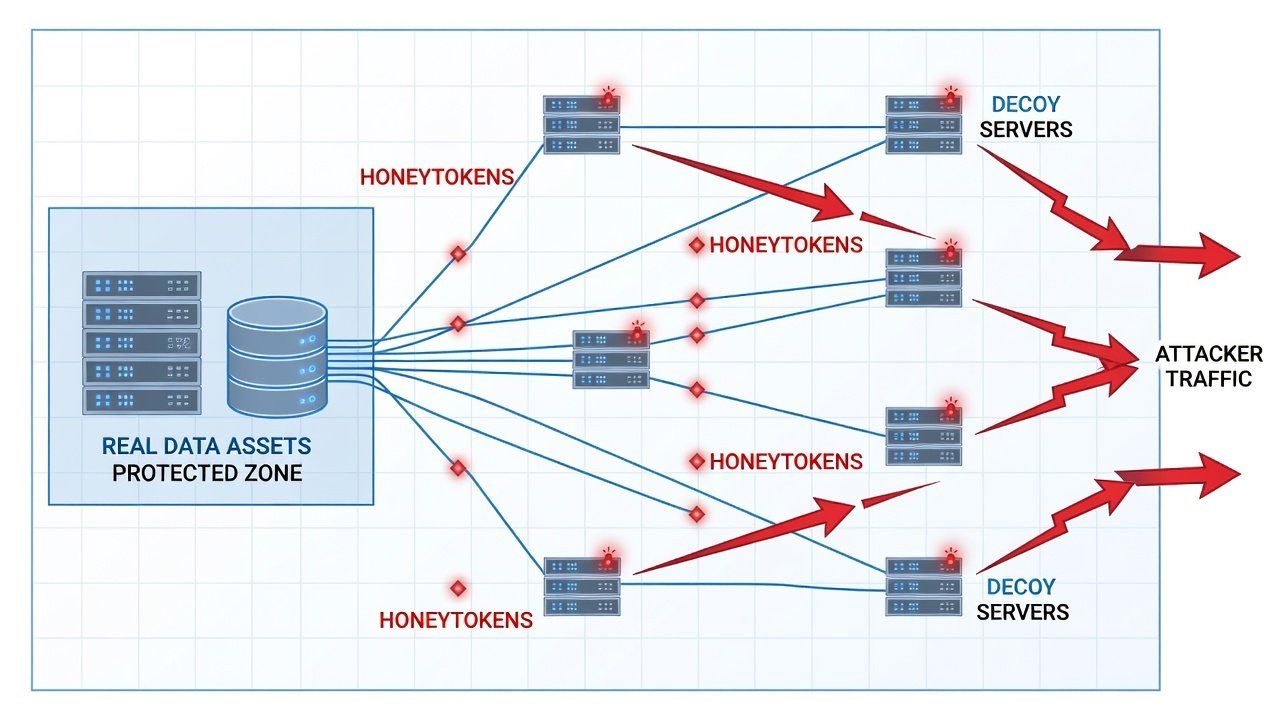
Honeypots are decoy servers or applications designed to attract and trap malicious actors. They mimic production systems but contain no valuable data, logging every interaction for threat intelligence. Honeytokens, such as fake credentials or files, act as tripwires that alert teams when accessed. Decoy systems extend this by creating entire networks of illusions that blend seamlessly with legitimate infrastructure. These elements have matured significantly by 2026, incorporating AI-driven adaptability to respond dynamically to attacker behavior. For example, a modern honeypot might emulate a specific database schema used in healthcare environments, complete with fabricated patient records that trigger alerts on any query attempt. This level of detail helps distinguish between automated scans and targeted human-led attacks. For deeper standards on cybersecurity frameworks, refer to NIST resources on proactive defenses.
Evolution to Counter Current Threats
Early deception tools focused on basic traps, but today's versions integrate machine learning to generate context-aware lures that evolve with threat landscapes. They now counter sophisticated attacks including supply-chain compromises and AI-powered reconnaissance by providing high-fidelity emulations that reveal attacker intent in real time. This evolution supports data privacy regulations by minimizing breach impact through early containment. In recent years, the shift from static to dynamic deception has been driven by the need to handle polymorphic malware that changes signatures rapidly. Organizations deploying these advanced systems report faster identification of lateral movement attempts, which traditional perimeter defenses often miss.
Implementation Steps for Organizations
Deploying deception technology requires careful planning to avoid operational disruptions. Follow these practical steps: First, conduct a thorough asset inventory and risk assessment to pinpoint crown-jewel data that would benefit most from protection. Second, evaluate vendor solutions based on scalability, ease of integration, and reporting capabilities. Third, begin with a pilot deployment in a segmented network zone, using low-interaction honeypots that require minimal maintenance. Fourth, progressively introduce high-interaction decoys that allow limited attacker engagement for richer data collection. Fifth, embed honeytokens into everyday workflows, such as embedding fake API keys in code repositories or fake database entries in shared drives. Sixth, define clear escalation procedures and automate alert correlation with existing SIEM platforms. Seventh, schedule quarterly reviews to update decoy configurations and measure effectiveness through metrics like time-to-detection. This phased approach minimizes risk while building internal expertise.
Comparisons to Reactive Security Tools
Unlike signature-based antivirus or firewall rules that react after detection, deception technology operates proactively by assuming breach. It reduces false positives through behavioral validation and provides richer forensics data. While reactive tools focus on blocking known threats, deception reveals unknown actors and their methods, offering superior visibility into advanced campaigns. Reactive approaches excel at high-volume filtering of commodity malware, yet they struggle with novel techniques. Deception fills this gap by creating controlled environments that expose attacker tools and infrastructure. A hybrid strategy that combines both yields the strongest posture, as seen in enterprises that layer deception atop endpoint detection and response platforms.
Integration with Existing Security Frameworks
Deception layers integrate smoothly with zero-trust architectures and NIST Cybersecurity Framework functions. Organizations often combine it with threat intelligence feeds from sources like CISA to correlate decoy activity with broader indicators of compromise. This creates a unified defense that enhances incident response times and supports compliance audits. Additional alignment with frameworks from ISO allows security teams to map deception outputs directly to risk management processes, ensuring continuous improvement and audit readiness.
Real-World Case Studies
A financial services firm deployed honeytokens across its cloud environment, detecting an insider threat within weeks that traditional monitoring missed. The tokens were placed in customer transaction logs, and access attempts triggered immediate isolation of the affected account. In another example, a healthcare provider used decoy systems to divert ransomware operators, buying critical time for backups and resulting in zero data loss. A third case involved a manufacturing company that integrated deception into its OT networks; fake PLC controllers lured state-sponsored actors, enabling attribution and subsequent law-enforcement cooperation. These cases highlight how deception delivers measurable ROI through reduced dwell time and preserved operational continuity.
Practical Security Tips
- Start small with targeted honeypots in non-production segments to build team expertise without overwhelming alert volumes.
- Ensure decoys mimic real traffic patterns to avoid easy detection by advanced adversaries using traffic analysis.
- Combine deception with user behavior analytics for layered protection that catches both external and internal threats.
- Train security teams on interpreting decoy alerts to maximize value and reduce response fatigue.
- Review and refresh lures quarterly to stay ahead of evolving attacker reconnaissance techniques.
- Document all deception assets thoroughly so legitimate users do not accidentally trigger them during routine operations.
- Leverage automation to quarantine any system interacting with a honeytoken while preserving forensic evidence.
FAQ: Common Deployment Challenges
How do I avoid performance impacts from deception tools?
Choose lightweight, containerized solutions and monitor resource usage during pilot phases; most modern platforms add less than 5 percent overhead when properly tuned.
Is deception technology suitable for small organizations?
Yes, managed deception services allow smaller teams to benefit without heavy in-house resources, often starting with cloud-based honeypot offerings.
What are the main risks of misconfiguration?
Poorly designed decoys can leak information or create new attack surfaces; thorough validation and segmentation mitigate this effectively.
How does it support data privacy compliance?
By isolating threats early, deception reduces the scope of potential data exposures under regulations like GDPR and CCPA.
Can deception technology be used in cloud-native environments?
Absolutely; many solutions now offer native integrations with Kubernetes and serverless platforms to place decoys alongside production workloads.
Conclusion
Deception technology represents a forward-thinking evolution in 2026 cybersecurity defense. By mastering honeypots, honeytokens, and decoy systems, security teams can transform their posture from reactive to anticipatory. Integrating these tactics with established frameworks delivers robust protection for data privacy against even the most determined adversaries. Organizations that invest in thoughtful implementation will gain a decisive edge in the ongoing battle against cyber threats, turning attacker curiosity into a strategic advantage.


No comments yet. Be the first!