 NeoBit Daily

Introduction to Cyber Risk Quantification in 2026
As organizations navigate an increasingly complex threat landscape in 2026, traditional qualitative risk assessments no longer suffice for protecting sensitive data privacy. Security leaders must adopt quantitative methods that deliver measurable insights into potential losses, enabling smarter resource allocation and stronger executive buy-in. This comprehensive guide examines proven strategies for cyber risk quantification, including advanced risk scoring frameworks, seamless integration of threat intelligence with business impact analysis, and sophisticated modeling tools such as FAIR and Monte Carlo simulations.
Mid-size enterprises often struggle with limited budgets yet face sophisticated attacks targeting customer data and intellectual property. Quantitative approaches transform vague concerns into actionable metrics, helping teams demonstrate ROI on security investments while complying with evolving regulations. By focusing on data-driven decision-making, leaders can prioritize controls that directly reduce exposure to high-impact events like ransomware or privacy breaches.
Understanding Risk Scoring Frameworks
Risk scoring frameworks form the backbone of any quantification effort by converting qualitative judgments into numerical values. Popular models combine factors such as vulnerability severity, threat actor capability, and asset criticality to generate composite scores. In 2026, these frameworks must account for new variables including AI-driven attacks and cross-border data privacy violations under updated global standards.
Teams should begin by customizing base frameworks to their industry. For instance, layering technical scores with financial impact multipliers creates a holistic view. Regular calibration sessions ensure scores reflect the latest threat data. This iterative process prevents outdated metrics from skewing priorities and supports continuous improvement across the security program.
Integrating Threat Intelligence with Business Impact Analysis
Successful quantification hinges on fusing real-time threat intelligence with detailed business impact analysis. External feeds provide probability estimates for specific attack vectors, while internal BIA workshops reveal the true cost of downtime, data loss, or regulatory penalties. The combination produces risk profiles that align technical realities with organizational objectives.
Mid-size companies benefit by mapping critical data flows to known threat campaigns. A logistics firm, for example, might correlate supply-chain vulnerabilities with potential revenue disruption and compliance fines. This integration yields dynamic risk registers that evolve alongside emerging threats. NIST Cybersecurity Framework supplies structured guidance for building these integrations effectively.
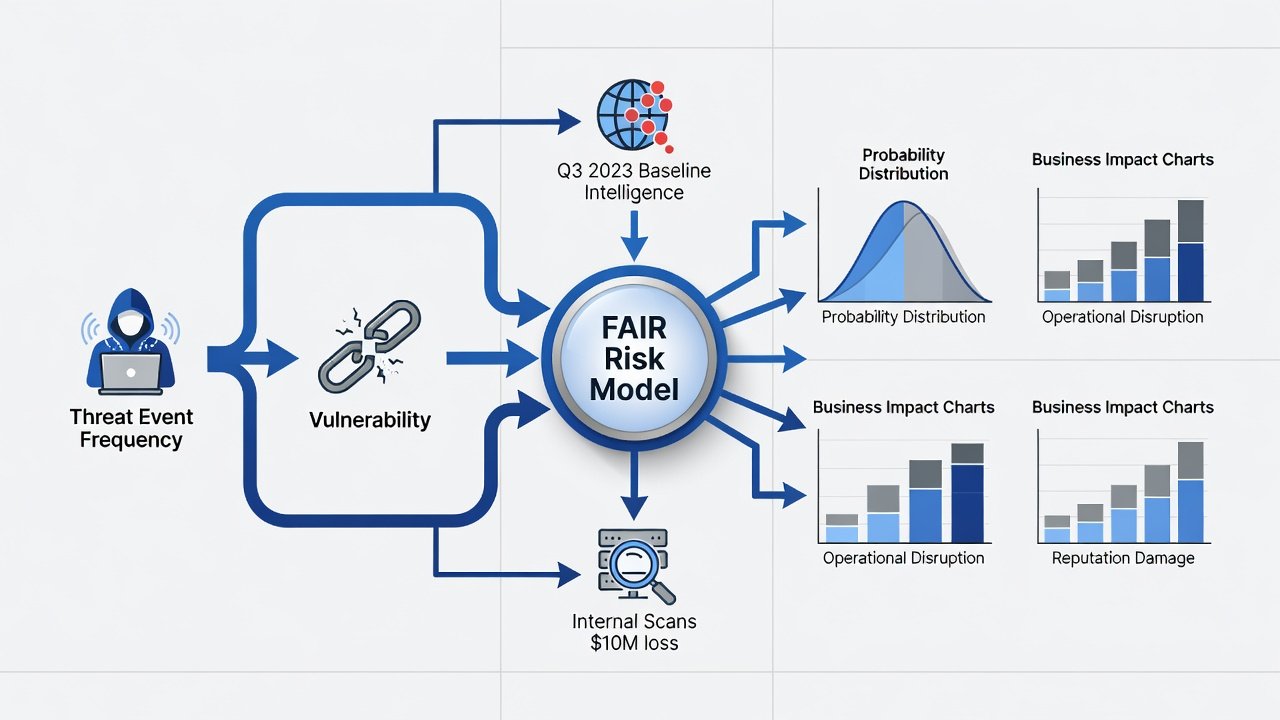
Applying FAIR and Monte Carlo Simulations
The FAIR model offers a standardized taxonomy for expressing risk in financial terms by decomposing loss event frequency and magnitude into measurable components. Organizations apply it to scenarios ranging from insider threats to cloud misconfigurations, generating loss exceedance curves that inform insurance decisions and control selection.
Monte Carlo simulations add statistical rigor by modeling thousands of possible outcomes based on variable inputs such as attack frequency distributions and recovery timelines. The resulting probability distributions help leaders understand tail risks and prepare contingency plans. Many mid-size enterprises start with spreadsheet-based implementations before migrating to specialized platforms that automate data ingestion and reporting.
Real-World Examples from Mid-Size Enterprises
A 450-employee financial services company applied FAIR to quantify risks associated with third-party vendor access to customer records. The analysis revealed an annual loss expectancy exceeding internal risk tolerance thresholds, prompting enhanced vendor due diligence protocols that lowered exposure by nearly half within eighteen months.
Another case involved a 700-employee healthcare system that combined threat intelligence with BIA to evaluate ransomware threats. Monte Carlo outputs highlighted a 22% probability of multimillion-dollar losses from extended system outages. This insight drove investments in immutable backups and tabletop exercises, significantly improving resilience scores.
A manufacturing enterprise with 800 staff used quantitative scoring to prioritize IoT device security. By assigning dollar values to potential production halts and intellectual property theft, the team secured approval for network segmentation projects that reduced overall risk by 40% over two quarters.
Step-by-Step Implementation Guidance
- Conduct a comprehensive asset inventory and classify data according to sensitivity and regulatory requirements.
- Aggregate threat intelligence from multiple authoritative sources and normalize it for internal use.
- Facilitate cross-functional BIA workshops to quantify revenue, operational, and reputational impacts.
- Select a primary model such as FAIR and calibrate parameters using historical incident data.
- Execute Monte Carlo simulations and perform sensitivity analysis on key variables.
- Develop visual dashboards that translate quantitative outputs into clear recommendations for leadership.
- Establish quarterly review cycles to refresh inputs and validate model accuracy against real events.
Quantitative vs Qualitative Approaches: A Comparison
- Quantitative methods deliver precise probability and loss estimates that facilitate cost-benefit analysis of controls, yet demand quality data and analytical expertise.
- Qualitative methods enable rapid initial assessments using simple scales but frequently produce inconsistent results and struggle to justify large security expenditures.
- Hybrid approaches leverage the speed of qualitative input collection with the rigor of quantitative modeling, offering the most practical path for resource-constrained teams.
Organizations that blend both approaches achieve better alignment between technical teams and business stakeholders in fast-changing 2026 environments.
Common Pitfalls and How to Avoid Them
Many programs fail due to poor data quality or over-reliance on generic industry benchmarks. To mitigate this, teams should gather organization-specific metrics and validate assumptions through pilot projects. Another frequent issue involves insufficient executive communication; translating complex simulations into concise business narratives helps secure ongoing support.
Additionally, neglecting to update models as threats evolve can render outputs obsolete. Implementing automated data pipelines and scheduled recalibrations addresses this challenge effectively.
Tools and Technologies for 2026
Modern platforms now incorporate machine learning to automate variable estimation within FAIR models. Open-source libraries support initial Monte Carlo experiments, while commercial solutions add collaborative features and regulatory reporting templates. Security leaders should evaluate tools based on integration capabilities with existing threat feeds and BI systems.
ISO 27001 and CISA resources provide additional benchmarks for selecting and deploying these technologies responsibly.
Conclusion
Cyber risk quantification strategies equip security leaders with the clarity needed to navigate 2026 data privacy threats. Through structured frameworks, integrated intelligence, and simulation techniques, mid-size enterprises can prioritize actions that deliver measurable protection and sustained compliance.
FAQs
How long does full FAIR implementation typically require?
Most mid-size organizations complete initial model deployment within six to ten weeks when dedicated resources are allocated.
What data sources improve Monte Carlo accuracy?
Internal incident logs combined with sector-specific threat reports from government agencies produce the most reliable inputs.
Can teams begin without specialized software?
Yes, spreadsheet templates and publicly available FAIR documentation allow meaningful quantification before investing in dedicated platforms.
How often should risk models be recalibrated?
Quarterly reviews are recommended, with immediate updates following major incidents or significant regulatory changes.
Which industries benefit most from quantitative approaches?
Healthcare, finance, and manufacturing see particularly strong returns due to high regulatory stakes and complex operational dependencies.


No comments yet. Be the first!