 NeoBit Daily
Introduction to the Cyber Kill Chain in 2026
The Cyber Kill Chain framework remains a cornerstone for understanding and stopping cyberattacks. Originally developed by Lockheed Martin, it breaks down intrusions into seven distinct phases. In 2026, evolving threats like AI-driven reconnaissance and advanced persistent threats demand updated defense strategies that emphasize early disruption and data privacy protection. Organizations must adapt quickly because attackers now leverage machine learning for faster reconnaissance and automated exploitation. This beginner-to-intermediate guide explores each phase in depth, providing real-world 2026 hacking news examples including reconnaissance and exfiltration tactics. By focusing on proactive measures, teams can significantly reduce breach risks and maintain compliance with data privacy regulations.
Businesses of all sizes benefit from mapping their defenses against this model. Early intervention at the reconnaissance stage prevents later stages from materializing, saving resources and protecting sensitive information. Throughout this article we examine common attack vectors, compare traditional and modern adaptations, and deliver step-by-step implementation advice backed by recent case studies.
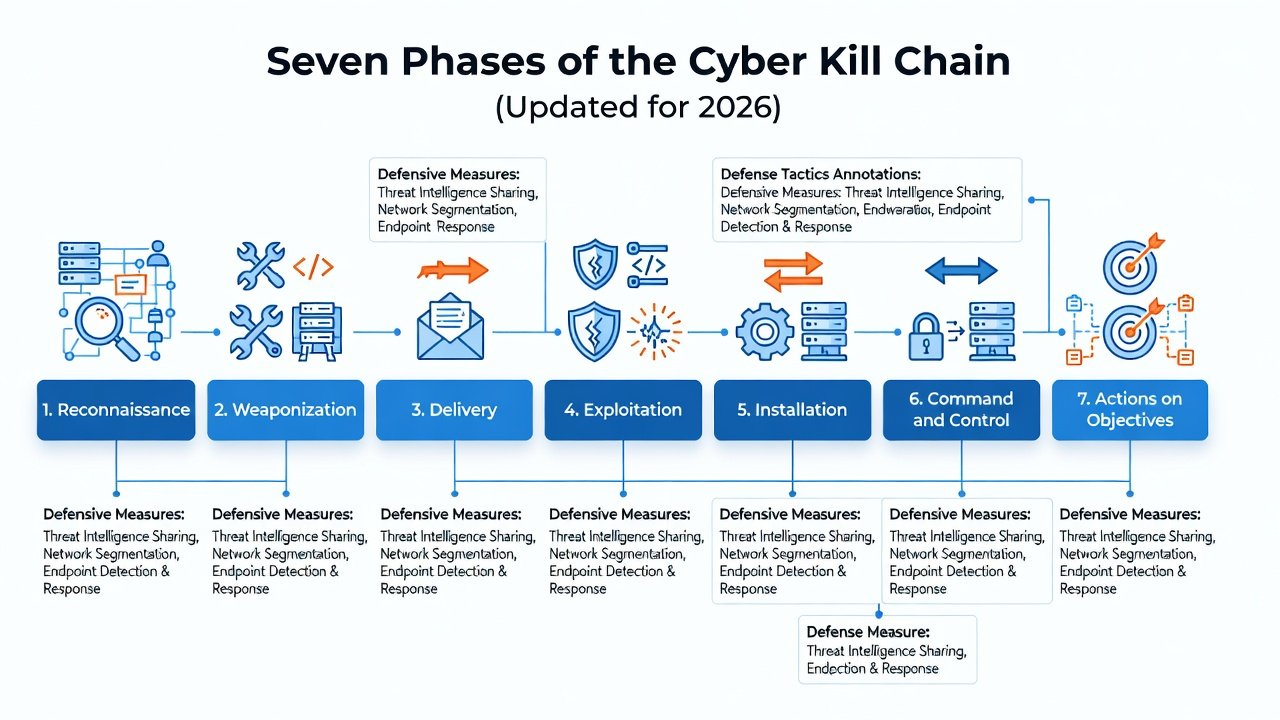
The Seven Phases of the Cyber Kill Chain Explained
Each phase offers a distinct opportunity to interrupt the attack. Understanding the nuances helps security teams prioritize investments in tools and processes.
1. Reconnaissance
Attackers gather intelligence using open-source intelligence, social media scraping, and AI-powered scanning tools. In 2026, tactics include automated analysis of cloud misconfigurations and employee LinkedIn profiles to identify high-value targets. Defenders should monitor for unusual external queries and deploy deception technologies such as honeytokens.
2. Weaponization
Malware is crafted and paired with exploits. Modern variants leverage polymorphic code that mutates to evade signature-based detection. Organizations can counter this by maintaining updated threat intelligence feeds and regularly patching known vulnerabilities.
3. Delivery
Payloads reach victims via phishing emails, malicious USB drives, or compromised supply chains. 2026 defenses emphasize zero-trust email gateways combined with sandboxing for all attachments. Training programs that simulate realistic phishing scenarios remain highly effective.
4. Exploitation
Vulnerabilities are triggered to gain initial access. Behavioral analytics platforms help spot anomalous process executions before lateral movement begins. Regular penetration testing reveals weak points that attackers might target.
5. Installation
Backdoors and persistence mechanisms are deployed. Endpoint detection and response solutions with machine learning capabilities prove critical for identifying hidden implants that traditional antivirus misses.
6. Command and Control
Attackers establish communication channels to control compromised systems. Monitoring DNS queries, unusual outbound traffic patterns, and encrypted tunnel anomalies allows teams to cut off attacker control quickly.
7. Actions on Objectives
Data exfiltration or ransomware deployment occurs. Encryption monitoring, data loss prevention policies, and strict access controls limit the final impact. Real-time alerting on large data transfers has become standard practice.
Mapping Common Attack Vectors in 2026
Common vectors include spear-phishing, vulnerable APIs, remote desktop protocol exploits, and insider threats. Recent 2026 hacking incidents show ransomware groups using initial access brokers who sell reconnaissance data on underground forums. Mapping these vectors involves creating a threat model tailored to your industry and infrastructure. For example, healthcare organizations face heightened risks from IoT device compromises while financial firms battle sophisticated business email compromise schemes.
Traditional vs Modern Kill Chain Adaptations
The classic model follows a linear progression, yet 2026 adaptations incorporate loops, parallel paths, and feedback mechanisms for agile threats. Modern versions integrate MITRE ATT&CK mappings for greater granularity and support agile red teaming exercises. Traditional approaches focused heavily on perimeter defense, whereas contemporary strategies emphasize continuous monitoring and zero-trust architectures across hybrid cloud environments.
Step-by-Step Implementation Advice for Security Teams
- Begin with a comprehensive asset inventory and risk assessment that includes cloud resources and third-party vendors.
- Deploy advanced tools for real-time behavioral monitoring across endpoints, networks, and user activities.
- Develop ongoing staff training programs that incorporate the latest 2026 phishing and social engineering tactics.
- Implement network segmentation and micro-segmentation to break potential delivery and command-and-control phases.
- Conduct quarterly red team exercises that simulate current threat actor behaviors documented in public breach reports.
- Establish incident response playbooks aligned with each kill chain stage for faster containment.
- Integrate threat intelligence platforms that provide 2026-specific indicators of compromise.
Case Studies from Recent Breaches
A 2026 financial sector breach illustrated how failing to detect exploitation early allowed attackers to move laterally across multiple subsidiaries. The organization later strengthened behavioral analytics and reduced similar risks dramatically. Another case in the healthcare industry demonstrated successful exfiltration prevention through enhanced data loss prevention combined with employee awareness training. In both examples, mapping defenses to the kill chain enabled quicker identification of gaps and more targeted remediation efforts.
Integrating Security Tips Like Behavioral Monitoring
Behavioral monitoring uses artificial intelligence to flag deviations from established user and system patterns. When combined with threat intelligence feeds from authoritative sources, it enables proactive defense before attackers reach later stages. Security teams should also adopt deception technologies and regular tabletop exercises to test response times across all seven phases.
FAQ
How does the Cyber Kill Chain improve data privacy?
It enables targeted controls at each stage, preventing unauthorized data access and exfiltration while supporting compliance requirements.
What challenges do security teams face in 2026?
Resource constraints, the speed of AI-enhanced attacks, and integration across multi-cloud environments top the list. Start with phased implementation focused on high-impact stages such as reconnaissance and delivery.
Can small organizations adopt this framework?
Yes, by prioritizing reconnaissance and delivery defenses first using affordable cloud-native tools and managed security services.
How often should kill chain assessments be updated?
Conduct formal reviews at least quarterly and after any major infrastructure change or publicized breach in your sector.
Conclusion
Mastering the Cyber Kill Chain equips teams to defend against 2026 threats effectively. Focus on early phases and continuous adaptation to safeguard critical assets and maintain strong data privacy standards. For further reading, explore resources at CISA, MITRE ATT&CK, and NIST Cybersecurity Framework.


No comments yet. Be the first!