 NeoBit Daily

Introduction to Sustainable AI in 2026
As machine learning adoption accelerates across industries, its environmental footprint has become a critical concern for practitioners worldwide. In 2026, sustainable AI tools enable teams to minimize energy consumption and carbon emissions without sacrificing model performance or innovation velocity. This comprehensive guide explores proven techniques, detailed metrics, and real-world strategies that help organizations align their AI workflows with sustainable development goals. The focus remains on practical implementation for ML teams seeking responsible innovation that meets both technical and ecological standards.
Understanding the Environmental Impact of Machine Learning
Machine learning workflows, particularly large-scale training runs, consume substantial electricity, often sourced from fossil fuels. Data centers supporting these operations contribute significantly to global greenhouse gas emissions. Research indicates that training a single large language model can emit as much carbon as several transatlantic flights. Understanding these impacts requires examining the full lifecycle, from data collection and preprocessing through model inference and ongoing maintenance. Sustainable practices address each stage by prioritizing efficiency and renewable energy integration. Teams that ignore these factors risk regulatory penalties and reputational damage as environmental accountability increases.
Energy-Efficient Model Training Techniques
Modern approaches prioritize efficiency from the very beginning of the project lifecycle. Core techniques include model pruning to remove redundant parameters, quantization to lower precision requirements, and knowledge distillation to transfer capabilities from large models to smaller ones. Mixed-precision training on compatible frameworks dramatically cuts energy use by optimizing numerical representations during forward and backward passes. Practitioners benefit from early stopping criteria combined with efficient optimizers such as AdamW paired with cosine annealing schedules that prevent wasteful overtraining. Federated learning further reduces centralized infrastructure needs by training across decentralized devices while preserving data privacy. Additional strategies involve dataset distillation to shrink training corpora without losing essential information and neural architecture search constrained by energy budgets. These methods have demonstrated consistent success in maintaining high accuracy while lowering power draw by 40 to 70 percent in controlled benchmarks. Teams should integrate profiling tools early to identify bottlenecks and iteratively refine their pipelines.
Carbon Footprint Tracking with AI Tools
Accurate measurement forms the foundation for meaningful improvement. Specialized platforms now integrate real-time emissions calculators directly into ML pipelines, providing actionable dashboards. Tools such as CodeCarbon and Experiment Impact Tracker deliver granular insights into kilowatt-hour usage per training run, allowing precise comparisons across different model architectures and hardware setups. Predictive extensions use historical data to forecast emissions before experiments begin, enabling proactive adjustments. 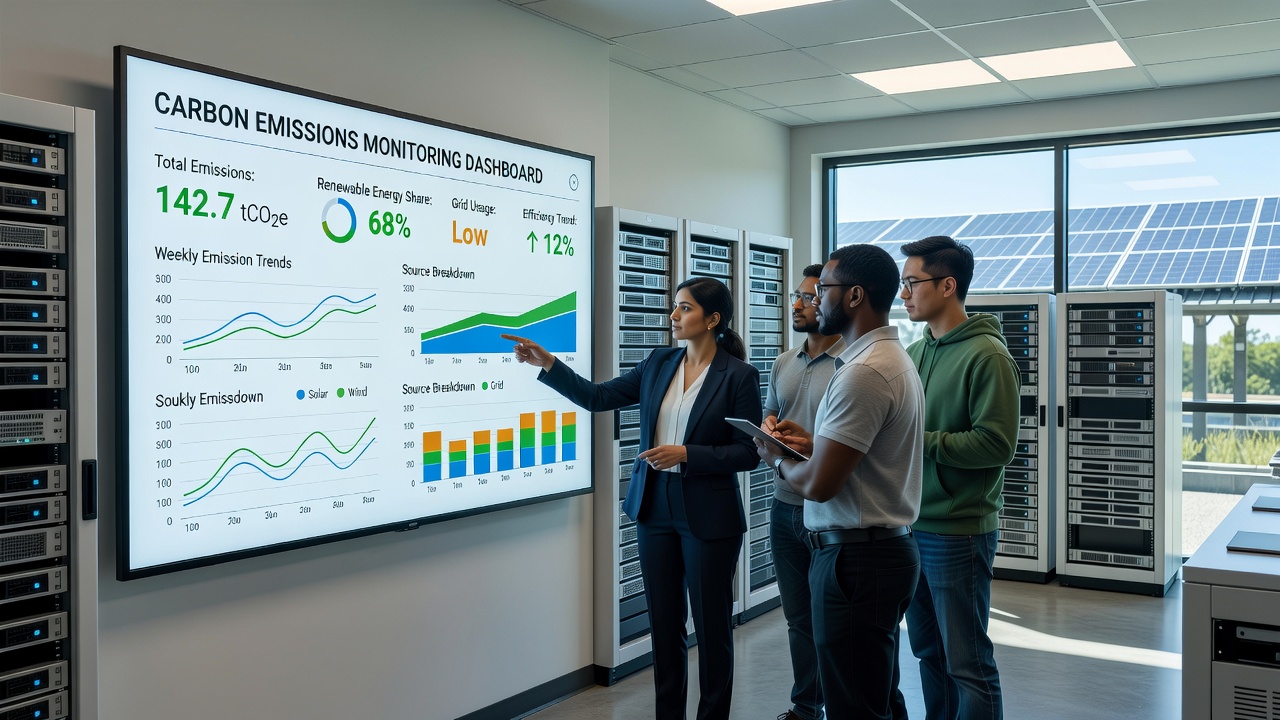
Comparisons of Low-Power Hardware Options
Hardware selection exerts a major influence on overall sustainability outcomes. Leading 2026 options encompass NVIDIA's energy-optimized GPU series, custom TPUs engineered for low-thermal inference workloads, and ARM-based processors suited for edge deployment. Emerging AI accelerators from specialized manufacturers further expand choices for power-constrained environments. When evaluating options, teams should analyze performance-per-watt metrics alongside total lifecycle considerations including manufacturing emissions and end-of-life recyclability. Cloud providers increasingly supply carbon-aware scheduling that routes jobs to regions dominated by renewable sources. Practical comparison criteria include:
- Thermal design power ratings benchmarked against standard ML workloads such as image classification and transformer training.
- Support for dynamic voltage and frequency scaling that adapts consumption to instantaneous demand.
- Availability of vendor programs for responsible sourcing and hardware take-back initiatives.
- Compatibility with open-source efficiency libraries that maximize utilization rates.
Edge devices often outperform centralized servers for inference tasks when latency and bandwidth constraints allow distributed architectures.
Real-World Examples from Leading Labs
Prominent organizations have published detailed case studies showcasing measurable gains. DeepMind has optimized training schedules to align with periods of high renewable availability, achieving substantial emission reductions. Hugging Face has released compressed model variants that deliver near-original performance with dramatically smaller resource requirements. Academic groups at Stanford and MIT have implemented internal carbon budgets for research projects, publishing both technical results and accompanying environmental impact statements. These examples demonstrate that sustainability measures frequently coincide with improved generalization and faster iteration cycles. Smaller startups have followed suit by adopting open-source tracking libraries and sharing best practices through community forums, accelerating collective progress across the field.
Step-by-Step Implementation Guide
Teams can follow this structured roadmap to embed green practices successfully:
- Conduct a comprehensive audit of existing workflows using established carbon tracking software to establish accurate baselines and identify high-impact areas.
- Refactor models systematically with pruning, quantization, and architecture optimizations while validating performance retention through rigorous testing suites.
- Choose hardware or cloud instances that prioritize low-power profiles and renewable energy availability, documenting the rationale for future reference.
- Deploy continuous monitoring dashboards that alert teams when emissions thresholds approach limits, prompting immediate intervention.
- Document outcomes thoroughly and contribute findings to public repositories to advance community knowledge and encourage wider adoption.
Starting with pilot projects on non-critical workloads builds confidence before expanding to production systems.
Metrics and Evaluation for Sustainability
Beyond raw energy figures, practitioners should track composite indicators such as carbon emissions per inference query and model efficiency scores normalized by accuracy. Regular reviews against industry benchmarks help maintain momentum. Integration with project management tools ensures sustainability remains a core consideration rather than an afterthought.
Common Barriers and FAQ
How can teams justify initial investments in sustainable tooling?
Long-term reductions in operational energy expenses combined with strengthened alignment to ESG reporting frameworks often deliver compelling returns that satisfy both technical and financial stakeholders.
Does prioritizing efficiency inevitably reduce model accuracy?
Well-designed optimizations frequently improve generalization by mitigating overfitting, with multiple peer-reviewed studies confirming comparable or superior results on standard benchmarks.
Which external resources support beginners in this area?
Consult documentation from the International Energy Agency on digital sector energy trends, guidelines from the United Nations on technology and sustainable development, and reports available at Environmental Protection Agency covering data center best practices.
What organizational changes accelerate adoption?
Establishing cross-functional sustainability committees and tying performance reviews to environmental metrics fosters accountability and cultural shift.
By systematically adopting sustainable AI tools and practices, ML teams position themselves to lead responsible innovation throughout 2026 while consistently meeting demanding performance requirements.

No comments yet. Be the first!