 NeoBit Daily

Introduction: Why AI News Curation Matters for ML Teams
In 2026, machine learning teams face an unprecedented volume of AI developments. Breakthroughs in large language models, multimodal systems, and efficient training techniques appear daily across research repositories and industry announcements. Effective curation transforms this flood into actionable insights that directly influence model improvements and tool selection. Teams that master structured monitoring gain competitive edges by adopting reliable advancements faster while avoiding distractions from exaggerated claims. The rapid pace means that without a disciplined approach, valuable opportunities for optimization are lost amid noise, leading to slower iteration cycles and potential technical debt from outdated methods.
This guide delivers step-by-step methods tailored for professionals. It covers automated alert systems, rigorous evaluation frameworks, and a repeatable weekly process. Real-world scenarios illustrate how curated updates have guided decisions at leading labs. By implementing these strategies, ML teams can build institutional resilience against information overload while staying at the forefront of the field.
Setting Up Automated Alerts for Machine Learning Breakthroughs
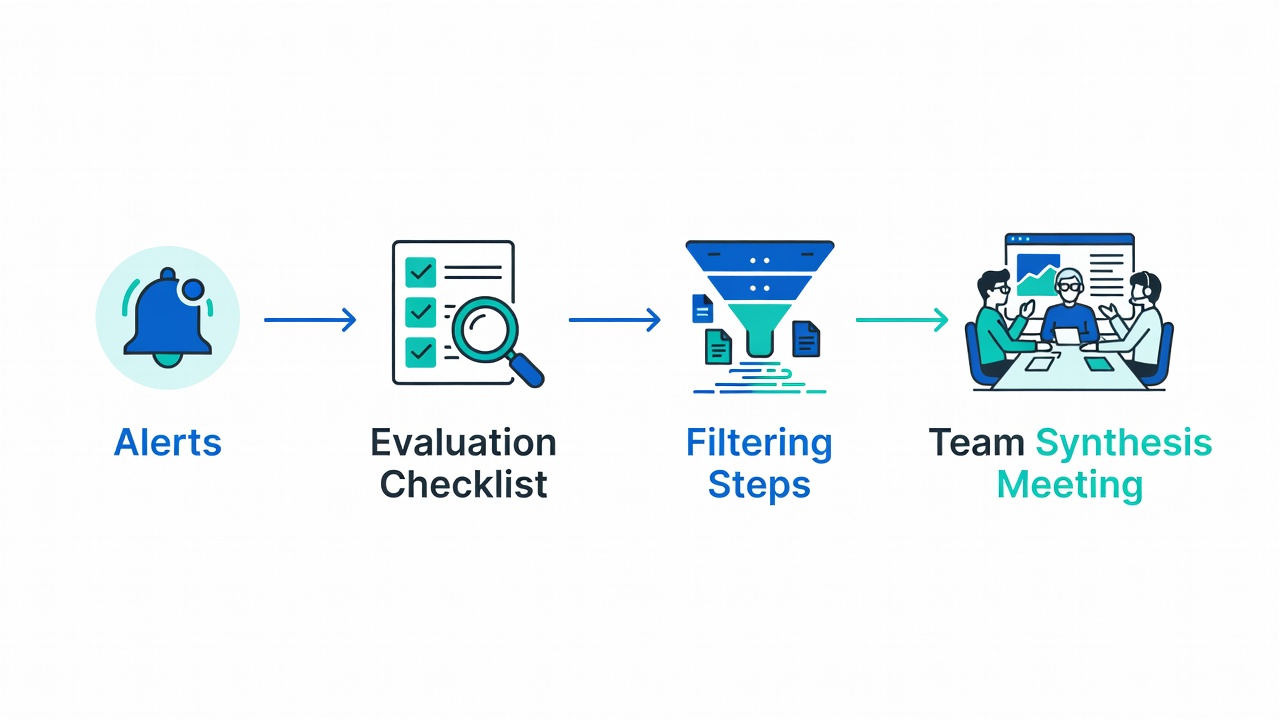
Automated alerts reduce manual scanning time while capturing high-signal sources. Begin by configuring RSS feeds from arXiv categories such as cs.LG and cs.AI. Pair these with keyword triggers including "transformer efficiency," "diffusion model scaling," and "federated learning benchmarks." Customize queries to include emerging terms like "mixture of experts" or "retrieval augmented generation" to stay ahead of trends.
Next, integrate Google Alerts for industry outlets and conference proceedings. Advanced users connect these to Slack or email digests using automation tools. For deeper coverage, subscribe to newsletters from established research organizations and configure daily summaries. This layered approach ensures no major paper or release slips through during high-velocity periods. Consider adding monitoring for GitHub repositories of major frameworks to catch code releases alongside papers.
Evaluating AI Tools Mentioned in News Sources
News articles often highlight new frameworks or platforms, yet claims require verification. Create a standardized evaluation checklist covering benchmark transparency, reproducibility of results, hardware requirements, and integration compatibility with existing stacks. Cross-reference performance claims against independent leaderboards on Papers with Code.
Teams should run small-scale pilots on internal datasets before full adoption. Document findings in a shared repository to build institutional knowledge. Expand the checklist to include licensing terms, community support activity, and long-term maintenance signals. This process filters marketing noise and surfaces tools that genuinely accelerate training or inference, saving weeks of potential rework later.
Filtering Hype from Reliable Updates
Distinguishing substantive progress from hype demands source credibility scoring. Prioritize peer-reviewed publications and results validated by multiple independent groups. Discount announcements lacking ablation studies or accompanied only by cherry-picked demos. Real examples include early claims around certain scaling laws that later required significant revisions after broader testing.
Apply a simple scoring rubric: assign points for open-source code availability, third-party replications, and alignment with established theory. Discard updates scoring below a threshold. Over time this habit protects teams from chasing transient trends and builds a trusted internal knowledge base that compounds in value with each cycle.
Building a Weekly Curation Process: Step-by-Step Example
Implement a repeatable workflow to maintain consistency. Follow these phases each Monday:
- Collection (2 hours): Review automated alerts and scan top sources for the prior seven days. Use saved searches to speed up the process.
- Triage (1 hour): Apply the hype filter and shortlist 8–12 items with potential impact. Tag items by relevance to current projects.
- Deep Dive (3 hours): Read papers, test lightweight demos, and note implications for current projects. Include code snippets where available.
- Synthesis (1 hour): Summarize key takeaways in a team brief, highlighting tool candidates and model improvement opportunities.
- Action Planning (30 minutes): Assign owners for follow-up experiments and schedule review in the next sprint.
This cadence keeps the team informed without overwhelming daily work. Adjust time allocations based on team size and project urgency. Incorporate feedback loops so the process evolves with team needs.
Comparing Popular News Aggregation Platforms
Several platforms support AI-focused curation. Feedly excels at organizing RSS feeds with AI-powered topic clustering and team collaboration features. Google Alerts offers simplicity and broad web coverage but limited filtering depth. Hugging Face daily papers provide curated research summaries with direct links to models and datasets. Hugging Face stands out for its seamless integration with model hubs.
Specialized tools like Perplexity Pro combine search with source attribution, aiding quick verification. Teams often combine two platforms—one for breadth and one for depth—to optimize coverage. Evaluate each option against criteria such as export capabilities, notification latency, and pricing transparency before committing. A comparison table in your internal wiki can help track which sources yield the highest actionable insights over time.
Integrating Curation Insights into Model Development Pipelines
Curated news should feed directly into sprint planning and architecture reviews. For instance, when a new optimization technique surfaces, assign a small task force to prototype it within the existing training pipeline. Track metrics such as convergence speed and resource utilization to quantify benefits. This integration turns passive reading into active experimentation that compounds model performance gains across quarters.
Real-World Scenarios: From Curation to Impact
Consider an NLP team monitoring efficiency improvements. A curated alert surfaced a new quantization technique validated on multiple model families. After pilot testing, the group reduced inference costs by 35 percent while preserving accuracy, directly informing their next production deployment. The team documented the entire process, creating a reusable template for future evaluations.
Another example involves computer vision engineers evaluating a novel data augmentation library. The weekly process flagged reproducibility concerns in early coverage. Further investigation revealed limitations on edge cases, steering the team toward a more robust alternative already integrated in their pipeline. These cases demonstrate how disciplined curation translates news into measurable model gains. A third scenario from a reinforcement learning group showed how monitoring conference announcements led to early adoption of a new exploration strategy that improved sample efficiency by 22 percent in their simulations.
FAQ: Addressing Common Challenges Like Information Overload
How do I prevent alert fatigue?
Start with narrow keyword sets and gradually expand. Use priority labels in your inbox or Slack channels so only high-scoring items trigger immediate notifications.
What if my team lacks time for weekly deep dives?
Rotate responsibility among members or dedicate one focused session per sprint. Leverage summaries from trusted aggregators to shorten reading time.
How should we handle contradictory research claims?
Document conflicting findings and prioritize replication studies. Maintain a living document of resolved debates to guide future decisions.
Is there a recommended team size for this process?
Teams of three to eight members work well, with clear role assignments for collection, analysis, and synthesis phases.
Conclusion
Structured AI news curation equips ML teams to navigate 2026 developments with clarity. By combining automated alerts, disciplined evaluation, and a consistent weekly process, professionals convert information into strategic advantages. The result is faster tool adoption, stronger models, and reduced exposure to hype. Begin implementing these strategies today to build a resilient monitoring system that scales with the field and delivers sustained competitive value.


No comments yet. Be the first!