 NeoBit Daily

Introduction: The Tightening Link Between AI Headlines and ML Policy
In 2026, AI news cycles are no longer background noise for machine learning professionals. A single high-profile model release or data breach can trigger regulatory drafts within weeks. This article examines the direct causal pathways from viral AI stories to enforceable ML rules across jurisdictions, offering ML teams concrete compliance frameworks rather than abstract overviews. The speed at which information spreads through specialized outlets and mainstream media now directly shapes legislative priorities, forcing organizations to integrate news monitoring into their core governance processes.
Recent Regulatory Announcements Triggered by AI Headlines
Throughout early 2026, several headline events accelerated policy timelines. Reports on autonomous decision systems in hiring prompted the European Parliament to fast-track transparency amendments to the EU AI Act. Similarly, coverage of synthetic media misuse led Asian regulators to introduce mandatory watermarking standards for generative models. In the United States, investigative pieces on large language model energy consumption directly influenced proposed updates to federal procurement guidelines for AI systems used in government contracts. These announcements demonstrate that media visibility now functions as a de facto policy accelerator.
ML teams must treat major AI news outlets as early-warning systems. Monitoring not only model capabilities but also the framing of risk narratives helps predict which jurisdictions will act first. Additional examples include rapid responses to reports on multimodal models affecting election integrity, which spurred new disclosure requirements in multiple countries within a single quarter.
Impacts on Data Privacy and Model Transparency Standards
AI news has sharpened focus on two core areas: data lineage and explainability. Following widespread reporting on training-data provenance issues, regulators in multiple regions now require auditable records of dataset sources. Model transparency rules have also evolved, with new mandates for disclosing training compute budgets and fine-tuning methodologies when models exceed certain capability thresholds. These changes affect everything from data collection pipelines to deployment logging practices.
Teams that previously relied on opaque third-party datasets now implement internal provenance tracking to maintain audit readiness. Privacy standards have tightened around inferred data usage, requiring explicit consent mechanisms that were previously considered optional. The ripple effects extend to model evaluation protocols, where news-highlighted failures in fairness testing have led to mandatory third-party audits in high-stakes applications such as healthcare diagnostics and credit scoring.
Real-World Company Adaptations
Several enterprises have already restructured ML workflows in response to news-driven policy signals. A European fintech firm introduced automated bias-audit checkpoints after coverage of discriminatory lending algorithms. In Asia, a large e-commerce platform added real-time watermarking modules to its content-generation pipeline following regulatory alerts sparked by deepfake incidents. A North American healthcare provider revised its patient-data handling procedures after media scrutiny of anonymization techniques used in training diagnostic models, implementing differential privacy layers across all production systems within 45 days.
These examples illustrate how proactive monitoring translates into operational changes that reduce compliance risk. Another case involved a global logistics company that paused deployment of a new reinforcement learning system after news reports highlighted safety concerns in similar autonomous technologies, allowing time for internal safety reviews aligned with emerging standards.
Step-by-Step Guide for Monitoring AI News Sources Effectively
- Curate a core feed of five authoritative outlets covering both technical advances and policy developments. Prioritize sources that combine technical depth with regulatory analysis to avoid information overload.
- Set daily alerts for keywords tied to regulatory language such as “transparency,” “audit,” and “high-risk.” Customize these alerts by jurisdiction to surface region-specific developments faster.
- Map each headline to the most likely jurisdiction and regulatory body within 24 hours. Maintain a simple tagging system in your tracking tool to categorize items by potential impact level.
- Document potential pipeline impacts in a shared compliance tracker. Include estimated engineering effort and legal review timelines for each item.
- Schedule weekly reviews with legal and engineering leads to prioritize adjustments. Use these sessions to update risk registers and assign ownership for follow-up actions.
Comparing Regulatory Approaches: US, EU, and Asia
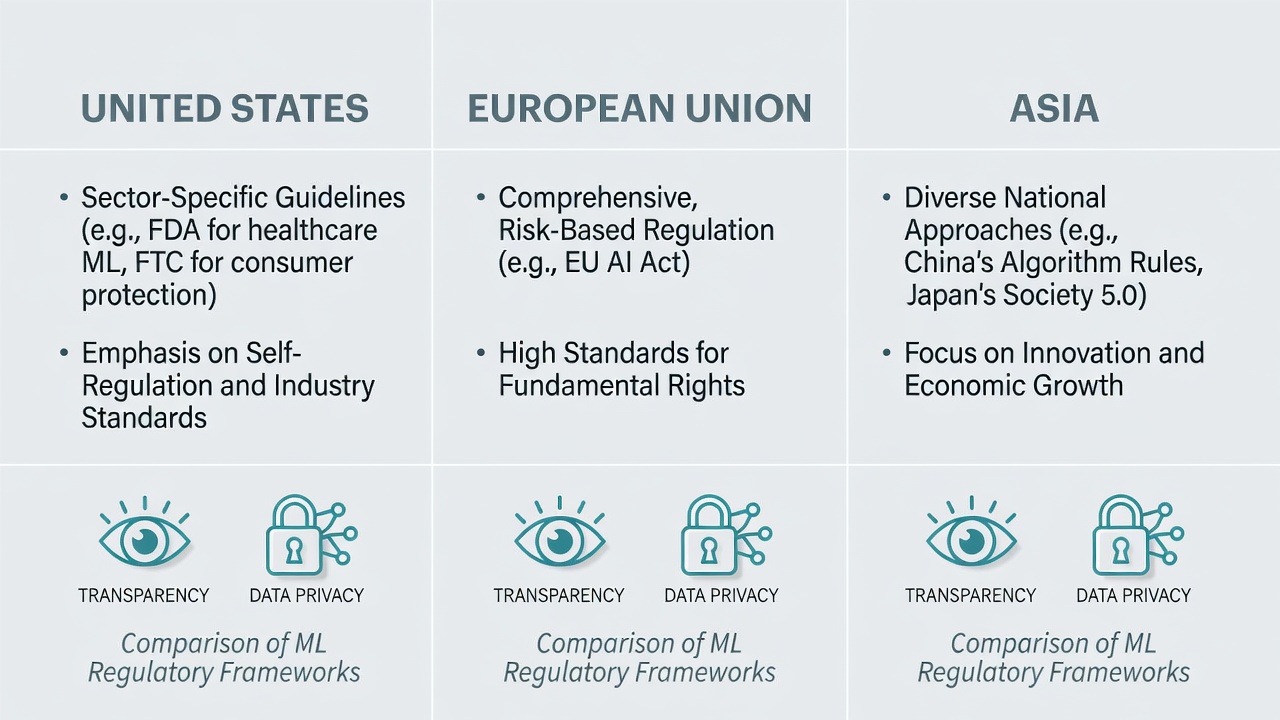
The United States continues to favor sector-specific guidance from agencies such as the FTC and NIST, emphasizing voluntary frameworks updated in response to public incidents. The EU maintains a risk-based, horizontal approach through the AI Act, where news coverage often accelerates classification of new high-risk use cases. Asian jurisdictions, particularly Singapore and South Korea, blend prescriptive technical standards with rapid iteration, frequently releasing guidance within 30 days of major model releases.
ML teams operating globally must maintain jurisdiction-specific risk registers because a single model version may trigger different obligations depending on deployment location. The NIST resources provide detailed voluntary frameworks, while the European Commission publishes official AI Act guidance. Additional context is available through the OECD AI policy observatory for cross-border comparisons.
Tools and Technologies for Compliance Monitoring
Beyond basic RSS readers, many teams now deploy custom dashboards that aggregate news from regulatory trackers and technical forums. Integration with internal ticketing systems allows automatic creation of compliance tasks when certain keyword thresholds are met. Open-source libraries for natural language processing can help filter high-relevance articles, reducing manual review time by up to 60 percent in large organizations.
Common Pitfalls in Adapting to News-Driven Regulations
One frequent mistake is overreacting to preliminary reports without verifying the actual regulatory text. Another is neglecting to update legacy models that were trained under previous standards. Teams should also avoid siloed decision-making; legal, engineering, and communications departments must coordinate to ensure consistent messaging and technical implementations.
FAQ: Common Compliance Questions
How quickly should teams respond to regulatory signals from AI news?
Best practice is to complete an initial impact assessment within 72 hours of a headline that mentions enforcement mechanisms.
Do news-driven rules apply retroactively to existing models?
Most frameworks include grandfathering clauses, yet material changes to deployed systems often require re-certification.
Which news sources carry the highest regulatory weight?
Official government channels and peer-reviewed technical reports tend to precede formal proposals more reliably than general media.
What internal documentation is typically required during audits?
Expect requests for dataset provenance logs, model card updates, and records of bias testing performed at each development stage.
Conclusion
AI news has become an integral input into the global ML regulatory machine. Teams that build structured monitoring and rapid-response processes will maintain compliance velocity while competitors react late. The strategies outlined above provide a repeatable system for converting information flow into regulatory advantage, ensuring long-term operational resilience in an environment where policy landscapes shift alongside technological breakthroughs.


No comments yet. Be the first!