 NeoBit Daily

Introduction: Turning 2026 AI News into Competitive ML Insights
In 2026, the volume of artificial intelligence news has grown exponentially, making it challenging for machine learning practitioners to separate signal from noise. Specialized AI tools now excel at mining this content to uncover emerging patterns, such as novel transformer architectures or ethical AI frameworks. This approach shifts practitioners from reactive updates to proactive trend detection, enabling faster model innovations and strategic decisions. The daily influx of preprints, conference updates, and industry announcements creates both opportunity and overwhelm, but targeted AI mining solutions turn raw information into structured foresight that directly influences research priorities and product roadmaps.
By leveraging natural language processing and predictive analytics, these tools process thousands of sources daily. The result is actionable intelligence that can inform everything from research priorities to deployment roadmaps. This article explores selection criteria, integration steps, real applications, and common challenges to help you build a robust news-mining system that delivers measurable advantages over traditional monitoring methods.
Why AI-Powered News Mining Matters for ML Practitioners in 2026
Manual curation of AI news often leads to missed opportunities because human readers cannot scale across global publications, preprints, and forums. AI tools apply consistent filtering and pattern recognition, highlighting trends like advances in multimodal learning or federated privacy techniques before they dominate mainstream discussions. Early identification of these signals allows teams to allocate resources more effectively and experiment with emerging methods ahead of competitors.
Key benefits include reduced time spent on information gathering and improved foresight. For instance, early detection of a new optimization method can accelerate your team's experimentation cycles by weeks. Practitioners report higher model performance when incorporating trends identified through systematic mining rather than ad-hoc reading. In fast-moving fields such as generative models and edge deployment, this proactive stance translates into tangible leadership in benchmarks and market positioning.
Selecting the Right AI News-Mining Tools
Choosing tools requires evaluating factors such as data source coverage, customization options, and integration capabilities. Look for platforms that support RSS feeds, academic repositories, and social signals while offering sentiment analysis and trend forecasting. Consider how well each option aligns with your team's technical stack and compliance requirements.
- Source Breadth: Ensure access to diverse outlets including research archives and industry reports from major institutions.
- Analytical Depth: Prioritize features like entity recognition for tracking specific algorithms or researchers.
- Scalability: Tools should handle high-volume inputs without performance degradation during peak news cycles.
- Security: Enterprise-grade options provide data privacy controls essential for proprietary workflows.
- Customization: Ability to train on internal historical data improves relevance for niche domains like computer vision or NLP.
Popular categories range from general NLP suites to niche AI monitors. Test multiple options through trial periods to match your specific use case and evaluate output quality against internal benchmarks.
Step-by-Step Integration Workflow
Implementing an AI news-mining system follows a structured process that minimizes disruption to existing operations. Begin by aligning the system with organizational goals so every alert serves a clear purpose.
- Define objectives: Specify target trends such as reinforcement learning breakthroughs or hardware acceleration methods, and document success metrics like reduced experiment duplication.
- Configure data ingestion: Connect feeds from reliable sources and set relevance thresholds, starting conservative and tightening over time.
- Train custom models: Fine-tune on historical data to improve detection accuracy for your domain, incorporating feedback loops from past trend validations.
- Establish alerting mechanisms: Set notifications for high-confidence trend signals, routing them to the appropriate team members based on expertise.
- Review and iterate: Conduct weekly audits to refine parameters based on output quality and emerging business needs.
- Integrate with existing pipelines: Connect outputs to internal dashboards or version control systems for seamless collaboration.
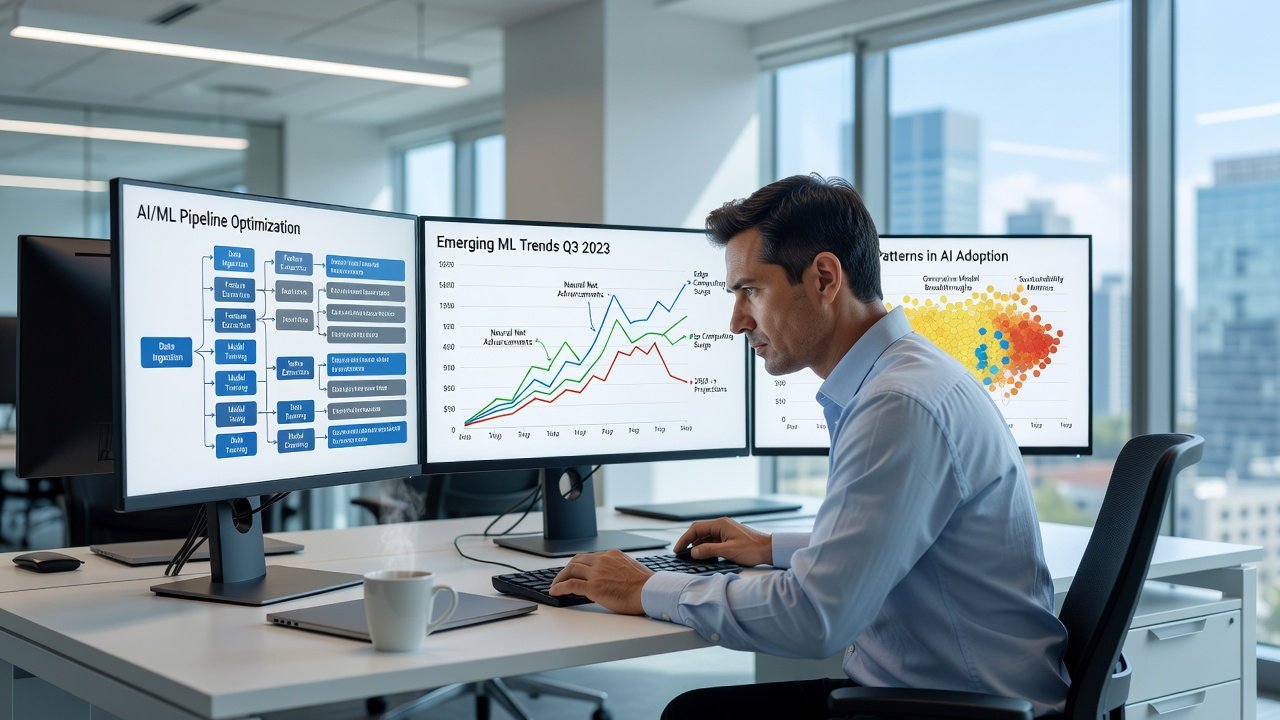
This workflow typically requires initial setup time but delivers compounding returns through consistent trend visibility. Document each phase to facilitate knowledge transfer as the team scales.
Real-World Examples of Trend-to-Model Applications
Consider a team that used news-mining tools to identify rising interest in sparse attention mechanisms. By cross-referencing signals from multiple 2026 publications, they quickly prototyped an updated model that reduced inference costs significantly. The same approach helped them anticipate regulatory discussions around model transparency, allowing preemptive compliance adjustments.
Another case involved detecting early discussions around quantum-inspired optimization. The insights guided partnerships with hardware providers and led to a competitive edge in a benchmark competition. A third example comes from a healthcare AI startup that spotted emerging federated learning patterns in news from academic and regulatory sources, enabling them to redesign their privacy architecture before industry standards shifted. These examples demonstrate how mined trends translate directly into model improvements and strategic positioning across varied sectors.
Comparing AI Mining Accuracy Versus Manual Curation
Studies and practitioner benchmarks show AI tools achieve higher recall rates for niche developments, often surfacing 30-40% more relevant items than manual reviews. Precision remains comparable when tools are properly calibrated, though human oversight still excels at contextual nuance. Automated systems excel at volume processing and consistent application of rules, while humans provide interpretive depth that machines may overlook.
Hybrid approaches combining both methods yield the best outcomes. AI handles volume while experts validate top signals. This balance reduces oversight risks and maintains high relevance. Teams that adopt hybrid models report faster iteration and fewer missed opportunities compared to purely manual or fully automated setups.
Potential Pitfalls and Mitigation Strategies
Data overload represents a primary challenge, where excessive alerts dilute focus. Mitigation involves strict filtering rules and periodic dashboard reviews to maintain signal quality. Bias in training data can skew trend detection toward popular narratives, so incorporate diverse sources and regular audits using multiple validation sets.
Another risk is over-reliance on automation, which may miss emerging qualitative shifts. Maintain a human-in-the-loop process for critical decisions. Additional pitfalls include integration friction with legacy systems and evolving data privacy regulations. Address these by piloting small, documenting lessons learned, and staying current with compliance standards from recognized bodies. Addressing these issues ensures sustainable, high-value outputs from your mining efforts.
Best Practices for Long-Term Success
Establish clear governance around data sources and update frequency to keep the system aligned with evolving research landscapes. Schedule quarterly reviews of tool performance against key performance indicators such as trend-to-implementation conversion rate. Encourage cross-team collaboration by sharing mined insights through centralized repositories. Finally, combine mined trends with internal experimentation logs to create a feedback loop that continuously improves detection accuracy.
Frequently Asked Questions
What are typical implementation timelines?
Most teams complete basic integration within two to four weeks, followed by ongoing refinement as new data sources and objectives emerge.
How does ROI manifest in practice?
ROI appears through faster research cycles, reduced redundant experiments, and earlier adoption of high-impact techniques, delivering qualitative competitive advantages over time.
Are there data privacy considerations?
Yes, select tools with strong compliance features and review data handling policies before full deployment to protect sensitive organizational information.
Can small teams benefit from these tools?
Absolutely. Many solutions offer tiered pricing and modular features that allow smaller groups to start with core mining capabilities and expand as needs grow.
How often should alerts be reviewed?
Daily triage of high-priority signals combined with weekly deeper analysis strikes the right balance between responsiveness and avoiding notification fatigue.
Conclusion: Building a Proactive ML Advantage
AI tools for mining machine learning trends from 2026 news empower practitioners to stay ahead of the curve. By following structured selection, workflows, and safeguards, you can convert daily information into lasting model and strategic gains. Start with clear objectives and iterate based on results to maximize impact while avoiding common implementation traps. The organizations that master this capability will lead the next wave of machine learning innovation.


No comments yet. Be the first!