 NeoBit Daily

Introduction to 2026 AI News and Unsupervised Learning Advances
The landscape of artificial intelligence continues to evolve rapidly, with 2026 AI news highlighting significant progress in unsupervised machine learning. These developments allow AI tools to analyze vast datasets without requiring labeled examples, unlocking new possibilities for industries where data annotation is costly or impractical. This comprehensive guide delves deep into the latest artificial intelligence breakthroughs, focusing on how modern AI tools enhance clustering, dimensionality reduction, and anomaly detection. Unsupervised learning stands apart from supervised methods by identifying hidden patterns autonomously. As of late 2026, innovations in this area are reshaping data-scarce sectors like healthcare diagnostics, financial fraud monitoring, and supply chain optimization. Practitioners now benefit from more efficient algorithms that process unstructured data streams in real time, reducing reliance on expensive human labeling efforts. The broader implications extend to ethical AI development, where unsupervised approaches minimize bias introduced by labeled training sets.
Understanding Core Techniques: Clustering, Dimensionality Reduction, and Anomaly Detection
Clustering groups similar data points without predefined categories, making it foundational for exploratory data analysis. In 2026, enhanced algorithms powered by AI tools achieve higher accuracy on complex, high-dimensional data through adaptive density estimation and graph-based methods. Dimensionality reduction simplifies datasets while preserving key information, often using techniques like autoencoders integrated with neural networks and variational inference. Anomaly detection identifies outliers that may indicate fraud or equipment failure, with recent AI news emphasizing hybrid models that combine these methods for real-time processing across edge devices. Together, these techniques form a powerful triad for handling the explosion of unlabeled data generated by IoT sensors, social platforms, and scientific instruments.
Emerging Breakthroughs in 2026 AI News
Key advancements include self-supervised pretraining frameworks that bootstrap unsupervised models more efficiently than ever before. Researchers have refined contrastive learning approaches, enabling better feature extraction from raw data streams across multiple modalities. These breakthroughs, covered extensively in recent AI news cycles, reduce computational overhead significantly compared to earlier generations. Integration with large language models has also accelerated progress, allowing unsupervised systems to handle multimodal data such as text, images, and sensor readings simultaneously. Additional innovations involve diffusion-based models adapted for clustering tasks and federated learning setups that preserve privacy while performing unsupervised analysis on distributed datasets. The result is a new generation of AI tools capable of continuous learning without constant human intervention.
Popular AI Tools Driving These Developments
Leading platforms such as TensorFlow and PyTorch now include specialized modules for unsupervised workflows, including advanced implementations of transformer-based autoencoders and graph neural networks. Additional tools from scikit-learn provide accessible implementations of cutting-edge clustering variants like HDBSCAN and spectral clustering. These AI tools offer built-in support for scalable training on cloud infrastructure, making advanced techniques available to practitioners without massive hardware investments. Emerging integrations with platforms like Hugging Face further lower barriers by offering pre-trained unsupervised checkpoints that can be fine-tuned quickly.
Real-World Applications in Data-Scarce Industries
In healthcare, unsupervised methods help discover disease subtypes from genomic data where labels are limited, enabling personalized treatment plans based on patient similarity clusters. Financial services leverage anomaly detection to flag suspicious transactions in real time, protecting against evolving fraud patterns without needing exhaustive labeled examples. Manufacturing benefits from dimensionality reduction to monitor equipment health via sensor streams, predicting failures before they occur. Retail and logistics sectors apply these techniques to customer segmentation and demand forecasting in environments with sparse historical labels. Case studies from 2026 demonstrate improved operational efficiency when deploying these AI-driven solutions, with organizations reporting faster time-to-insight and reduced annotation costs. For example, a logistics firm used unsupervised clustering on shipment data to optimize routes dynamically, achieving measurable gains in delivery performance.
Comparing New Versus Traditional Algorithms
Traditional k-means clustering has been surpassed by density-based and hierarchical variants enhanced with deep learning components. Newer approaches demonstrate superior performance on noisy, high-volume data typical of 2026 enterprise environments, particularly when dealing with non-convex cluster shapes. Comparisons reveal that while legacy methods remain useful for quick prototyping and baseline establishment, modern AI tools deliver more robust results with fewer hyperparameters to tune and better handling of high-dimensional spaces. Traditional algorithms often struggle with scalability on massive datasets, whereas 2026 innovations incorporate incremental learning to adapt continuously. Practitioners should evaluate both categories based on data characteristics, computational resources, and desired interpretability levels before selecting an approach.
Step-by-Step Implementation Examples
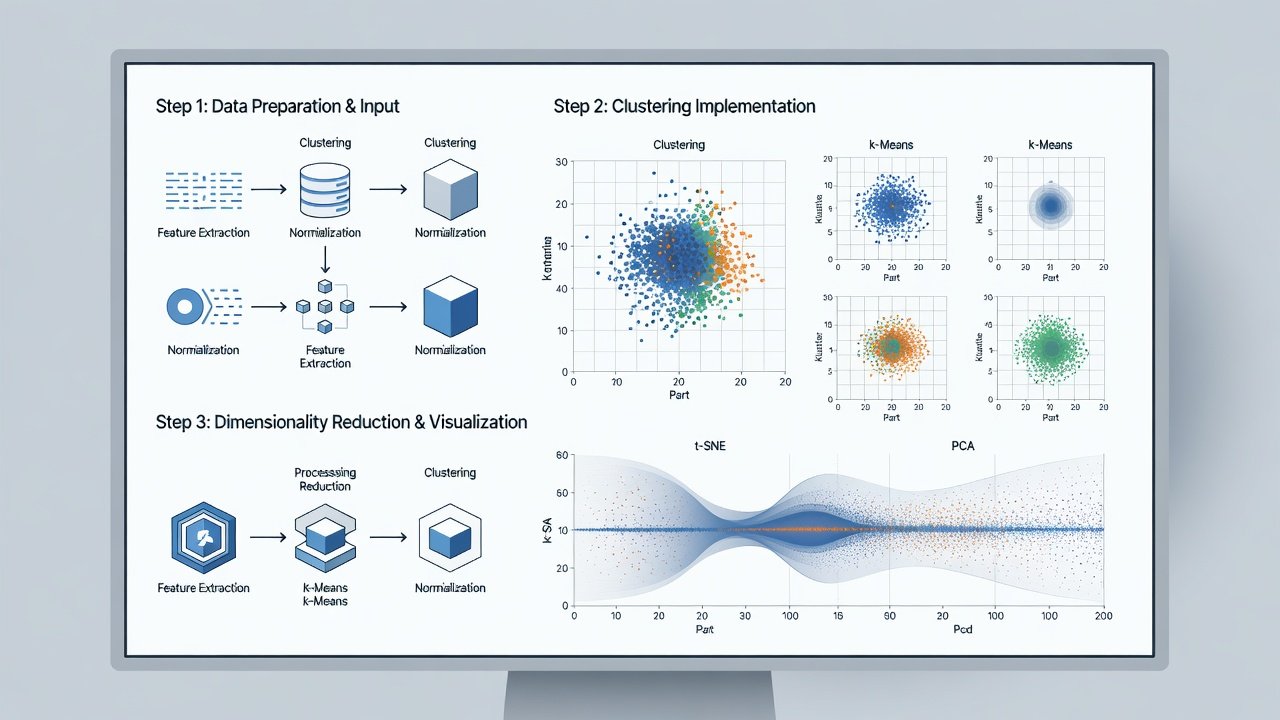
Follow these practical steps using popular platforms for a complete unsupervised pipeline:
- Prepare your dataset by normalizing features, handling missing values through imputation, and removing duplicates to ensure clean input for subsequent stages.
- Select an appropriate AI tool, such as PyTorch for custom autoencoder models or TensorFlow for distributed training on large clusters.
- Implement clustering with libraries like TensorFlow's clustering APIs or scikit-learn's updated ensemble methods, experimenting with different distance metrics.
- Evaluate results using internal validation metrics like silhouette scores, Davies-Bouldin index, and visual inspection via dimensionality-reduced plots.
- Iterate by adjusting model architecture, incorporating regularization techniques, and retraining on subsets of data while monitoring for stability across runs.
- Deploy the model into production with monitoring for data drift, using tools that support online learning to maintain performance over time.
These detailed examples provide a foundation for building production-ready unsupervised pipelines tailored to specific industry needs.
Practical Tips for Practitioners
- Start with smaller datasets to validate model behavior before scaling to full production volumes, allowing quick identification of issues.
- Leverage visualization libraries such as t-SNE or UMAP projections to interpret clusters and anomalies effectively and communicate findings to stakeholders.
- Combine multiple techniques, such as pairing dimensionality reduction with clustering, for enhanced insights and more meaningful groupings.
- Monitor for concept drift in streaming data applications by setting up automated alerts and periodic retraining schedules.
- Document all preprocessing steps and hyperparameter choices thoroughly to ensure reproducibility and facilitate team collaboration.
- Consider hybrid human-AI review loops for high-stakes decisions to balance automation with expert oversight.
Potential Pitfalls and How to Avoid Them
Common challenges include overfitting to noise in unlabeled data and selecting inappropriate evaluation metrics that do not reflect real-world utility. Practitioners should cross-validate findings with domain experts and maintain comprehensive logging of experiments for auditability. Avoid over-reliance on default parameters; instead, perform systematic hyperparameter searches using available AI tool capabilities and grid or Bayesian optimization. Another frequent pitfall is ignoring scalability limits early in development, which can lead to costly refactoring later. Mitigate this by testing on representative data subsets and planning for distributed computing from the outset. Privacy concerns also arise when handling sensitive unlabeled data, so incorporate differential privacy techniques where applicable.
Frequently Asked Questions
How do I integrate unsupervised learning into existing workflows?
Begin by auditing your data pipeline for opportunities where labels are absent, then prototype with open-source AI tools before full deployment, ensuring compatibility with current infrastructure.
What are the main integration challenges?
Challenges often involve computational resources, interpretability of results, and alignment with business objectives. Address them through incremental scaling, explainable AI extensions, and close collaboration between data scientists and domain teams.
Can these techniques work with small datasets?
Yes, many 2026 breakthroughs focus on data-efficient methods that perform well even with limited samples by leveraging transfer learning from related domains.
How do I choose between different clustering algorithms?
Evaluate based on data distribution, desired cluster shape, and computational constraints, starting with simpler methods before advancing to more complex deep learning variants.
Conclusion
The 2026 AI news cycle underscores how unsupervised learning, empowered by sophisticated AI tools, is transforming machine learning practices across industries. By understanding breakthroughs, comparing approaches, and following detailed implementation guidance, professionals can harness these advances effectively. The continued evolution promises even greater accessibility and performance in the years ahead, making now an ideal time to experiment and integrate these capabilities into real-world solutions.
No comments yet. Be the first!