 NeoBit Daily
Introduction to Proactive Model Drift Detection
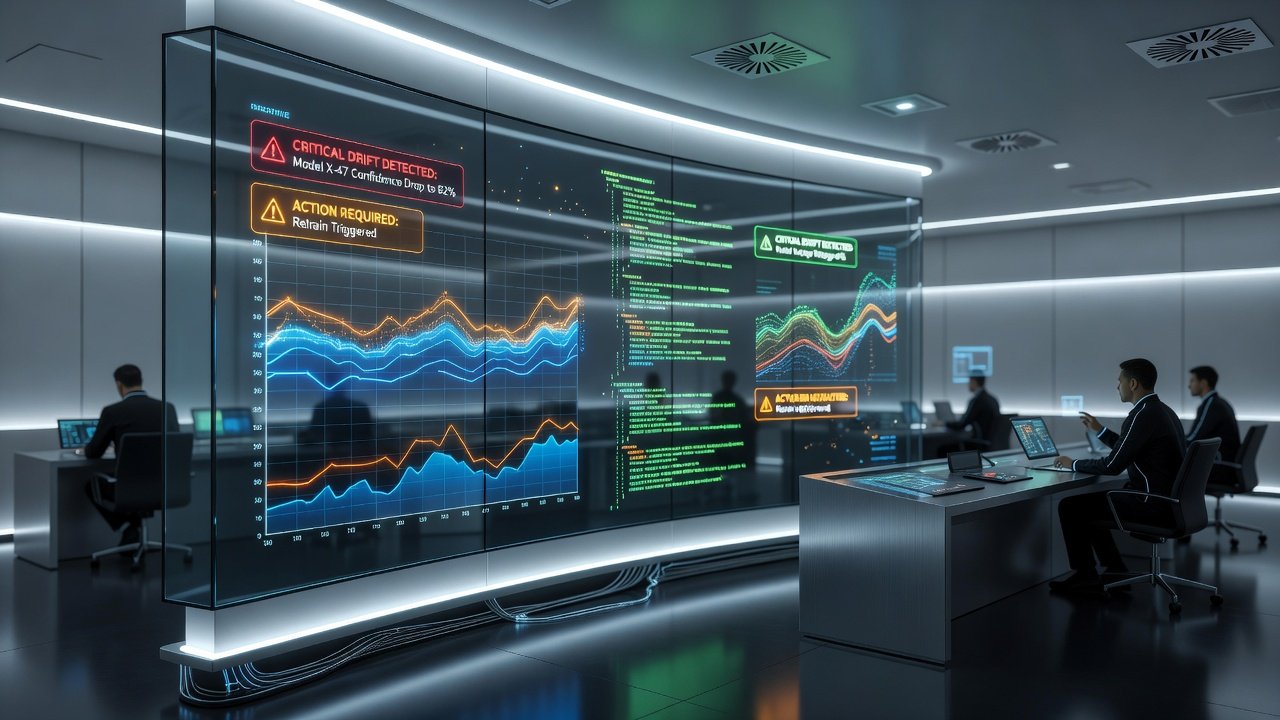
In 2026, machine learning systems face increasing challenges from evolving data landscapes. Proactive detection of model drift ensures models maintain accuracy without waiting for performance degradation. This article examines AI-driven approaches that leverage real-time monitoring and artificial intelligence techniques to identify and mitigate drift early. ML practitioners benefit from shifting from reactive fixes to continuous oversight. By integrating advanced AI tools, teams can sustain long-term reliability across production environments. The focus remains on practical maintenance strategies that adapt to changing inputs and relationships in data.
Traditional monitoring often reacts after accuracy drops, leading to costly downtime. Proactive methods use predictive analytics to forecast potential issues. This shift supports industries where model reliability directly impacts decisions, such as finance and healthcare. Real-time AI news integration helps teams stay informed about emerging data patterns affecting their systems.
Common Types of Model Drift
Model drift occurs when the statistical properties of input data or target relationships change over time. Key types include covariate drift, concept drift, and label drift. Covariate drift involves shifts in feature distributions while the relationship to the target remains stable. For example, a fraud detection model may encounter new transaction patterns due to seasonal shopping changes. Concept drift happens when the underlying data-generating process affects predictions, such as evolving customer behaviors in recommendation systems. Label drift refers to variations in the target variable distribution, common in classification tasks where class balances shift unexpectedly.
Understanding these distinctions allows targeted monitoring strategies using AI analytics. Practitioners should track multiple drift indicators simultaneously. In practice, combining statistical tests with machine learning detectors provides comprehensive coverage. Real-world deployments show that early identification of any drift type prevents cascading errors in downstream applications.
The Role of AI in Real-Time Drift Monitoring
Modern AI tools process streaming data to detect anomalies faster than traditional statistical methods. Techniques such as autoencoders and recurrent neural networks flag subtle shifts before they impact outputs. Integration with platforms like TensorFlow enables seamless embedding of these detectors into existing pipelines. Recurrent models excel at capturing temporal dependencies in time-series data, while autoencoders reconstruct normal patterns and highlight deviations.
Real-time AI news feeds and anomaly detection models further enhance responsiveness by incorporating external signals about data source changes. Ensemble methods that combine several detectors improve robustness across diverse datasets. AI monitoring also supports explainability features, allowing teams to understand why a particular drift signal triggered an alert. This level of insight accelerates root-cause analysis and informed decision-making.
Step-by-Step Implementation Workflow
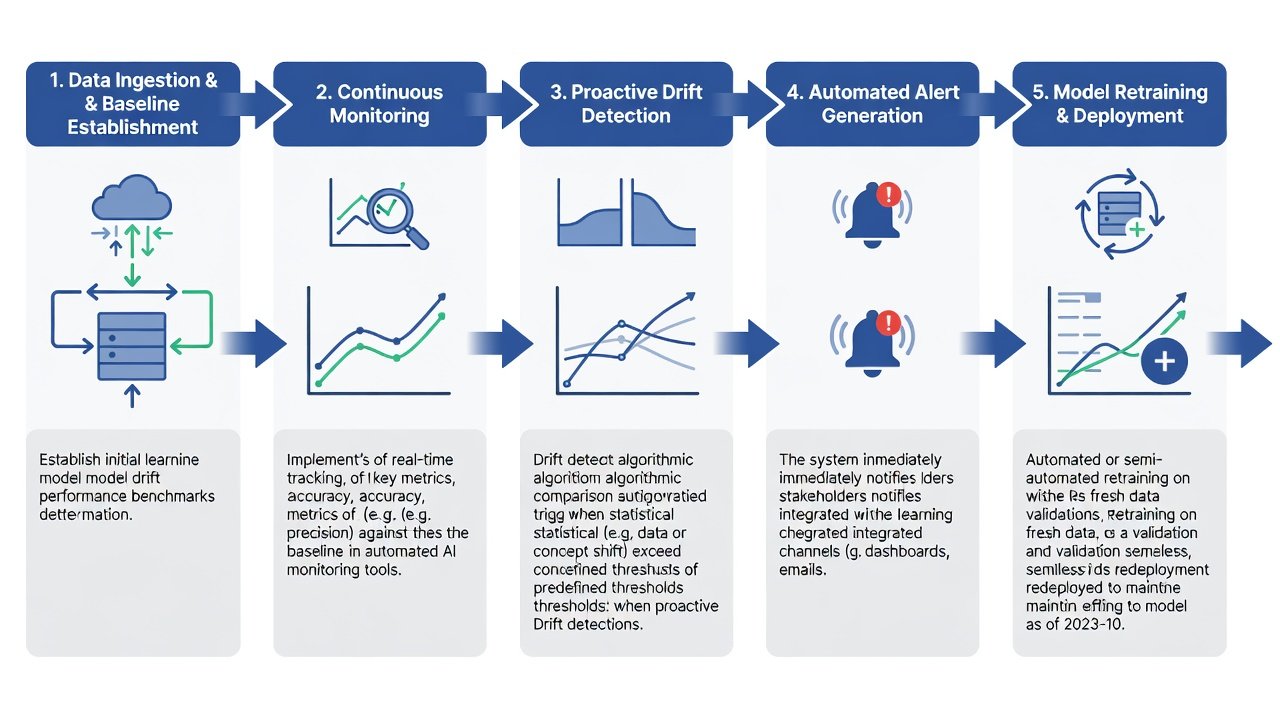
Follow this practical workflow to deploy proactive monitoring. First, establish baseline metrics using historical data to define normal operating ranges. Second, select and configure AI monitoring tools for continuous evaluation of incoming streams. Third, define drift thresholds based on domain-specific tolerances, adjusting them through iterative testing. Fourth, implement automated alerts and retraining triggers that activate only when thresholds are crossed. Fifth, validate mitigations through A/B testing in staging environments before full rollout. Sixth, document outcomes and refine models iteratively based on observed performance.
Each step benefits from clear documentation and cross-team collaboration. Automation reduces manual overhead, while periodic human review ensures thresholds remain relevant. Teams often start with pilot projects on non-critical models to refine the process. This structured approach minimizes downtime and supports scalable maintenance across multiple models simultaneously.
Leading AI Tools and Solution Comparisons
Several platforms stand out for 2026 deployments. Tools built on MLflow offer open-source flexibility for drift tracking, while enterprise solutions provide advanced visualization and scalability. Key comparison factors include latency, integration ease, and support for multi-model environments. AI-enhanced options outperform basic statistical checks in complex scenarios involving high-dimensional data. Open-source frameworks allow customization but require more engineering effort. Commercial platforms deliver pre-built connectors and dashboards at the cost of flexibility.
Practitioners evaluate tools based on their existing tech stack and team expertise. Hybrid approaches often combine open-source cores with commercial monitoring layers for optimal results. Feature sets such as automated retraining pipelines and drift visualization dashboards differentiate leading solutions in competitive evaluations.
Real-World Industry Examples
Financial institutions use proactive drift detection to maintain credit scoring accuracy amid economic shifts. One major bank implemented continuous monitoring that reduced false positives in loan approvals by adapting to new market conditions within hours. Retail platforms apply similar techniques to recommendation engines, reducing customer churn by catching seasonal data changes early. A global e-commerce company reported sustained conversion rates after deploying AI drift detectors across its product catalog models.
Healthcare providers monitor diagnostic models to adapt to new patient demographics without accuracy loss. In one deployment, an AI system flagged distribution changes in imaging data caused by updated scanner hardware, enabling timely recalibration. Manufacturing firms use drift detection on predictive maintenance models to anticipate equipment failures despite varying operational loads. These examples illustrate how proactive strategies deliver measurable operational improvements across sectors.
Performance Benchmarks and Best Practices
Benchmarks from recent deployments show AI tools reducing detection time by up to 70% compared to manual reviews. Best practices emphasize combining multiple detection methods and regular audits. Teams should monitor not only model outputs but also upstream data quality metrics. Avoid common pitfalls such as over-reliance on single metrics or neglecting data quality upstream. Regular retraining schedules informed by drift signals maintain accuracy longer than fixed-interval approaches.
Documentation of every detection event supports compliance and continuous improvement. Cross-validation across environments ensures findings generalize beyond development datasets. Investing in training for ML teams on these tools accelerates adoption and maximizes return on monitoring investments.
Mistakes to Avoid in Drift Detection
Many teams overlook the importance of setting adaptive thresholds that evolve with data. Ignoring feature importance shifts can mask underlying concept changes. Another frequent error is failing to test mitigation strategies thoroughly before production deployment. Over-alerting from poorly calibrated systems leads to alert fatigue and ignored signals. Practitioners should also ensure monitoring covers edge cases and rare events that may indicate emerging drift patterns.
Frequently Asked Questions
What are the first signs of model drift?
Declining prediction confidence scores and increasing error rates on validation sets often indicate early drift. Monitoring feature distributions provides additional early warnings before output quality suffers.
How often should monitoring occur?
Continuous real-time monitoring is ideal, with daily summaries for most production systems. High-stakes applications may require sub-minute granularity depending on data velocity.
Can small teams implement these tools effectively?
Yes, open-source frameworks lower barriers, allowing gradual adoption without extensive resources. Starting with core metrics and expanding coverage over time proves effective for resource-constrained teams.
What role does external data play in drift detection?
External signals from industry reports or real-time AI news can contextualize internal drift observations and guide proactive adjustments.
Conclusion
Proactive ML model drift detection powered by AI tools is essential for reliable systems in 2026. By following the workflows and leveraging leading solutions outlined above, practitioners can maintain model performance amid changing data conditions. Continuous refinement of monitoring strategies ensures sustained accuracy and operational efficiency over the long term.

No comments yet. Be the first!