 NeoBit Daily

Introduction to Resilient ML Systems in 2026
Machine learning systems face increasing challenges from data drift, adversarial attacks, and infrastructure failures. In 2026, ML engineers must leverage AI tools to build systems that recover quickly and maintain performance under pressure. This guide provides in-depth strategies tailored for tech leads and practitioners integrating resilience into existing pipelines amid rapid advancements in AI technology. Resilience goes beyond basic error handling. It involves proactive vulnerability assessment, continuous monitoring powered by AI, strategic redundancy, and seamless integration with production environments. Enterprise teams adopting these tactics report fewer downtime incidents and improved model accuracy over time. The pace of AI news developments means that models trained even a few months ago can quickly become outdated, making proactive resilience essential for maintaining competitive advantage. Organizations that invest in these practices see measurable gains in system uptime and reduced operational costs associated with model retraining and incident response.
Key subtopics include detailed vulnerability assessment techniques, automated monitoring setups using cutting-edge AI, redundancy techniques that prevent single points of failure, and practical integration methods with legacy pipelines. Throughout this guide, we include step-by-step implementation examples drawn from real-world scenarios, tool comparisons to help with decision making, and case studies from enterprise settings that highlight both successes and pitfalls. By the end, readers will have a clear roadmap for deployment along with a comprehensive checklist.
Assessing Vulnerabilities in ML Pipelines
Start by mapping potential failure points across data ingestion, model training, inference, and deployment stages. AI-driven tools can automate scans for data shifts using statistical tests like Kolmogorov-Smirnov or population stability index. Common threats include concept drift, where underlying data patterns change unexpectedly, and security vulnerabilities such as model inversion attacks or poisoning attempts during training. To perform a thorough assessment, begin with a full inventory of data sources and dependencies. Use automated scanning tools that leverage machine learning itself to detect anomalous patterns in feature distributions. For instance, run periodic evaluations comparing current production data against the original training set to quantify drift severity. Practical steps include conducting regular audits with frameworks like the NIST AI Risk Management Framework. Identify high-risk components by simulating failures in a staging environment. For example, inject noise into training datasets to evaluate model robustness before scaling to production. Another effective tactic involves adversarial testing where synthetic attack vectors are applied to uncover hidden weaknesses. Document findings in a centralized risk register that tracks mitigation status and assigns ownership to specific team members. This structured approach prevents oversight and ensures accountability across the ML lifecycle.
Setting Up Automated Monitoring with AI Tools
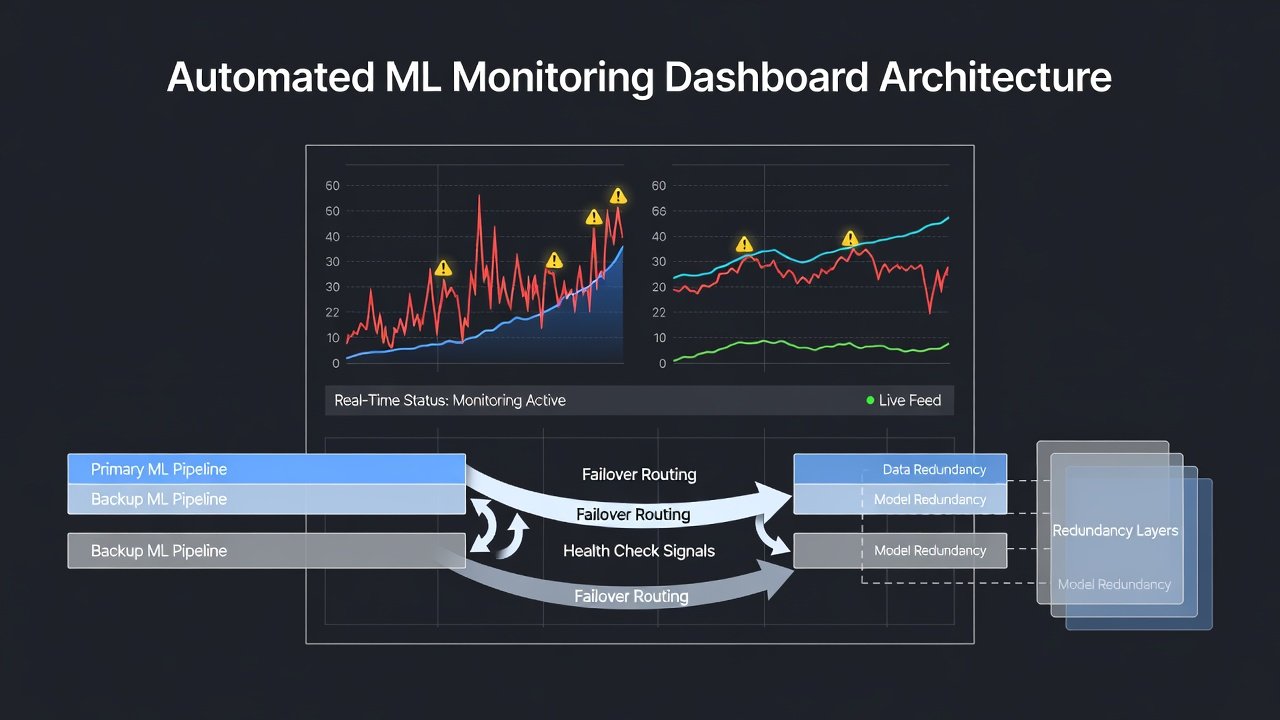
Automated monitoring forms the backbone of resilient systems. Deploy AI-based observability platforms that track metrics such as prediction latency, feature drift, and anomaly scores in real time. Tools like Prometheus combined with ML-specific extensions enable alerting when thresholds are breached. Implementation example: Configure a monitoring pipeline using open-source libraries. First, instrument your model with logging hooks that capture input features, predictions, and ground truth labels where available. Next, train a lightweight anomaly detection model on historical telemetry data to establish baselines. Finally, integrate alerts via webhooks to Slack or PagerDuty for immediate response. This setup catches issues like sudden data distribution changes within minutes rather than days. Expand the system by incorporating predictive elements that forecast potential failures before they occur, using time-series forecasting models on monitoring data. Regularly review and tune alert thresholds to reduce false positives while maintaining sensitivity to genuine issues.
Tool Comparison for Monitoring
- MLflow: Strong for experiment tracking and model registry with built-in drift detection plugins, making it suitable for teams already invested in the MLflow ecosystem.
- Evidently AI: Specializes in dashboard generation for data and concept drift reports, ideal for quick visual insights and stakeholder communication.
- WhyLabs: Offers scalable, privacy-preserving monitoring suited for large-scale enterprise deployments where data sensitivity is paramount.
- Arize AI: Provides advanced root cause analysis features that help engineers quickly pinpoint the source of performance degradation.
Implementing Redundancy Techniques
Redundancy ensures continuity during outages. Use ensemble methods where multiple models vote on predictions, or maintain shadow deployments that run in parallel to the primary system. AI tools can dynamically route traffic to the most reliable model based on live performance scores. Additional techniques include geographic distribution of inference endpoints and automated model versioning that allows instant rollback to previous stable versions. Case study from a financial services firm: They implemented redundant inference endpoints across three cloud regions. When one region experienced latency spikes due to network congestion, AI-orchestrated failover maintained 99.9% uptime. The approach involved containerizing models with Kubernetes and using AI-driven load balancers for intelligent switching. A second case study from a retail analytics company demonstrated how combining ensemble predictions with real-time monitoring reduced error rates during peak shopping seasons by 40 percent. These examples illustrate that redundancy is not merely backup capacity but an active, intelligent layer that adapts to conditions.
Integrating Resilience into Existing Pipelines
Integration requires minimal disruption to ongoing operations. Begin by wrapping core ML components with resilience layers such as circuit breakers and retry logic enhanced by predictive AI. Gradually migrate to CI/CD pipelines that include automated resilience tests at each stage. Step-by-step guide: 1) Audit current pipeline with dependency mapping tools to visualize data flows and potential bottlenecks. 2) Introduce feature stores with versioning for rollback capability and consistent feature engineering across environments. 3) Add chaos engineering experiments using libraries like Chaos Monkey adapted for ML workloads to test system behavior under stress. 4) Validate end-to-end with synthetic failure scenarios that mimic real production incidents. 5) Establish feedback loops where monitoring insights automatically trigger retraining jobs. Document all changes for compliance and team knowledge sharing. Successful integration often involves phased rollouts starting with non-critical models before applying changes to revenue-impacting systems.
Enterprise Case Studies and Lessons Learned
Healthcare organizations have used AI tools to create resilient diagnostic systems that adapt to evolving patient data patterns. One provider reduced false positive rates by 25% after deploying continuous retraining triggered by monitoring alerts. Tech companies similarly apply these methods to recommendation engines, ensuring stability amid fluctuating user behaviors. Lessons learned emphasize the importance of starting small with pilot projects on non-critical models before expanding. Cross-functional collaboration between data scientists and DevOps teams accelerates adoption and uncovers hidden risks early. Another key insight is the value of investing in training for all team members on resilience best practices to foster a culture of proactive maintenance.
FAQ
How often should vulnerability assessments occur?
Conduct quarterly assessments or after any major data source update to stay ahead of emerging threats and maintain system integrity.
What are the main costs involved?
Focus on tool licensing and compute resources, which vary by scale; prioritize open-source options initially for cost efficiency while scaling as needed.
Can these techniques apply to small teams?
Yes, begin with lightweight monitoring scripts and scale redundancy as infrastructure and team capacity grow over time.
How do I measure the success of resilience efforts?
Track metrics such as mean time to recovery, model accuracy stability, and incident frequency before and after implementation.
Deployment Checklist
- Map all pipeline components and failure modes with clear ownership assignments.
- Implement baseline monitoring with drift detection and anomaly scoring.
- Test redundancy mechanisms under simulated load and failure conditions.
- Document integration points, rollback procedures, and escalation paths.
- Schedule regular reviews and updates to the resilience plan based on new threats.
- Conduct team training sessions and run tabletop exercises for incident response.
By following this comprehensive approach, ML teams can build systems that thrive amid 2026's rapid AI advancements. For further reading, explore resources from NIST, TensorFlow, and MLflow.


No comments yet. Be the first!