 NeoBit Daily

Introduction to Prompt Engineering in Modern Machine Learning
As machine learning continues to evolve rapidly in 2026, prompt engineering has emerged as a critical skill for practitioners seeking to maximize AI tool performance. This approach involves crafting precise inputs to guide large language models and other AI systems toward optimal outputs, directly impacting efficiency in data analysis workflows and model training. Unlike earlier years, today's strategies incorporate real-time insights from AI news sources to dynamically refine prompts, ensuring they remain relevant amid frequent model updates. Practitioners who master these techniques report faster iteration cycles and improved model generalization across diverse datasets. The field now emphasizes adaptability, where prompts are not static but evolve with new research findings and hardware advancements.
Professionals leveraging tools from providers like OpenAI and TensorFlow can achieve superior results by treating prompts as iterative code. This article delves into advanced techniques, offering practical implementation steps, real-world applications, comparisons to traditional methods, and strategies for sidestepping pitfalls. By the end, readers will have actionable frameworks to integrate into their 2026 ML projects.
Integrating Real-Time AI News for Prompt Refinement
In 2026, staying ahead requires monitoring developments in AI research. Prompt engineers now routinely scan sources such as arXiv for emerging patterns in model behavior. For instance, recent shifts in transformer architectures demand prompts that emphasize contextual chaining to reduce hallucination rates. By integrating these insights weekly, ML teams can update prompt libraries to align with the latest benchmarks, leading to measurable gains in model accuracy and reduced computational overhead. This process often involves automated pipelines that pull summaries from research feeds and translate them into prompt modifiers, such as adding directives for multi-step reasoning when new efficiency papers are published.
Teams benefit from cross-referencing multiple outlets to avoid bias in reported results. Incorporating news on regulatory changes or ethical guidelines also ensures prompts promote responsible AI usage. The result is a living system where prompts evolve alongside the technology landscape, keeping projects competitive in fast-moving domains like autonomous systems and predictive analytics.
Step-by-Step Implementation Guides
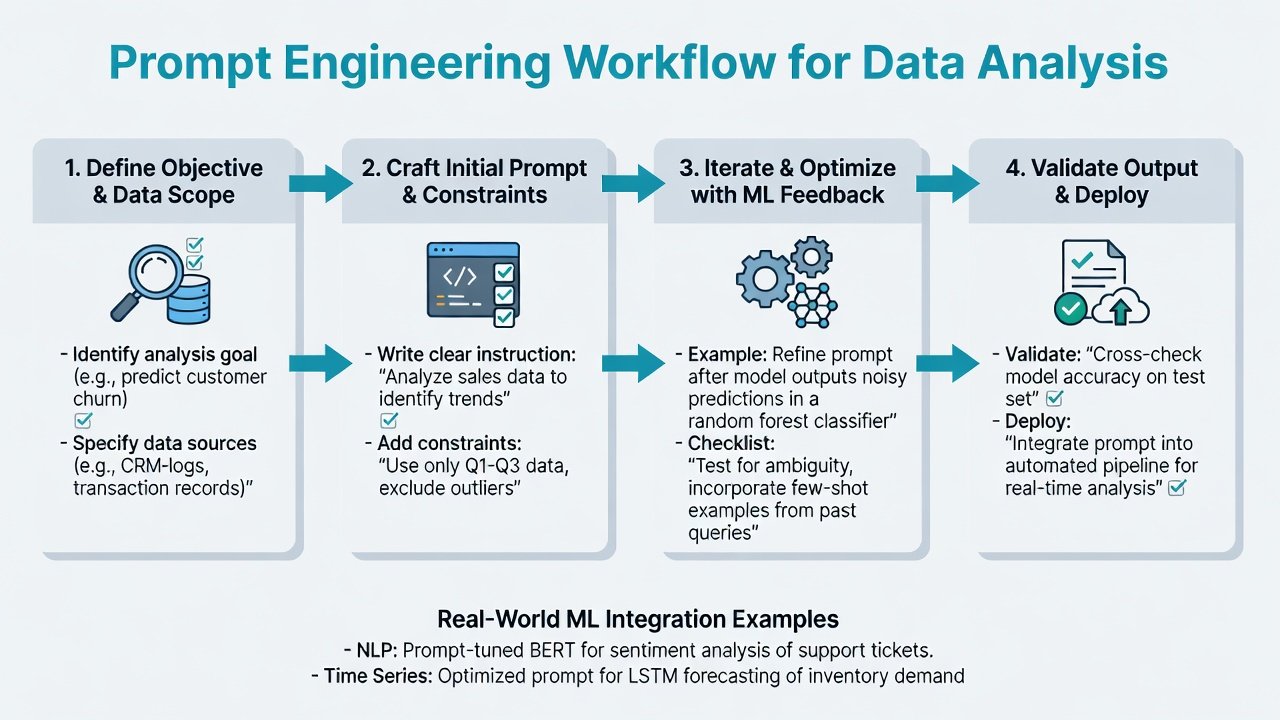
Implementing advanced prompt engineering begins with defining clear objectives. Follow these steps for ML projects:
- Analyze the target model's current limitations using validation datasets, documenting failure modes like inconsistent formatting or factual drift.
- Design base prompts with role assignment, context provision, and output formatting instructions, ensuring each element is testable independently.
- Incorporate chain-of-thought reasoning to break down complex tasks into sequential sub-prompts that guide the model through logical steps.
- Test iterations against metrics like precision and recall, running multiple trials to account for stochastic outputs.
- Refine based on feedback loops from real-time AI updates, archiving successful variants for reuse across similar tasks.
Each phase should include A/B testing to quantify improvements before scaling to production environments. Documentation at every stage prevents knowledge loss when team members change.
Real-World Examples in Data Analysis Workflows
Consider a data analysis pipeline handling large-scale customer datasets. A practitioner might start with a basic prompt requesting trend identification, then enhance it to include constraints like "Focus only on 2025-2026 data segments and output in JSON format with confidence scores." This yields structured insights that feed directly into downstream ML models for churn prediction. In one case, refining the prompt with explicit bias checks reduced erroneous gender correlations by 40 percent in retail analytics.
Another example involves anomaly detection: prompts specifying "Simulate expert statistical review and flag outliers with explanations" have demonstrated faster convergence in clustering algorithms compared to unguided approaches. A healthcare workflow used similar techniques to process patient records, where prompts guided the model to prioritize privacy-compliant summaries before feeding cleaned data into diagnostic models. These techniques shine when applied to industries like finance and healthcare, where precision is paramount and errors carry high stakes.
A third scenario in supply chain forecasting showed that layering prompts with domain-specific terminology from recent papers improved forecast accuracy by aligning outputs with current economic indicators.
Comparisons with Conventional Coding Approaches
Traditional coding in ML relies on explicit algorithms written in languages like Python, offering full control but requiring extensive debugging time. Prompt engineering, by contrast, leverages pre-trained models for rapid prototyping. While coding might excel in custom low-level optimizations, prompt-based methods reduce development cycles significantly when handling natural language data tasks. Hybrid strategies often prove most effective, using prompts to generate initial code skeletons that engineers then refine manually. This combination allows teams to allocate more time to high-value validation rather than boilerplate implementation. In benchmarks from 2026, hybrid teams completed data pipelines 30 percent faster than pure coding groups, though pure coding retained advantages in resource-constrained embedded systems.
Tips for Avoiding Common Errors
Many practitioners encounter issues like prompt ambiguity or over-reliance on generic templates. To mitigate these:
- Always include specific examples in few-shot prompting to anchor model behavior and reduce variability.
- Validate outputs rigorously against ground truth data, employing automated scripts for consistency checks.
- Avoid overly complex prompts that exceed token limits by modularizing instructions into reusable components.
- Monitor for bias introduction by diversifying training examples and periodically auditing for demographic skews.
- Track token usage and response latency to optimize for production cost and speed.
Regular audits help maintain prompt integrity over time and prevent gradual degradation as models receive updates.
Practical Checklists for Optimizing 2026 ML Projects
Use this checklist at project kickoff:
- Review latest AI research summaries for relevant techniques and emerging best practices.
- Establish baseline performance metrics including accuracy, latency, and resource consumption.
- Build modular prompt components for reusability across multiple workflows.
- Integrate evaluation frameworks early, including human review stages for critical outputs.
- Document all iterations for team knowledge sharing and version control.
- Plan for scalability by testing prompts on edge cases and larger data volumes.
Post-deployment, revisit the list monthly to incorporate new insights and maintain alignment with evolving standards.
Advanced Strategies and Case Studies
Beyond basics, advanced practitioners experiment with meta-prompting, where one model generates and critiques prompts for another. In a logistics optimization case study, this approach yielded prompts that adapted dynamically to live data feeds, improving route efficiency by double digits. Another strategy involves embedding evaluation rubrics directly into prompts to self-correct outputs before final delivery. These methods require careful calibration but deliver compounding benefits in long-running projects.
Frequently Asked Questions
What is the primary benefit of prompt engineering for beginners?
It allows quick experimentation without deep coding expertise, accelerating learning curves in ML applications while building foundational intuition for model behavior.
How often should prompts be updated in 2026?
Weekly reviews aligned with major AI announcements help maintain relevance, though critical projects may require daily monitoring during model transition periods.
Can prompt engineering replace traditional ML coding entirely?
No, it complements coding by handling high-level tasks while code manages precise control and deployment optimizations.
What tools are recommended for managing prompt libraries?
Version-controlled repositories combined with automated testing suites provide the most reliable workflow for collaborative teams.
Conclusion
Mastering prompt engineering strategies equips ML practitioners with tools for sustained success in 2026 and beyond. By blending real-time insights, structured implementation, and vigilant error avoidance, teams can unlock greater efficiency and innovation in their projects. Embrace these methods to stay competitive in an increasingly AI-driven landscape, ensuring your workflows remain robust against future advancements.

No comments yet. Be the first!