 NeoBit Daily
Introduction to Synthetic Data in Machine Learning
As machine learning models grow more sophisticated in 2026, the demand for vast, diverse, and high-quality training data continues to surge. Traditional data collection methods often fall short due to privacy concerns, high costs, and inherent biases present in real-world samples. This is where AI-powered synthetic data generation emerges as a transformative solution. Synthetic data, artificially created to mimic real-world patterns and distributions, enables ML teams to train robust models without relying solely on sensitive or limited real datasets. The search for practical implementation guides drives much of the interest in this topic. Teams seek actionable strategies to integrate these tools effectively while addressing challenges like data accuracy and privacy compliance. In this comprehensive guide, we examine emerging AI tools, core techniques such as GANs and diffusion models, step-by-step processes, real-world applications in finance and manufacturing, and comparisons of leading platforms with performance benchmarks drawn from recent 2026 trends.
Organizations across industries are shifting toward synthetic data because it offers controlled environments for testing edge cases that occur infrequently in reality. By generating data on demand, teams accelerate development cycles and reduce dependency on costly data acquisition campaigns. This article delivers in-depth coverage to help ML practitioners implement these solutions confidently.
Understanding Key Techniques: GANs and Diffusion Models
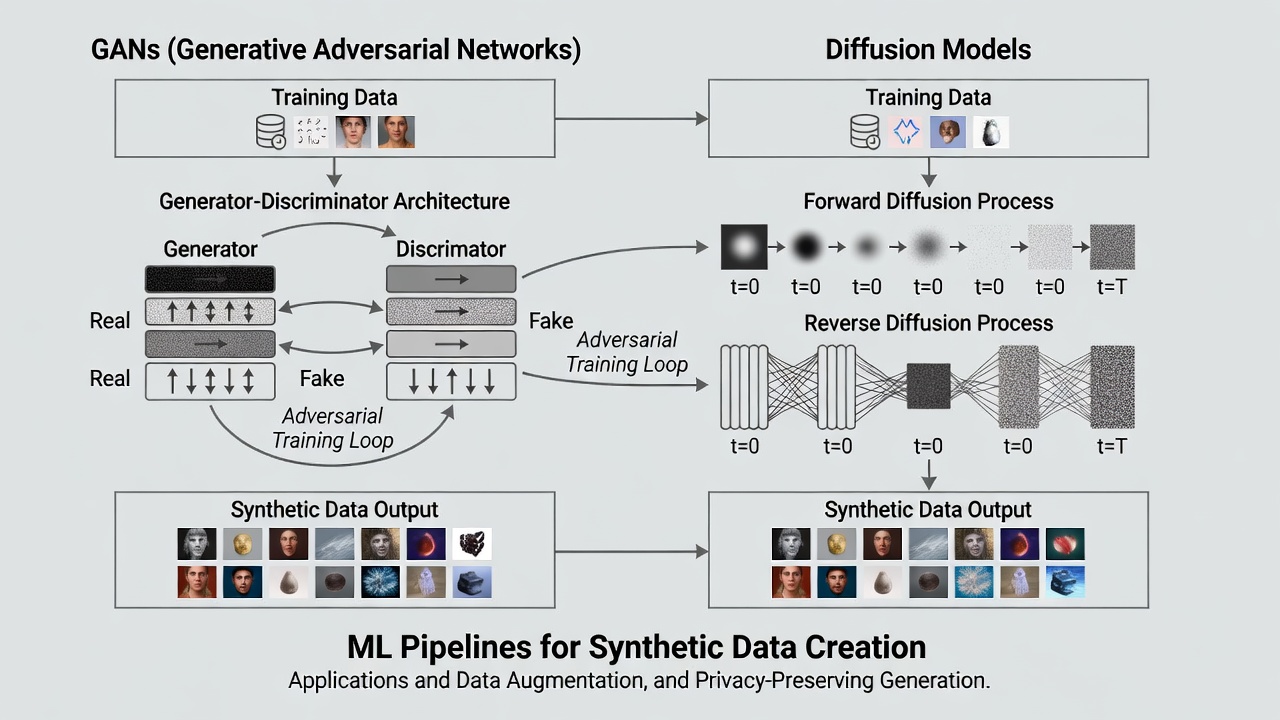
Generative Adversarial Networks (GANs) remain a cornerstone technique for synthetic data creation. In a GAN setup, two neural networks—the generator and the discriminator—compete in a minimax game to produce increasingly realistic data samples. The generator creates synthetic outputs designed to fool the discriminator, while the discriminator evaluates their authenticity against real data distributions. This adversarial training leads to high-quality results, particularly for image and tabular data modalities. Recent advancements in 2026 include conditional GANs that allow fine-grained control over generated attributes, such as specific demographic features to balance datasets.
Diffusion models have gained prominence for their ability to generate high-fidelity data through a gradual denoising process. Starting from random noise, these models iteratively refine outputs to match complex distributions found in real datasets. The forward diffusion adds noise step by step, while the reverse process learns to reconstruct clean data. Both techniques excel at reducing bias by allowing controlled augmentation of underrepresented classes during training. Practitioners often combine these methods, using GANs for rapid prototyping and diffusion models for final high-resolution outputs.
Practical integration begins with selecting a framework like PyTorch. Teams preprocess real data samples to normalize features, train the model on a representative subset while monitoring for mode collapse in GANs, and validate outputs using metrics such as Fréchet Inception Distance for image-based data or statistical similarity tests like Kolmogorov-Smirnov for tabular records. Hyperparameter tuning, including learning rates and noise schedules, plays a critical role in achieving optimal fidelity.
Benefits Over Real-World Data Collection
Synthetic data offers clear advantages in scalability and bias mitigation compared to traditional collection. Real-world gathering often involves lengthy ethical reviews, sampling limitations, and exposure to regulatory risks. In contrast, AI tools can generate millions of records on demand, tailored precisely to target distributions without additional human effort. Reduced bias occurs through deliberate oversampling of minority groups during generation, enabling fairer model outcomes across demographics. Scalability supports rapid iteration in model development cycles, allowing engineers to experiment with variations that would be impractical to source organically.
Privacy benefits arise because synthetic datasets contain no personally identifiable information, aligning seamlessly with regulations like GDPR and emerging AI governance frameworks. Additionally, synthetic data facilitates collaboration between organizations by removing barriers associated with sharing proprietary information. Cost savings become evident when factoring in reduced need for data labeling services and storage of massive raw datasets.
Leading AI Tools and Performance Benchmarks
Several established platforms lead the 2026 landscape for synthetic data generation. Tools built on open-source libraries such as those from PyTorch and Hugging Face provide flexible starting points for custom implementations. Enterprise solutions often layer additional features for compliance auditing, version control, and cloud deployment scalability.
Benchmarks typically compare generation speed, fidelity scores, and downstream ML performance improvements. For instance, diffusion-based tools frequently outperform GANs on complex image datasets, achieving higher precision in preserving statistical properties. Tabular data tools show strong results in maintaining correlation structures between variables. Teams should evaluate tools based on their specific data modality—tabular, image, time-series, or text—while considering integration ease with existing MLOps pipelines. Open-source options allow full customization, whereas commercial platforms prioritize ease of use and support for regulated industries.
Step-by-Step Integration Process
Successful adoption requires a structured approach. Follow these detailed steps for seamless integration:
- Assess data requirements by auditing current datasets for gaps, bias indicators, and volume needs. Document target distributions and privacy constraints.
- Choose a technique (GAN or diffusion) aligned with data type, testing initial prototypes on small subsets to compare output quality.
- Configure training parameters using libraries from TensorFlow or equivalent, setting appropriate batch sizes, epochs, and regularization terms to prevent overfitting.
- Generate initial synthetic batches and run quality checks including distributional tests, visual inspections, and correlation analysis against real data.
- Integrate outputs into ML pipelines by replacing or augmenting portions of real data, then retrain baseline models to measure uplift in accuracy and fairness metrics.
- Monitor performance continuously with feedback loops, refining generation parameters iteratively based on model validation results and stakeholder feedback.
Each phase benefits from version-controlled experiments and automated reporting to track improvements over successive iterations.
Real-World Examples from Finance and Manufacturing
In finance, synthetic transaction data helps detect fraud patterns without exposing customer records. Banks train anomaly detection models on generated datasets that simulate rare events such as sophisticated laundering schemes, improving detection accuracy while maintaining strict privacy standards. One major institution reported enhanced model robustness after incorporating synthetic samples representing seasonal spending variations.
Manufacturing applications include generating sensor data for predictive maintenance. AI tools create realistic failure scenarios, allowing models to learn from edge cases that rarely occur in actual production lines. This approach accelerates deployment of reliable systems and reduces unplanned downtime. Automotive manufacturers have used synthetic vibration and temperature readings to train models that predict equipment wear with greater precision than real-only datasets.
Challenges and How to Overcome Them
Despite advantages, synthetic data introduces challenges such as distribution shift, where generated data diverges subtly from real environments, leading to degraded model performance in production. Mitigation involves rigorous holdout testing and domain adaptation techniques. Another concern is ensuring long-term fidelity as data patterns evolve; regular retraining of generative models with fresh real samples addresses this. Computational overhead during generation can be high, but optimized frameworks and cloud scaling help manage resources efficiently.
Future Outlook for 2026 and Beyond
Looking ahead, hybrid approaches combining multiple generative techniques with reinforcement learning are expected to dominate. Increased focus on explainability in synthetic data pipelines will help teams audit generation processes. Regulatory bodies continue developing guidelines that favor transparent synthetic data usage, positioning early adopters for competitive advantage in responsible AI development.
Addressing Accuracy and Privacy Concerns: FAQ
How accurate is synthetic data compared to real data?
Modern tools achieve over 95% statistical similarity in controlled benchmarks, though validation against holdout real data remains essential for critical applications where even minor discrepancies matter.
Does synthetic data fully resolve privacy issues?
While it eliminates direct identifiers, differential privacy techniques should still be applied during generation to guard against potential inference attacks from sophisticated adversaries.
What are common mistakes when starting with these tools?
Overlooking distribution shifts between synthetic and real data often leads to poor model generalization. Always perform rigorous cross-validation and monitor production drift.
Can synthetic data replace real data entirely?
In many scenarios it augments rather than replaces real data; hybrid datasets often yield the best performance by combining the strengths of both sources.
Conclusion
AI tools for synthetic data generation represent a pivotal advancement for machine learning teams in 2026. By leveraging techniques like GANs and diffusion models, organizations achieve scalable, less biased datasets while navigating privacy constraints effectively. Following the outlined integration steps, learning from detailed industry examples, and proactively addressing challenges positions teams to implement these solutions successfully. Continued exploration of emerging benchmarks and hybrid methodologies will ensure ongoing optimization of ML workflows and sustained innovation.


No comments yet. Be the first!