 NeoBit Daily
Introduction: The AI-Driven Evolution of Game Development in 2026
Artificial intelligence and machine learning are reshaping video game creation, enabling faster workflows and more sophisticated mechanics than ever before. Developers in 2026 leverage these technologies to handle complex tasks like procedural content generation and intelligent NPC behaviors, reducing manual effort while boosting creativity and immersion. The integration of ML models allows teams to simulate realistic physics, generate adaptive storylines, and optimize resource allocation during production cycles. This shift not only shortens development timelines but also opens new possibilities for indie creators and AAA studios alike to deliver personalized player experiences at scale.
This article examines real-world applications, tool comparisons, practical integration steps, performance data, and ethical considerations to help developers integrate AI effectively into ML-powered game systems. By exploring concrete examples and decision frameworks, readers will gain actionable insights for implementing these breakthroughs in their own projects.
Real-World Case Studies of AI-Enhanced Procedural Generation
Procedural generation has long been a staple in games, but AI enhancements in 2026 allow for dynamic, context-aware worlds. Studios now use generative models to create vast environments that adapt to player choices in real time. For instance, a major open-world title employed reinforcement learning agents to analyze thousands of play sessions and automatically refine terrain features, resulting in unique ecosystems that evolve based on exploration patterns.
Another case features indie teams employing diffusion-based models to craft unique level layouts that maintain narrative consistency, demonstrating how AI scales creative output for smaller studios. One studio reported generating over 500 distinct dungeon variants in a single week, each tailored to different difficulty curves while preserving thematic coherence. A third example from a multiplayer survival game used generative adversarial networks to produce resource distributions that balanced player economies more effectively than manual design, leading to sustained engagement metrics across global servers.
These cases highlight how ML-driven procedural systems reduce repetitive design work and foster emergent gameplay that traditional scripting cannot easily replicate.
Comparing Leading AI Tools for NPC Behavior Modeling
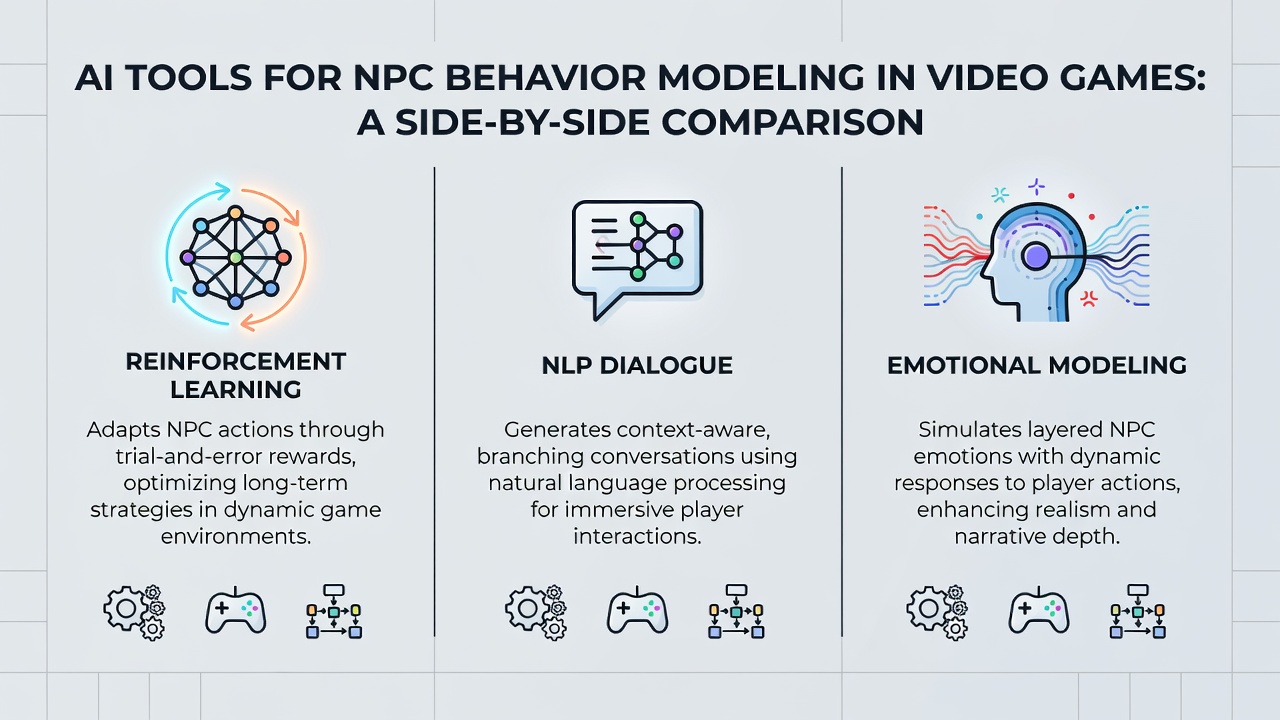
Selecting the right tool for NPC intelligence is critical. Here is a comparison of prominent options available in 2026:
- Tool A: Excels in reinforcement learning for adaptive behaviors, ideal for complex simulations. It supports multi-agent training and integrates seamlessly with popular engines for real-time decision trees.
- Tool B: Focuses on natural language processing to enable realistic dialogue trees that evolve with player interactions. Developers praise its ability to generate context-sensitive responses without extensive manual scripting.
- Tool C: Offers hybrid systems combining pathfinding with emotional modeling for believable crowd dynamics. This tool shines in large-scale environments where NPCs must react consistently to group events.
Developers should evaluate based on project scale, hardware constraints, and desired realism levels. Benchmarks from recent implementations show Tool A achieving 25% faster training cycles in large environments compared to predecessors. In contrast, Tool B reduces dialogue authoring time by approximately half when handling branching narratives. Tool C excels in memory efficiency during runtime, making it suitable for mobile titles where performance margins are tight.
NVIDIA provides foundational hardware and frameworks that power many of these tools, enabling accelerated inference on consumer hardware.
Step-by-Step Integration Guides for ML Game Mechanics
Integrating AI into existing pipelines requires careful planning. Follow these steps for successful adoption:
- Assess current workflows and identify bottlenecks suitable for ML automation, such as asset creation or enemy AI loops. Map out data sources like playtest logs that can feed training datasets.
- Prototype with lightweight models to test compatibility with your game engine. Start with pre-trained checkpoints and fine-tune on small subsets of your project data.
- Train models using domain-specific datasets derived from playtests. Incorporate player feedback loops to iteratively improve output quality and reduce hallucinations in generated content.
- Implement monitoring systems to track performance and iterate on outputs. Use visualization dashboards to spot anomalies in NPC decision paths early.
- Deploy iteratively, starting with non-critical features like background animations. Scale up to core mechanics only after validating stability across target platforms.
Always validate outputs against design intent to avoid unintended gameplay issues. Teams that follow this phased approach report smoother transitions and fewer rollback incidents during production.
Performance Benchmarks and Optimization Techniques
Recent evaluations indicate that optimized ML models can reduce asset creation time by up to 40% in 2026 projects. Key metrics include inference speed on consumer GPUs and memory footprint during runtime. For example, quantized models running on mid-range hardware achieve sub-10 millisecond response times for NPC pathfinding queries.
Techniques such as model quantization and edge computing help maintain smooth frame rates. Developers report improved efficiency when combining AI generation with traditional scripting for hybrid systems. Additional strategies include pruning redundant neural layers and leveraging transfer learning from similar game genres to accelerate convergence during training.
Unity offers documentation and plugins that facilitate these optimizations, while Unreal Engine provides complementary blueprint integrations for rapid prototyping.
Ethical Considerations in AI-Generated Content
While powerful, AI tools raise questions around originality, bias in training data, and player data privacy. Studios must establish guidelines to ensure generated content respects intellectual property and avoids perpetuating stereotypes. Bias can emerge when training datasets overrepresent certain cultural tropes, leading to unbalanced NPC personalities or world designs.
Transparency with players about AI usage builds trust, and regular audits of models help mitigate risks associated with automated decision-making in games. Developers are encouraged to implement human-in-the-loop review processes for all generated assets before shipping. This approach not only addresses ethical concerns but also improves overall quality and player satisfaction.
Common Mistakes to Avoid When Implementing AI Tools
Many teams encounter pitfalls during adoption. Over-reliance on default model parameters often leads to generic outputs that lack game-specific flavor. Another frequent error is neglecting to version control training data, which complicates debugging when behaviors drift over time. Finally, ignoring cross-platform performance differences can result in inconsistent experiences between PC and console versions.
FAQ: Addressing Common Implementation Challenges
How do I handle model training data scarcity?
Start with publicly available game datasets and augment them through synthetic generation techniques. Partnering with academic institutions can also yield high-quality annotated play logs.
What hardware is recommended for 2026 ML workflows?
High-end GPUs with at least 16GB VRAM are standard for efficient training and inference, though cloud instances offer flexible scaling for smaller teams.
Can small teams compete with large studios using these tools?
Yes, accessible cloud-based AI services level the playing field by providing scalable compute resources without heavy upfront investment.
How do I ensure generated content aligns with my game's lore?
Fine-tune models on custom lore documents and implement constraint layers that filter outputs against predefined narrative rules.
What are the main risks of using third-party AI APIs?
Data leakage and dependency on external uptime are primary concerns; always maintain fallback systems and review privacy policies carefully.
Conclusion
AI tools are fundamentally accelerating ML breakthroughs in video game development throughout 2026. By studying case examples, comparing options, following structured integration processes, and addressing ethics proactively, developers can harness these advancements to create more engaging and efficient experiences. Staying informed on emerging techniques ensures continued innovation in the field and positions teams for long-term success in an increasingly competitive market.


No comments yet. Be the first!