 NeoBit Daily

Introduction to AI Tools in Reinforcement Learning
Reinforcement learning (RL) continues to drive breakthroughs in machine learning, particularly as AI tools evolve rapidly in 2026. These tools help practitioners optimize policies, handle complex environments, and integrate RL into production systems more efficiently than ever before. This article examines the latest advancements, offering practical strategies for integration while addressing key challenges like reward shaping. As machine learning workflows grow more sophisticated, AI-enhanced RL enables agents to learn from sparse feedback in real time, powering applications from robotics to recommendation engines. Practitioners searching for integration strategies will find concrete comparisons, benchmark data, and step-by-step guidance to accelerate their projects.
Understanding Reinforcement Learning Fundamentals in 2026
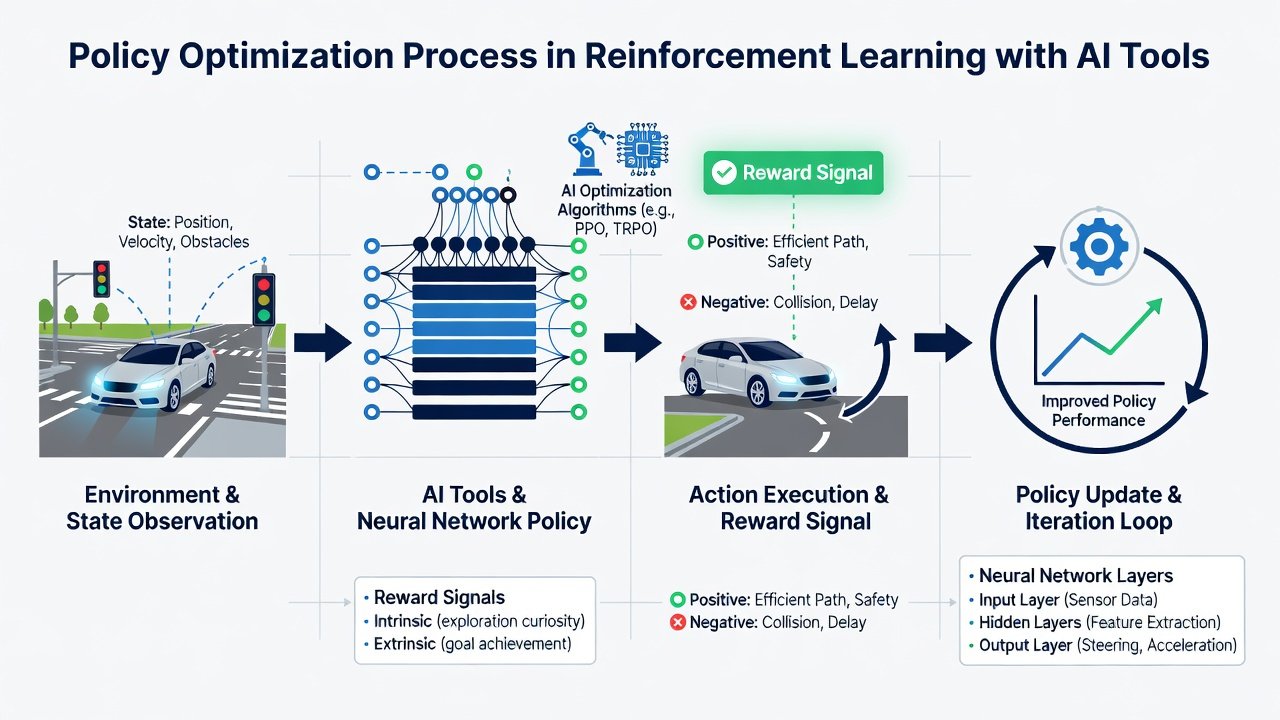
Reinforcement learning involves agents learning optimal actions through trial and error in dynamic environments. In 2026, AI enhancements focus on scalability and sample efficiency. Modern frameworks build on foundational concepts from deep RL, enabling faster convergence in high-dimensional state spaces. Key components include the Markov Decision Process, where states, actions, and rewards define the learning loop. Recent AI tools incorporate transformer architectures to model long-term dependencies, improving performance on partially observable tasks. This evolution allows RL systems to handle continuous action spaces more effectively, a critical requirement for real-time control systems.
Leading AI Tools for Policy Optimization
Several AI-powered platforms stand out for enhancing RL algorithms. Comparisons reveal strengths in areas like distributed training and integration with neural architectures. TensorFlow Agents offers robust support for scalable RL pipelines with built-in policy gradient methods, making it ideal for production environments requiring high throughput. PyTorch-based libraries excel in flexibility for custom reward functions and rapid prototyping, appealing to researchers who need to experiment with novel loss functions. Specialized platforms from major providers offer automated hyperparameter tuning tailored to RL tasks, reducing manual tuning time significantly. When comparing these tools, consider factors such as ease of distributed scaling, support for multi-agent scenarios, and compatibility with existing ML pipelines. For instance, teams working on large-scale simulations often prefer frameworks with native GPU acceleration and cloud integration features.
- Evaluate sample efficiency metrics from 2026 benchmarks before selecting a tool.
- Test policy optimization algorithms like PPO or SAC within each platform.
- Assess community support and documentation quality for long-term maintenance.
These tools reduce development time while improving performance on benchmarks from recent evaluations.
Real-World Examples from Autonomous Systems
Autonomous vehicles and robotics showcase RL's impact. For instance, AI tools enable adaptive path planning in self-driving cars by simulating millions of scenarios. TensorFlow resources highlight case studies in this domain. Similarly, drone navigation systems use enhanced RL for obstacle avoidance in unpredictable weather. In industrial settings, warehouse robots leverage these tools for dynamic task allocation, achieving higher throughput than traditional scripted approaches. Another compelling example comes from autonomous delivery systems that optimize routes in urban environments using real-time sensor data fused with RL policies. These applications demonstrate how AI tools bridge the gap between simulation and deployment, allowing safe transfer learning across different hardware platforms.
Step-by-Step Implementation Guide
Follow these steps to integrate AI tools into your RL workflow:
- Define the environment using standardized interfaces like OpenAI Gym equivalents updated for 2026, ensuring compatibility with vectorized simulations for faster training.
- Select a policy optimization algorithm such as PPO or SAC enhanced by AI accelerators, then configure exploration strategies to balance discovery and exploitation.
- Implement reward shaping techniques to mitigate sparse reward issues by incorporating potential-based shaping functions that preserve optimal policies.
- Train models on distributed clusters with monitoring for stability, using early stopping criteria derived from validation curves.
- Evaluate using 2026 benchmark suites and deploy with continuous learning loops that incorporate online feedback from production data.
Each step benefits from version control for environments and systematic logging of hyperparameters to reproduce results reliably.
Overcoming Common Challenges Like Reward Shaping
Reward shaping remains a critical hurdle, often leading to unintended agent behaviors. AI tools now include automated shaping modules that learn from demonstrations. Practitioners should validate shaped rewards against baseline performance to avoid policy exploitation. Additional challenges include the exploration-exploitation dilemma, where AI tools provide intrinsic motivation bonuses to encourage discovery of novel states. Scalability issues arise when moving from single-agent to multi-agent setups; modern platforms address this through hierarchical RL frameworks. Data from 2026 benchmarks shows improvements in convergence rates when using these methods, particularly in environments with delayed rewards.
2026 Benchmark Insights and Trends
Recent evaluations indicate significant gains in sample efficiency across RL tasks. AI tools contribute to these advances by leveraging larger models and better exploration strategies. Stay updated via authoritative sources such as PyTorch documentation and Hugging Face RL libraries. Trends show increasing adoption of offline RL methods that leverage large datasets without risky online interactions. Practitioners should monitor metrics like normalized score and wall-clock training time to compare progress across tools.
Practical Tips and Mistakes to Avoid
When adopting AI tools for RL, start with smaller environments to validate pipelines before scaling. Common mistakes include neglecting proper environment randomization, which leads to overfitting, and ignoring safety constraints during early training phases. Always incorporate regularization techniques and conduct ablation studies to isolate the impact of each AI enhancement. Documenting failure modes helps teams iterate faster on subsequent projects.
Conclusion
AI tools are transforming reinforcement learning by streamlining workflows and solving longstanding issues. By adopting the strategies outlined, ML practitioners can achieve more robust and scalable solutions in 2026 and beyond.
FAQ
How do AI tools improve RL scalability?
They enable distributed training and efficient resource allocation, handling larger state spaces effectively through parallel simulation and model parallelism.
What ethical considerations apply to RL in autonomous systems?
Key issues include bias in reward functions and safety in decision-making; always incorporate human oversight and testing protocols aligned with industry standards.
Which AI tool is best for beginners in RL?
Beginners often benefit from PyTorch ecosystems due to intuitive APIs and extensive tutorials, though TensorFlow Agents provides strong production-ready options as projects mature.


No comments yet. Be the first!