 NeoBit Daily

Introduction
The cybersecurity landscape in 2026 demands increasingly sophisticated defenses as threats evolve in complexity and scale. Machine learning (ML) has long been a cornerstone of these defenses, but the integration of advanced AI tools is now transforming how organizations detect, prevent, and respond to attacks. This article examines practical ML applications in cybersecurity, focusing on threat detection models, automated vulnerability scanning, and predictive risk analysis. It also compares AI-driven approaches with traditional ML methods using 2026 benchmarks, shares enterprise case studies, and provides integration guidance for ML teams. Search intent for this topic centers on actionable insights rather than theory, helping practitioners understand exactly how to implement these technologies to stay ahead of sophisticated adversaries.
By leveraging AI enhancements, security professionals can achieve higher accuracy and faster response times. Authoritative resources such as NIST highlight the importance of adaptive frameworks in this space. Organizations that fail to evolve their ML pipelines risk falling behind in an environment where attack surfaces expand daily through cloud adoption, IoT devices, and remote workforces.
The Evolution of ML in Cybersecurity
Traditional ML models relied heavily on supervised learning with labeled datasets to identify known attack patterns. In 2026, AI tools introduce unsupervised and reinforcement learning capabilities that adapt in real time to zero-day threats. This shift enables systems to learn from unlabeled data streams and continuously improve without manual retraining. Earlier generations of ML cybersecurity solutions often required extensive feature engineering by data scientists, creating bottlenecks during rapid threat evolution.
Key advancements include generative AI for synthetic data creation to train models on rare attack scenarios and large language models that parse security logs for anomalies. These tools reduce the dependency on static signatures and improve resilience against polymorphic malware. The result is a move from reactive detection to proactive defense postures that anticipate attacker behavior based on contextual signals across networks, endpoints, and user activity.
AI Tools Enhancing Threat Detection Models
Modern threat detection leverages AI to process vast volumes of network traffic and endpoint data. Tools incorporating deep neural networks can identify subtle behavioral deviations that signal intrusions. For instance, graph neural networks map relationships between entities to uncover lateral movement attempts that traditional rule-based systems miss. AI also excels at analyzing encrypted traffic without decryption, preserving privacy while still spotting command-and-control communications.
Compared to legacy systems, AI-enhanced models demonstrate superior performance in handling encrypted traffic analysis and insider threat identification. Benchmarks from 2026 show detection rates improving by significant margins when AI layers are added to baseline ML pipelines. Real-world examples include AI systems that correlate events across multiple data sources in milliseconds, enabling security operations centers to triage incidents with greater context and fewer missed signals.
Automated Vulnerability Scanning with AI
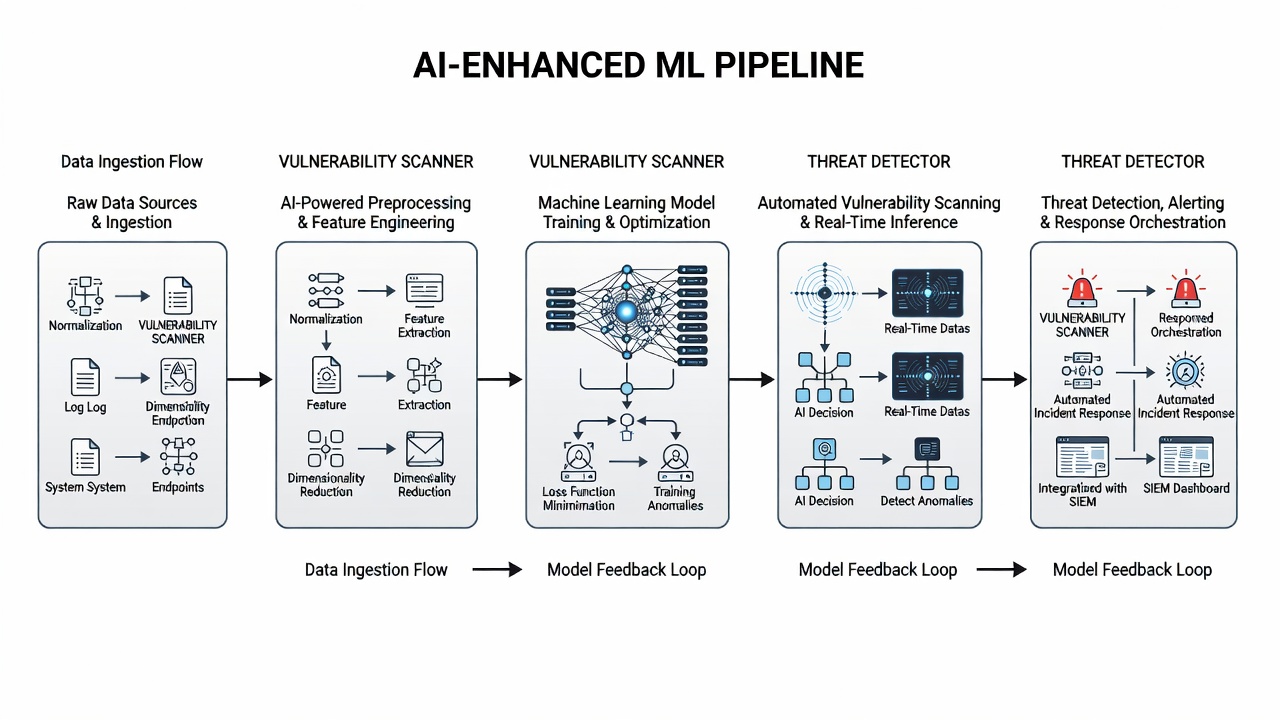
Automated scanning has progressed beyond signature-based checks. AI tools now use predictive models to prioritize vulnerabilities based on exploitability and business impact. They integrate with code repositories to perform continuous analysis during development cycles, catching issues before code reaches production. Reinforcement learning agents can simulate attacker perspectives, dynamically adjusting scan parameters to focus on the most likely exploitation paths.
Practical examples include AI-driven platforms that simulate attack paths using reinforcement learning. This allows teams to focus remediation efforts on high-risk issues first. Integration with existing DevSecOps workflows ensures scans occur seamlessly without disrupting operations. Teams report faster identification of misconfigurations in containerized environments and API endpoints, areas that traditional scanners often overlook due to their dynamic nature.
Predictive Risk Analysis Capabilities
Predictive analytics powered by AI forecast potential breaches by analyzing historical incidents, threat intelligence feeds, and organizational telemetry. Models combine time-series forecasting with anomaly detection to generate risk scores that evolve dynamically. These systems ingest data from sources ranging from dark web monitoring to internal user behavior analytics, producing forward-looking assessments that guide resource allocation.
Enterprise deployments benefit from these insights by allocating resources proactively. For example, AI can predict ransomware campaigns targeting specific industries based on emerging patterns reported by sources like CISA. Organizations using these capabilities have shifted from periodic risk assessments to continuous monitoring that adjusts defenses in near real time, significantly lowering exposure windows.
AI-Driven vs Traditional ML Approaches: 2026 Benchmarks
Comparisons reveal clear advantages for AI-augmented systems. Traditional ML often struggles with concept drift, where attack patterns change rapidly. AI tools mitigate this through continual learning mechanisms that update models on the fly. In 2026 evaluations, AI-enhanced solutions consistently outperform baselines in precision, recall, and adaptability across diverse threat landscapes.
- Accuracy: AI models achieve higher precision in distinguishing benign anomalies from threats, often reducing missed detections in complex environments.
- Scalability: They handle petabyte-scale data with distributed computing frameworks, supporting global enterprises without performance degradation.
- False positives: Reduction rates improve notably due to contextual understanding provided by transformer architectures that evaluate multiple signals simultaneously.
- Adaptability: Reinforcement learning components allow models to test defensive responses in simulated environments before deployment.
These benchmarks underscore why organizations are migrating toward hybrid AI-ML stacks that combine the reliability of established methods with the agility of newer AI techniques.
Real-World Case Studies from Enterprise Deployments
A global financial institution implemented AI-enhanced ML for endpoint detection, resulting in faster identification of advanced persistent threats. The deployment integrated graph-based models with existing SIEM systems, cutting mean time to detect from days to hours while lowering analyst workload. Another manufacturing firm used predictive models to safeguard industrial control systems, preventing downtime from targeted attacks by forecasting likely entry points based on supply chain telemetry.
A third example comes from a healthcare provider that combined automated vulnerability scanning with predictive risk scoring. This allowed the organization to prioritize patching of medical device firmware ahead of potential ransomware campaigns. These cases illustrate measurable improvements in mean time to detect and respond, validating the shift to AI-integrated solutions across regulated industries with strict compliance requirements.
Common Pitfalls When Integrating AI into ML Pipelines
Many teams encounter challenges during adoption. Over-reliance on black-box models can create explainability issues during audits. Another frequent mistake is insufficient data governance, leading to biased training sets that increase false negatives for certain attack types. Teams should also avoid deploying models without rigorous adversarial testing, as attackers increasingly target ML systems directly through data poisoning.
Best practices include maintaining human oversight loops, versioning all model changes, and conducting regular red-team exercises that specifically probe AI components. Addressing these pitfalls early prevents costly rollbacks and maintains stakeholder trust in automated security decisions.
Integration Steps for ML Pipelines
Teams can follow these steps to incorporate AI tools effectively:
- Assess current ML infrastructure and identify data sources needing enrichment with real-time threat intelligence.
- Select AI frameworks compatible with existing environments, such as those supporting PyTorch or TensorFlow extensions for seamless model fusion.
- Implement data pipelines that feed real-time streams into AI models for training and inference while ensuring encryption and access controls.
- Establish monitoring for model drift and performance metrics using dashboards that track both security outcomes and operational efficiency.
- Conduct phased rollouts with A/B testing against legacy systems, documenting lessons learned at each stage.
- Train security analysts on interpreting AI outputs to maximize the value of new detection capabilities.
Resources from OWASP offer additional guidance on secure AI adoption and common integration risks.
Top AI Tools Mentioned in Recent News
Leading solutions in 2026 combine generative capabilities with robust ML backends. They emphasize explainability to meet regulatory requirements and support multi-cloud deployments. Practitioners should evaluate tools based on their ability to integrate with existing telemetry rather than standalone performance claims.
FAQs on Scalability and False Positive Reduction
How do AI tools improve scalability? By leveraging cloud-native architectures and efficient algorithms that process data in parallel, enabling handling of enterprise-scale environments without proportional increases in infrastructure costs.
What techniques reduce false positives? Contextual analysis and ensemble methods allow models to cross-reference multiple signals before flagging alerts, while continual learning refines thresholds based on feedback from security teams.
Can smaller organizations benefit from these tools? Yes, many solutions now offer managed services and pre-trained models that lower the barrier to entry for teams without large data science departments.
Conclusion
AI tools are fundamentally enhancing machine learning for cybersecurity in 2026. By adopting these technologies thoughtfully, ML teams can build more resilient defenses against evolving threats. The combination of practical integration, real-world validation, and ongoing innovation positions organizations to maintain a strong security posture while delivering measurable improvements in detection speed and accuracy.

No comments yet. Be the first!