 NeoBit Daily

In 2026, artificial intelligence continues to evolve rapidly, but the real transformation lies in accessibility. Machine learning, once reserved for data scientists with advanced coding skills, is now within reach of marketers, small business owners, educators, and hobbyists thanks to intuitive AI tools. This democratization empowers non-experts to build, train, and deploy models without writing complex code, fostering innovation across industries. The shift is driven by platforms that combine visual interfaces with automated processes, allowing users to focus on real-world problems instead of technical implementation details. As a result, organizations of all sizes are integrating machine learning into daily operations, from forecasting sales trends to personalizing customer experiences.
Understanding the Democratization of Machine Learning
Democratization means removing technical hurdles so anyone can harness predictive analytics, image recognition, and natural language processing. Platforms integrate real-time data feeds and pre-built templates, allowing users to focus on business problems rather than algorithms. This shift accelerates adoption in sectors like healthcare, finance, and retail, where quick insights drive decisions. Non-experts benefit from automated feature selection and model evaluation, which previously required months of specialized training. The result is faster experimentation and broader participation in AI development, leading to more diverse applications and innovative solutions that reflect varied perspectives.
Leading No-Code Platforms for ML in 2026
Several established platforms stand out for their user-friendly interfaces. Hugging Face offers community-driven models that users can fine-tune visually. Google Cloud AutoML provides automated feature engineering, while Microsoft Azure Machine Learning Studio emphasizes drag-and-drop workflows. These tools support seamless integration with real-time AI news feeds for staying updated on emerging datasets. Additional options include platforms that connect directly to popular data sources like spreadsheets and cloud storage, enabling users to import information quickly and begin model training within minutes. Each platform prioritizes transparency by showing performance metrics in plain language, helping beginners understand results without deep statistical knowledge.
Free Versus Paid Tool Comparisons
Free tiers typically include limited datasets, basic model training, and community support. Paid plans unlock advanced automation, priority compute resources, and enterprise-grade security. Users should evaluate based on project scale: startups often begin with free options before upgrading for production deployment. Qualitative differences include faster iteration speeds and richer visualization dashboards on paid subscriptions. Free versions suit exploratory projects and learning, while paid editions add collaboration features and audit logs essential for teams handling sensitive information. Beginners are encouraged to test multiple platforms on sample data before committing to any single ecosystem.
Step-by-Step Onboarding Example
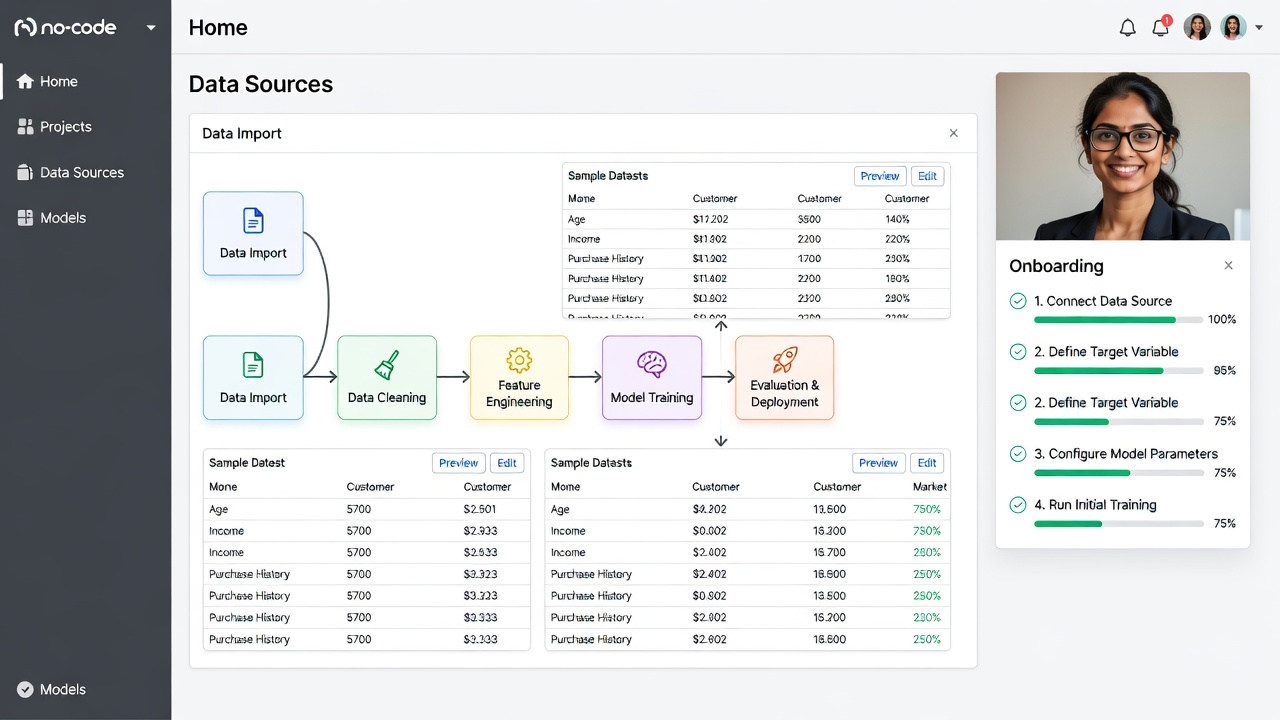
Getting started is straightforward. First, sign up for a platform account and connect your data source, such as a CSV file or cloud database. Next, select a template like classification or regression. Then, use the visual interface to define inputs and outputs. Finally, train the model and deploy it via API. This process usually takes under an hour for simple projects. To illustrate, consider a marketing professional uploading customer data to predict churn. The platform automatically suggests relevant variables, generates a preview of model accuracy, and provides export options for integration into existing dashboards. Users can iterate by adjusting parameters through sliders and immediately viewing updated predictions. Documentation and in-app tutorials guide each phase, reducing the learning curve significantly.
Real-World Success Stories
A retail chain used no-code tools to predict inventory needs, reducing waste by analyzing sales patterns in real time. In education, teachers built custom recommendation engines to personalize learning paths. Healthcare startups deployed diagnostic models for early disease detection, improving patient outcomes without hiring ML specialists. These examples highlight how diverse teams leverage accessible AI for tangible results. Another case involves a nonprofit organization that created a model to forecast donation trends based on historical campaigns, allowing better resource allocation during peak seasons. A logistics company optimized delivery routes by training a model on traffic and weather data, cutting fuel consumption noticeably. Such stories demonstrate the versatility of no-code solutions across profit and nonprofit sectors alike.
Common Pitfalls and How to Avoid Them
- Overfitting models to small datasets—always validate with separate test data and monitor for performance drops on new inputs.
- Ignoring data privacy—choose platforms with strong compliance features and review terms before uploading sensitive records.
- Skipping bias checks—review outputs for fairness across demographics by examining segmented results.
- Underestimating compute needs—start small and scale gradually while tracking usage metrics provided by the platform.
- Failing to document the process—maintain notes on data sources and model versions to enable reproducibility and team collaboration.
Future Accessibility Trends Beyond 2026
Expect deeper integration with voice interfaces and augmented reality overlays. Open-source communities will expand further, and regulatory frameworks may standardize ethical AI use. TensorFlow and similar libraries will likely introduce even more beginner-friendly extensions. Additional developments may include improved multilingual support and automatic model explanation features that translate technical outputs into everyday language. These advancements will further lower entry barriers and encourage wider adoption among non-technical professionals worldwide.
Practical Tips for Choosing and Using Tools
When selecting a platform, assess your primary data types and desired outcomes. Test free tiers thoroughly to confirm ease of use. Combine tools with real-time AI news feeds to stay informed about new datasets and techniques. Regularly review model performance and retrain as data evolves. Collaborate with colleagues by sharing project links and version histories. These steps ensure sustainable and effective use of accessible machine learning resources.
Frequently Asked Questions
What skills do I need to begin?
Basic spreadsheet knowledge and logical thinking suffice for most no-code platforms. Familiarity with data organization helps but is not mandatory.
How reliable are these models?
Quality depends on data input; always test thoroughly and monitor performance post-deployment with built-in evaluation tools.
Will AI replace data scientists?
No, it augments their work by handling routine tasks, freeing experts for complex challenges and strategic oversight.
Can small businesses benefit immediately?
Yes, many platforms offer quick-start templates tailored for common business scenarios like customer segmentation and demand forecasting.
How do I handle data security concerns?
Select providers with established security certifications and limit data uploads to essential fields only during initial testing phases.
Conclusion
The tools available in 2026 make machine learning a practical resource for everyone. By exploring platforms, following structured onboarding, and learning from real examples, non-experts can unlock powerful insights. Start today to stay ahead in an AI-driven world and contribute to the growing community of accessible machine learning practitioners.


No comments yet. Be the first!