 NeoBit Daily

Introduction to Bias Mitigation in 2026 Machine Learning
Bias in machine learning remains a critical challenge as models increasingly influence decisions in hiring, lending, healthcare, and criminal justice. In 2026, advancements in AI tools enable more sophisticated detection and mitigation strategies that go beyond basic statistical checks. Organizations must now integrate continuous monitoring, causal analysis, and regulatory-aware workflows to achieve truly equitable outcomes. This guide provides actionable steps for ethical implementation, covering common bias types, updated fairness libraries, real-time integration, and measurable fairness improvements that teams can apply immediately in production environments.
Common Types of Bias in Datasets and Models
Understanding bias sources is essential before applying tools. Selection bias occurs when training data fails to represent the full population, such as when a facial recognition dataset overrepresents lighter skin tones and underrepresents darker ones, leading to higher error rates for certain groups. Historical bias reflects past discriminatory practices embedded in records, for example credit scoring models trained on decades-old loan data that systematically denied applications from minority neighborhoods. Measurement bias arises from inconsistent data collection methods across groups, like varying survey response rates or sensor accuracies in different regions. Proxy bias emerges when features correlate with protected attributes like race or gender, even if those attributes are not directly used.
These issues can lead to disparate impact, where outcomes unfairly disadvantage certain demographics. Intersectional bias compounds problems when multiple attributes overlap, such as age and gender together affecting hiring recommendations. Effective mitigation starts with comprehensive data audits using automated scanning tools that flag these patterns early in the pipeline.
Comparing Updated Fairness Libraries in 2026
Several libraries have evolved to address 2026 needs. Fairlearn offers modular fairness constraints for scikit-learn pipelines and supports real-time threshold adjustments. IBM's AI Fairness 360 provides comprehensive metrics and algorithms for preprocessing, in-processing, and post-processing stages. Google's What-If Tool enables interactive exploration of model behavior across subgroups through visual interfaces. Newer additions like Aequitas focus on audit reporting for compliance teams, while Fairness Indicators from TensorFlow emphasize large-scale production monitoring.
Comparisons show Fairlearn excels in real-time integration with low overhead, while AI Fairness 360 supports broader metric coverage including causal metrics. Teams should evaluate based on their tech stack, model size, and compliance requirements. For instance, startups may prefer lightweight options, whereas enterprises need extensive documentation features.
NIST AI Risk Management Framework offers foundational guidance for selecting appropriate tools and mapping them to risk tiers.
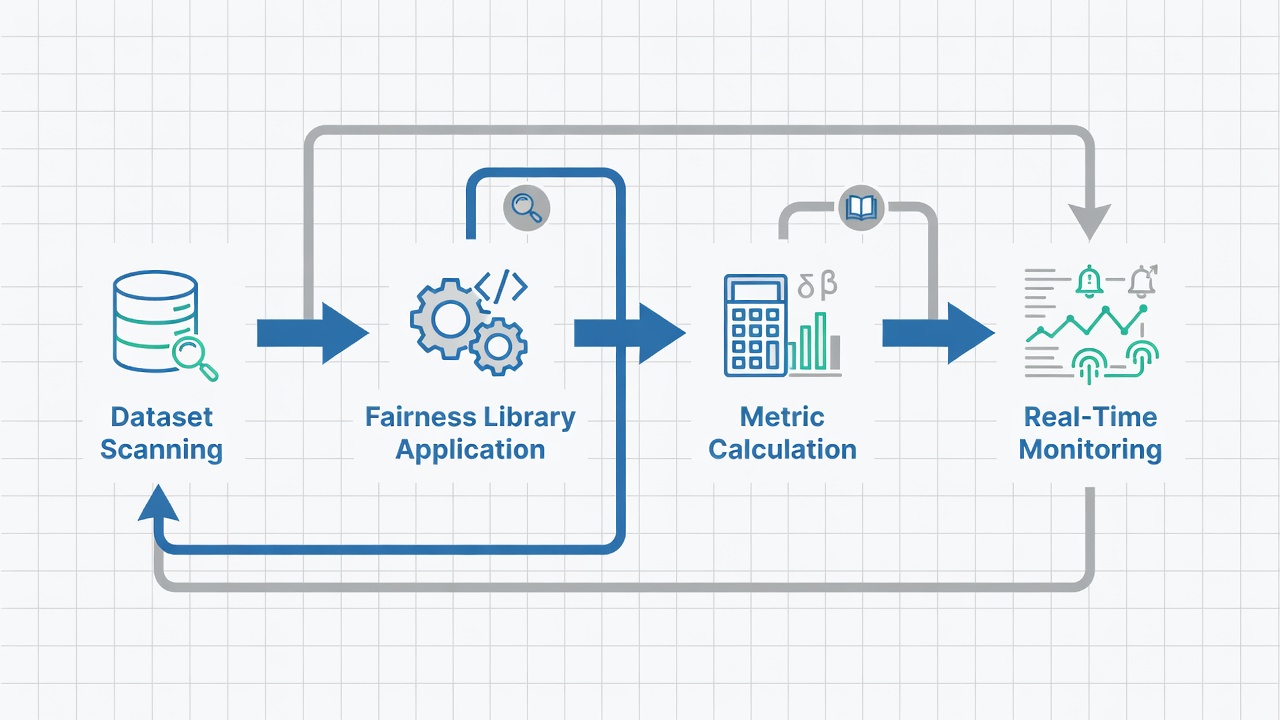
Actionable Bias Audit Examples and Implementation Workflows
Begin with a bias audit workflow that includes these detailed phases. First, load the dataset and explicitly identify protected attributes such as race, gender, age, or disability status. Second, apply statistical parity difference and equalized odds metrics to quantify disparities across groups. Third, retrain the model incorporating fairness constraints like demographic parity or equal opportunity. Fourth, validate performance on holdout sets that preserve subgroup distributions. Fifth, generate automated reports and schedule periodic re-audits every quarter or after significant data drift.
A concrete example involves a credit scoring model. Use Fairlearn's ThresholdOptimizer to adjust decision thresholds per demographic group, balancing false positive rates and reducing disparate impact. In one documented case, this approach lowered the gap in approval rates between groups from 18% to under 5% while maintaining overall accuracy above 82%. Another workflow example uses preprocessing techniques in AI Fairness 360 to reweight samples before training, which proved effective for a healthcare prediction model where initial bias led to under-diagnosis in certain ethnic populations.
Step-by-Step Integration with Real-Time AI News Feeds
- Connect monitoring tools to APIs for ongoing bias alerts triggered by new research or incidents.
- Incorporate feedback loops from news sources tracking regulatory changes, such as updates to the EU AI Act or NIST guidelines.
- Automate retraining triggers when drift exceeds predefined thresholds detected via continuous evaluation.
- Log all interventions in an immutable audit trail for compliance reviews.
- Share aggregated fairness dashboards with stakeholders through secure internal portals.
Metrics for Measuring Fairness Improvements
Key metrics include demographic parity difference, which measures the absolute difference in positive outcome rates across groups, equal opportunity difference focusing on true positive rates, and calibration error assessing whether predicted probabilities match actual outcomes per subgroup. Additional advanced metrics in 2026 tools cover counterfactual fairness and individual fairness scores. Track these pre- and post-mitigation to quantify gains, and visualize trends over multiple model versions using built-in reporting in libraries like AIF360. For example, a logistics optimization model saw its equal opportunity difference drop from 0.22 to 0.07 after applying mitigation techniques, directly improving service equity across regions.
Challenges with Scalable Deployment and Regulatory Compliance
Scaling bias mitigation across large models involves computational overhead, data privacy concerns under regulations like GDPR, and the risk of accuracy trade-offs. Regulatory frameworks such as the EU AI Act demand transparency, risk assessments, and human oversight for high-stakes applications. ACM guidelines emphasize audit trails, stakeholder involvement, and documentation of all fairness interventions. Common pitfalls include over-correction leading to reduced accuracy, ignoring intersectional biases, and failing to update models when societal contexts shift. To address scalability, organizations are adopting federated approaches that allow bias checks without centralizing sensitive data.
FAQs on AI Tools for Inclusive Artificial Intelligence
What are common pitfalls when starting bias mitigation?
Teams often overlook intersectionality or rely solely on automated tools without human oversight. Always combine quantitative metrics with qualitative reviews from domain experts and affected communities.
How will future AI tool innovations improve inclusivity?
Expect advances in causal inference methods, automated bias discovery using large language models, and federated learning that preserves privacy while addressing bias at scale across distributed datasets.
Which metrics should be prioritized for regulatory reporting?
Focus on those required by specific jurisdictions, such as equalized odds for lending models under emerging US state laws, and maintain version-controlled records of all calculations.
Conclusion
Implementing AI tools for bias mitigation in 2026 requires structured workflows, appropriate library selection, and ongoing measurement. By following these practices, organizations can build more equitable ML systems that meet both ethical standards and evolving regulatory requirements while delivering reliable performance across all user groups.


No comments yet. Be the first!