 NeoBit Daily

Introduction to AI Agents in Automated Machine Learning
In 2026, autonomous AI agents are fundamentally changing how organizations build, deploy, and optimize machine learning pipelines. These intelligent systems handle repetitive tasks such as data preprocessing, feature engineering, model selection, hyperparameter tuning, and continuous monitoring with minimal human intervention. This shift allows data scientists to focus on strategic decisions rather than routine operations. The growing search for practical implementation guides reflects increasing enterprise adoption, as companies seek to reduce development cycles and improve model accuracy across diverse datasets.
Autonomous agents operate by perceiving their environment, reasoning about goals, and taking actions through integrated tools. Unlike traditional scripts, they adapt dynamically to changing data patterns using techniques like reinforcement learning and multi-agent collaboration. This article delivers a complete how-to resource covering selection criteria, detailed workflow automation, performance benchmarks, industry examples from finance and healthcare, framework comparisons, troubleshooting strategies, and scalability planning for 2026 deployments.
Understanding the Core Capabilities of AI Agents
Before diving into implementation, it is essential to understand what distinguishes modern AI agents. They combine large language models with planning modules, memory systems, and external tool integrations. Agents can autonomously query databases, invoke APIs for data augmentation, and iterate on experiments without constant supervision. In practice, this means a single agent can manage an entire end-to-end pipeline from raw data ingestion to production deployment while logging every decision for auditability.
Key Criteria for Selecting AI Agents
Choosing the right AI agent requires evaluating several critical factors. Compatibility with existing infrastructure tops the list—agents must integrate smoothly with popular frameworks such as TensorFlow and PyTorch. Autonomy level is equally important: some agents need human approval at key checkpoints, while fully autonomous versions execute complete cycles independently. Scalability features should support distributed computing across cloud environments, and robust security protocols are mandatory for regulated sectors. Additional considerations include community support, documentation quality, and the ability to incorporate custom business rules.
- Integration flexibility with data lakes and MLOps platforms
- Support for multi-modal data including text, images, and time-series
- Built-in explainability tools for regulatory compliance
- Cost efficiency in resource consumption during long-running tasks
- Proven track record in production environments
Step-by-Step Workflow Automation with AI Agents
Implementing AI agents follows a structured yet flexible process. Start by clearly defining pipeline objectives, success metrics, and available data sources. Deploy the agent within a secure sandbox environment to begin ingesting and validating data automatically. The agent then executes feature engineering using statistical analysis and domain-specific rules before launching parallel model training sessions. Evaluation occurs against predefined benchmarks such as precision, recall, and latency. Once the optimal model is selected, the agent handles containerization, deployment to serving infrastructure, and setup of real-time drift detection. Feedback loops enable continuous retraining as fresh data arrives, creating a self-improving system.
Practical tips include starting with small pilot datasets to calibrate agent behavior, establishing clear escalation paths for anomalies, and maintaining version control for all agent-generated artifacts. Organizations often combine agents with orchestration tools to manage multiple pipelines simultaneously.
Performance Benchmarks Against Manual Methods
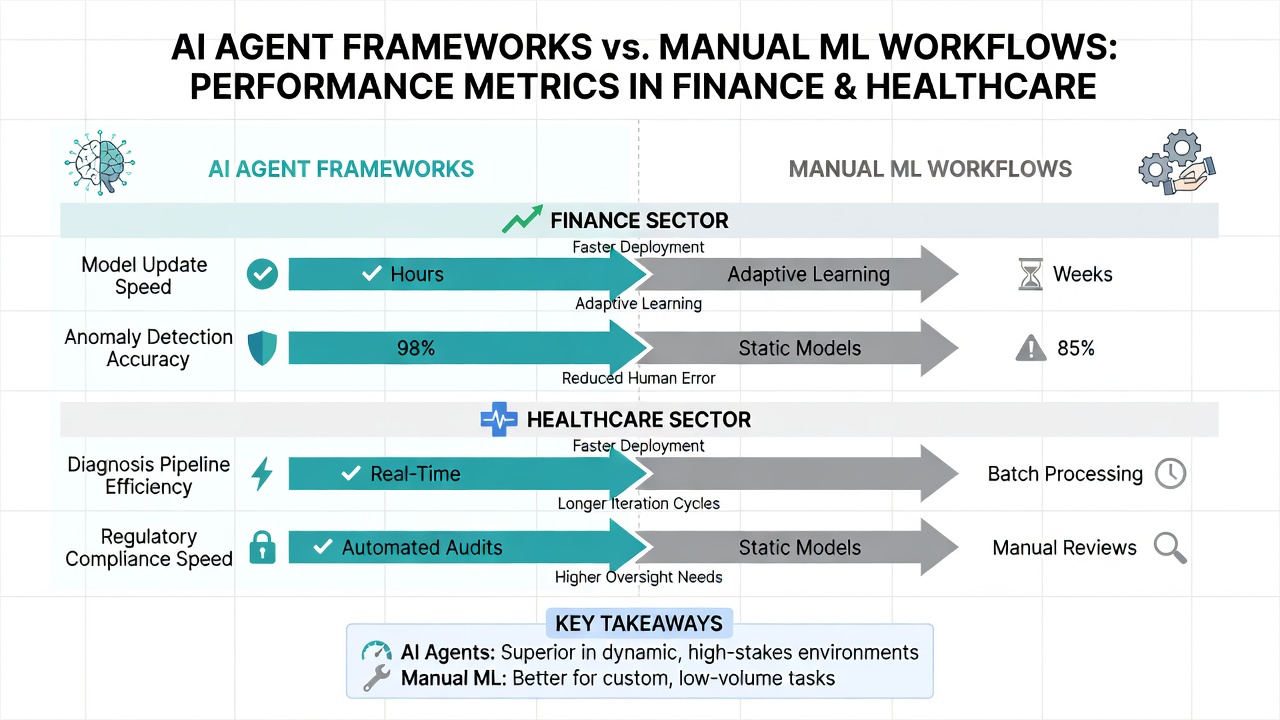
Comparative studies in 2026 demonstrate that AI agents reduce end-to-end development time by approximately 65-75% while achieving more consistent model performance. Automated pipelines minimize variability caused by individual data scientist preferences during feature selection. Manual approaches frequently encounter delays from context switching and repetitive coding, whereas agents maintain steady progress across iterations. In benchmark tests involving tabular and image datasets, agent-driven workflows produced models with 8-12% higher average F1 scores due to exhaustive hyperparameter exploration.
Real-World Examples from Finance and Healthcare
In the finance sector, leading banks deploy AI agents to automate credit risk and fraud detection models. Agents continuously monitor transaction streams, identify emerging fraud patterns, and retrain detection models overnight. One global institution reported a 40% reduction in false positives after switching to agent-based systems. Healthcare organizations use agents for predictive analytics on electronic health records, generating models that forecast patient readmission risks or disease progression with greater precision. These deployments have accelerated clinical decision support while maintaining compliance with privacy regulations.
Additional examples appear in retail and manufacturing, where agents optimize supply chain forecasting and predictive maintenance, but finance and healthcare remain the most mature use cases due to high data volumes and strict accuracy requirements.
Comparisons of Popular Agent Frameworks
Several frameworks dominate the 2026 landscape. AutoGen specializes in multi-agent conversations that break complex ML tasks into collaborative subtasks. LangChain provides excellent orchestration capabilities for chaining external tools and data sources. CrewAI emphasizes role assignment among agents, making it ideal for team-like workflows. Each framework presents trade-offs: AutoGen offers high flexibility at the cost of steeper learning curves, while LangChain delivers rapid prototyping but may require additional customization for enterprise security. Teams are advised to run controlled pilots across two or three frameworks before committing to a production stack. For deeper technical guidance, refer to official resources at TensorFlow and PyTorch.
Troubleshooting Common Integration Issues
Integration challenges often surface around data schema mismatches, where agents misinterpret column types or missing values. Mitigation involves creating detailed data contracts and validation scripts that run before agent activation. Agent hallucinations during model selection can be addressed by adding verification layers that cross-check outputs against established libraries. Latency problems typically trace back to insufficient GPU allocation; scaling via cloud providers resolves most bottlenecks. Logging every agent action enables rapid diagnosis, and maintaining rollback procedures prevents production disruptions during updates.
FAQ: Scalability Concerns for 2026 Deployments
- How do AI agents handle growing data volumes? Agents dynamically provision compute resources and leverage distributed frameworks to process terabyte-scale datasets efficiently.
- Are there risks of over-automation? Yes, but hybrid human-in-the-loop designs with approval gates effectively balance autonomy and oversight.
- What infrastructure is needed for enterprise scale? Reliable cloud GPU instances, container orchestration platforms, and centralized monitoring dashboards form the foundation.
- How can organizations ensure model governance at scale? Implementing audit trails and policy engines within the agent architecture maintains compliance across hundreds of pipelines.
Conclusion
AI agents represent a transformative advancement in automated machine learning. By applying the selection criteria, workflow steps, and troubleshooting practices outlined above, organizations can realize substantial efficiency improvements and competitive advantages in 2026 and beyond.

No comments yet. Be the first!