 NeoBit Daily

Introduction to Edge ML Optimization in 2026
Edge machine learning continues to evolve rapidly in 2026, driven by real-time AI news and emerging tools that enable efficient inference in resource-constrained environments. Organizations across industries now prioritize deploying models directly on devices such as microcontrollers, single-board computers, and embedded GPUs to achieve sub-100-millisecond response times without relying on constant cloud connectivity. This approach reduces bandwidth costs, enhances privacy, and supports applications where connectivity is unreliable, such as remote industrial sites or disaster response robotics. The focus remains on balancing model accuracy with strict limits on power consumption, memory footprint, and thermal output. Developers must navigate a landscape where hardware capabilities advance quickly, requiring constant adaptation of optimization pipelines.
The Role of Real-Time AI News and Emerging Tools
Staying updated with AI news sources helps practitioners adopt the latest frameworks and techniques ahead of competitors. In 2026, announcements from major AI research labs frequently highlight new compression algorithms and runtime improvements that directly benefit edge deployments. Emerging tools now integrate automated search for optimal quantization levels and support for hybrid execution across CPU, GPU, and specialized accelerators. For instance, integrating updates from leading AI ecosystems allows teams to test new compression methods quickly and adapt to changing hardware capabilities. Real-time feeds also surface benchmark results from independent labs, enabling informed decisions on tool selection for specific use cases like autonomous navigation or predictive maintenance.
Practical Workflows for Sensor Data Pipelines
Effective edge ML starts with robust sensor data integration. Popular frameworks such as TensorFlow and PyTorch offer edge-specific runtimes that handle streaming data from cameras, LiDAR, and IoT sensors. A typical workflow begins with raw data ingestion through lightweight drivers, followed by on-device preprocessing steps like normalization and feature extraction. Data is then buffered intelligently to match inference batch sizes, minimizing memory spikes. In robotics applications, pipelines often fuse multiple sensor streams using Kalman filters or similar algorithms before feeding the model. This ensures the model receives coherent input even when individual sensors experience noise or dropouts. Developers can extend these pipelines with custom operators for domain-specific transformations, such as edge detection on vision data or frequency analysis on audio streams.
Model Compression Techniques
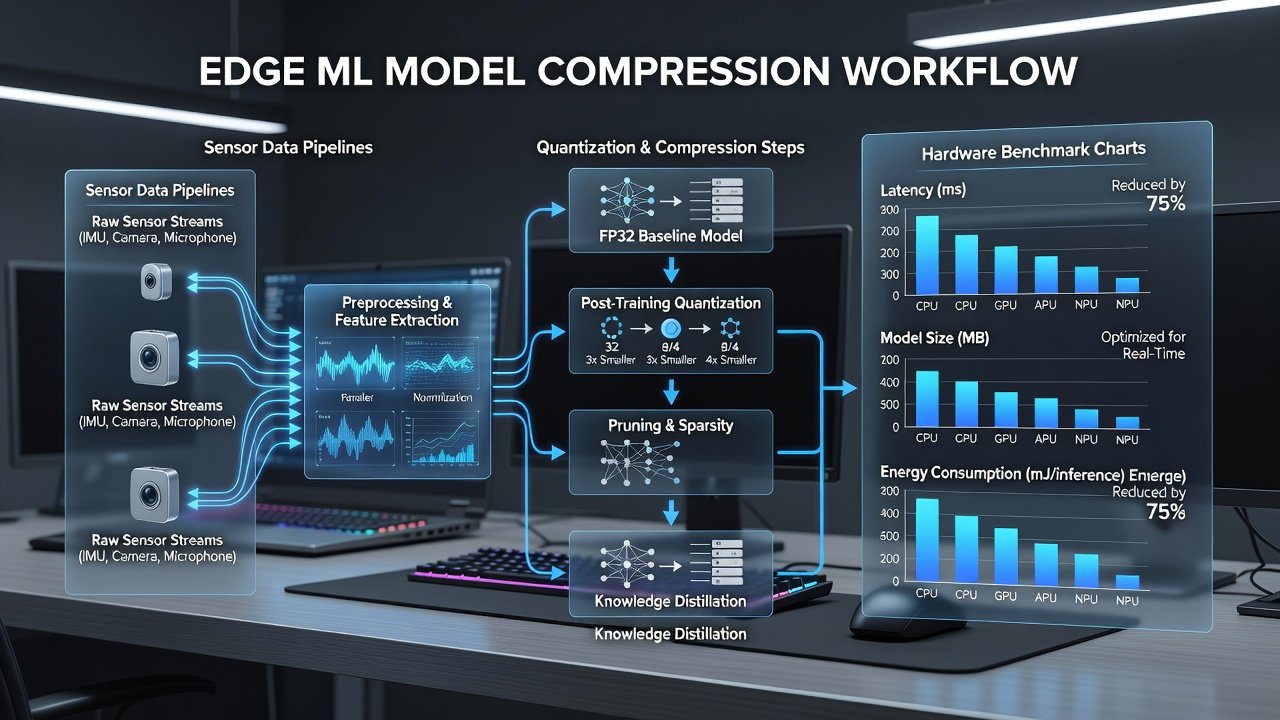
Key techniques include quantization-aware training, knowledge distillation, and structured pruning. Quantization reduces precision from 32-bit floats to 8-bit integers, dramatically cutting memory usage and accelerating matrix operations on integer-only hardware. Knowledge distillation transfers knowledge from a large teacher model to a compact student model, preserving performance while shrinking size. Structured pruning removes entire channels or layers based on importance scores, yielding hardware-friendly sparse models. These methods can shrink model size by 4-8x while preserving accuracy, essential for edge deployment. Real-world examples include compressing a ResNet-50 variant for object detection down to under 5 MB, enabling real-time performance on ARM Cortex-M processors in wearable health monitors.
Hardware Benchmarks and Power Efficiency Comparisons
Leading AI tools are compared for power efficiency using standardized suites that measure inference latency, energy per inference, and sustained throughput under thermal constraints. NVIDIA Jetson platforms often lead in throughput-per-watt for autonomous navigation tasks, delivering strong results on computer vision workloads. ARM-based NPUs excel in ultra-low-power sensor fusion scenarios, achieving high efficiency in always-on monitoring devices. Intel and other vendors provide competing solutions with varying support for mixed-precision arithmetic. Developers should evaluate metrics such as TOPS/W and thermal envelopes before final selection, running custom benchmarks on target hardware rather than relying solely on vendor claims. Comparative tables in recent AI news reports frequently highlight trade-offs, such as higher peak performance at the cost of increased power draw.
Step-by-Step Deployment to Robotics and Autonomous Systems
Deploying optimized models requires careful sequencing to avoid common pitfalls. First, profile the target hardware using vendor SDKs to identify bottlenecks in compute, memory bandwidth, or I/O. Second, apply compression pipelines within the chosen framework, iterating through quantization and pruning until accuracy targets are met. Third, validate latency and power consumption on representative datasets collected from the actual deployment environment. Fourth, package the model with runtime dependencies into a containerized format supporting over-the-air updates. Fifth, integrate monitoring hooks for performance telemetry and drift detection. Sixth, conduct field tests in staged environments before full rollout. In autonomous systems, this process often includes safety certification steps where model outputs are cross-checked against redundant sensors. Examples from industrial robotics show that following these steps can reduce end-to-end latency by 60% compared to unoptimized baselines.
Addressing Common Challenges: Drift Detection and Troubleshooting
Concept drift in distributed edge setups can degrade performance over time as environmental conditions or input distributions change. Implement statistical monitoring on-device using techniques like population stability index or simple threshold checks on prediction confidence. When drift is detected, systems can trigger alerts, switch to fallback models, or initiate federated learning rounds for privacy-preserving updates. Additional troubleshooting includes verifying sensor calibration regularly, handling edge cases with input sanitization, and maintaining versioned model registries. Common issues such as memory leaks during long-running inference are mitigated by periodic restarts and resource pooling. Teams should document failure modes observed during testing to build robust recovery procedures.
Conclusion
Optimizing ML for the edge in 2026 demands a blend of current AI news insights, proven compression methods, and rigorous benchmarking. By following structured workflows, teams can achieve low-latency, power-efficient deployments that scale across robotics and autonomous applications while addressing real-world challenges like data drift.
FAQ
What are typical deployment costs for edge ML solutions?
Costs vary by scale and hardware; focus on qualitative factors like reduced cloud dependency for long-term savings rather than fixed figures.
How do security considerations factor into edge optimization?
Secure boot, encrypted model weights, and runtime attestation are essential to protect against tampering in distributed networks. Additional layers include secure key storage and regular firmware validation.
What future trends are emerging from current AI news sources?
Expect greater adoption of neuromorphic chips and automated neural architecture search tailored for edge constraints, enhancing efficiency further. Continued improvements in compiler technologies will also simplify cross-hardware deployment.


No comments yet. Be the first!