 NeoBit Daily
Introduction to AI News and Predictive Maintenance in 2026
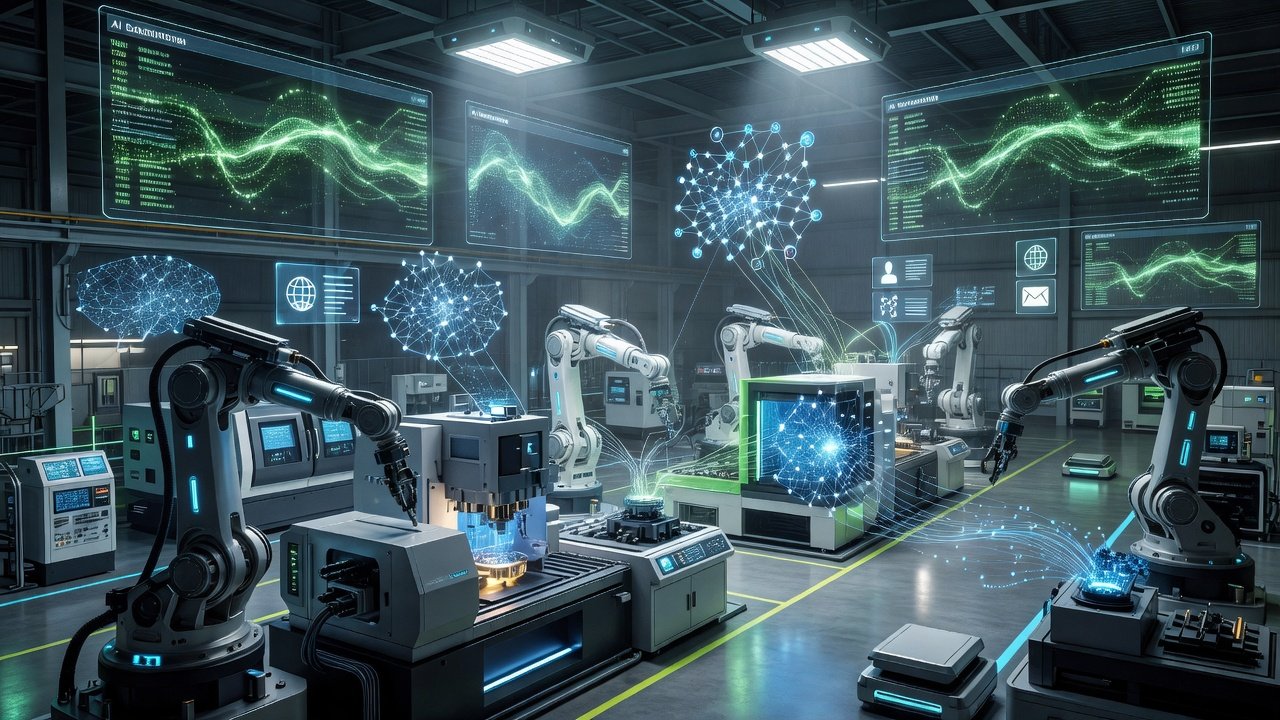
In 2026, manufacturing facilities increasingly rely on machine learning for predictive maintenance to minimize downtime and optimize operations. Real-time AI news feeds provide critical updates on emerging algorithms, sensor technologies, and industry breakthroughs that directly refine these models. By integrating external intelligence with internal sensor data, factories achieve higher accuracy in anomaly detection and failure forecasting. This dynamic approach allows ML systems to evolve beyond static training datasets, incorporating the latest research on topics such as federated learning for distributed factory networks or novel graph neural networks for complex equipment interdependencies.
Traditional predictive maintenance relied solely on historical sensor readings from vibration, temperature, and pressure monitors. However, the rapid pace of AI innovation means that models trained even six months prior can miss optimizations published in recent papers or industry reports. AI news integration bridges this gap, delivering contextual updates that improve model robustness across varying operational conditions like seasonal load fluctuations or supply chain disruptions affecting spare parts availability.
Integrating Real-Time AI News Feeds with ML Pipelines
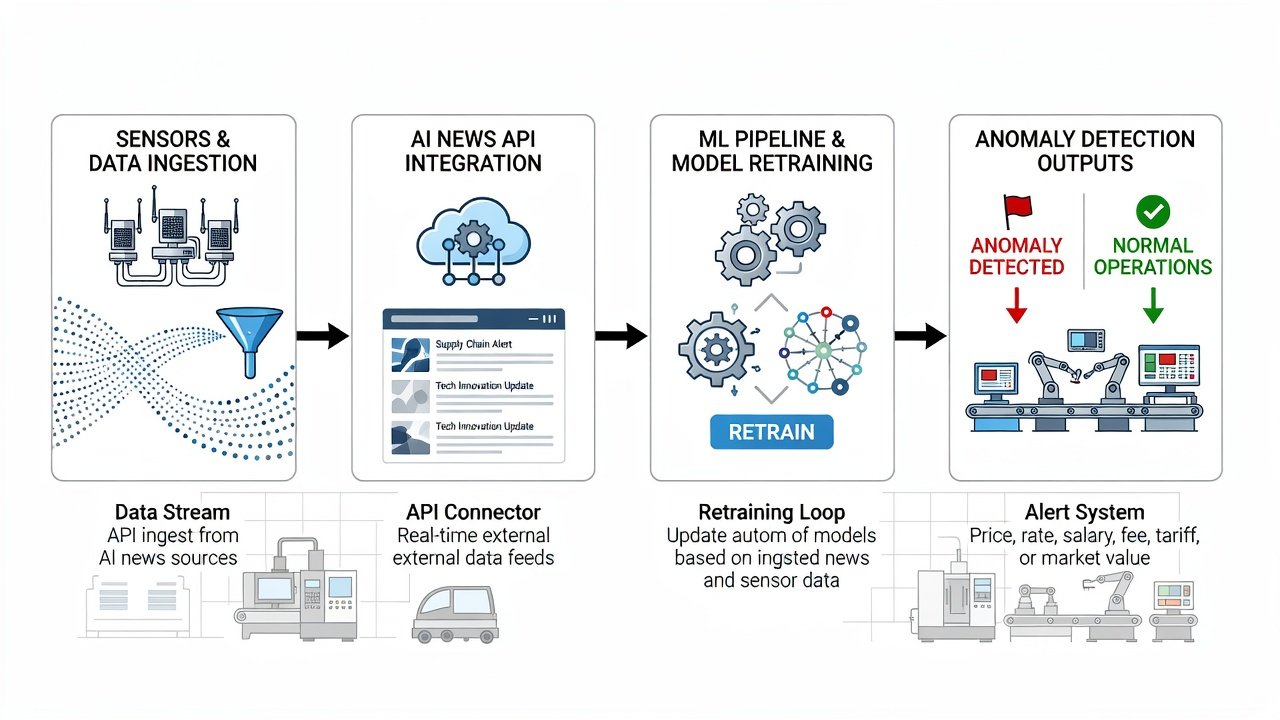
Connecting news APIs to existing ML workflows requires careful architecture planning. The process begins with selecting reliable sources focused on artificial intelligence developments relevant to industrial applications. These feeds deliver structured data on new techniques for time-series analysis, edge computing optimizations, or unsupervised anomaly detection methods. Once ingested, the information undergoes filtering through natural language processing pipelines to extract actionable insights, such as improved neural network architectures for vibration analysis or updates on explainable AI frameworks that help maintenance teams trust model outputs.
This enriched dataset then augments training pipelines, allowing models to incorporate novel patterns discovered in recent research. Integration also involves handling data heterogeneity—news content often arrives in unstructured formats while sensor data is highly structured, necessitating custom embedding layers that align both modalities effectively.
Workflow Steps for API Integration
- Identify and authenticate news APIs specializing in AI and manufacturing technologies, prioritizing those with high update frequency and relevance scoring.
- Build a data ingestion layer that parses JSON outputs and converts them into feature vectors compatible with sensor streams using vector databases for efficient retrieval.
- Implement a middleware module for semantic matching between news content and maintenance datasets, employing topic modeling to discard irrelevant updates like consumer gadget AI news.
- Retrain models on a scheduled cadence such as weekly or bi-weekly, blending new intelligence with historical telemetry while applying regularization techniques to prevent overfitting to transient trends.
- Deploy updated models with continuous monitoring dashboards to validate performance lifts in production environments, including drift detection alerts when news-driven features underperform.
- Establish feedback loops where maintenance engineers rate prediction accuracy, feeding back into the news filtering system for iterative refinement.
Tool Comparisons for Anomaly Detection
Several platforms excel when combined with external AI intelligence. Open-source options like TensorFlow Extended or PyTorch offer flexibility for custom news integration through extensible data loaders. Commercial solutions such as those from major cloud providers provide pre-built connectors and managed pipelines that reduce development overhead. Key differentiators include scalability for high-volume sensor data exceeding millions of readings per day, native support for real-time updates from news streams, and built-in capabilities for model versioning that track which news items influenced specific retraining runs.
Comparisons reveal that hybrid setups—pairing established libraries with news-augmented features—outperform isolated systems in detecting subtle equipment degradation signals. For instance, incorporating recent advancements in contrastive learning from AI news can enhance separation between normal and faulty states in high-dimensional sensor spaces.
Real-World Examples from Automotive and Heavy Equipment Sectors
Automotive assembly lines have applied these techniques to robotic welding arms, using AI news on advanced reinforcement learning to refine failure predictions and reduce weld defects by adapting to new material science insights. In one implementation, news about transformer-based models for sequential data led to a 25 percent improvement in early detection of motor bearing wear. Heavy equipment operators in mining and construction leverage similar integrations for hydraulic systems, incorporating updates on new sensor fusion methods to anticipate component wear under extreme environmental conditions like dust or temperature extremes.
These cases demonstrate reduced unplanned outages through proactive interventions guided by the latest AI developments. Additional examples include food processing plants applying news-derived updates on multimodal learning to combine visual inspection feeds with vibration data for conveyor belt maintenance.
Benchmarks on Model Performance Gains
Facilities implementing AI news integration report enhanced precision in predictive models. Typical outcomes include faster convergence during retraining cycles and improved handling of rare failure modes, validated through controlled A/B testing against baseline systems. Performance metrics often show gains in F1 scores for anomaly classification and reduced mean time to detection, particularly when news feeds highlight breakthroughs in few-shot learning applicable to limited failure datasets common in manufacturing.
Actionable Implementation Checklists
- Audit current ML infrastructure for API compatibility and latency tolerances when handling external data streams.
- Establish data governance protocols for external news sources, including source credibility scoring and bias mitigation strategies.
- Pilot integrations on non-critical assets before full rollout to measure integration overhead and accuracy improvements.
- Train teams on interpreting AI-driven maintenance recommendations, including workshops on understanding news-influenced feature importance.
- Schedule quarterly reviews to align with evolving AI trends and update integration rules accordingly.
- Document all pipeline changes with version control to enable rollback if news integration introduces unexpected variance.
Common Pitfalls and How to Avoid Them
Over-reliance on unverified news sources can introduce noise into models, leading to false positives in maintenance alerts. Mitigate this by implementing strict validation layers that cross-reference multiple feeds before feature incorporation. Data latency between news publication and pipeline ingestion also poses risks of outdated information; address it with efficient streaming architectures using message queues. Finally, ensure compliance with data privacy standards when processing external feeds, especially when news items reference proprietary industry case studies.
Future Trends and Decision Framework for Adoption
Looking ahead, 2026 trends point toward tighter coupling of generative AI for synthetic data augmentation derived from news summaries and automated model suggestion systems. Mid-size operations should evaluate readiness through a decision framework assessing data maturity, team expertise, and expected ROI from reduced downtime. Start small with targeted use cases like critical pump monitoring before expanding plant-wide.
FAQ on Scaling These Techniques for Mid-Size Operations
How can smaller manufacturers start without massive infrastructure?
Begin with cloud-based ML services that support API extensions and scale gradually as results prove value, focusing first on high-impact assets.
What data volume is needed for meaningful improvements?
Even moderate sensor datasets of a few thousand readings benefit when augmented with targeted AI news insights on relevant methodologies and architectures.
Are there security concerns with external feeds?
Yes—use vetted APIs and sandbox testing environments to prevent injection of malicious data patterns or adversarial examples disguised as technical updates.
How does this approach compare to traditional IoT platforms?
Traditional platforms focus on internal data only, while news-augmented systems add external knowledge layers that accelerate adaptation to new AI techniques without waiting for vendor updates.
For authoritative guidance on industrial AI standards, refer to NIST, IEEE, and IBM.

No comments yet. Be the first!