 NeoBit Daily

Introduction to AI-Driven Supply Chain Optimization in 2026
Supply chains in 2026 face unprecedented volatility from geopolitical shifts, climate events, and fluctuating consumer demands. Machine learning models enhanced by real-time AI news insights provide a powerful way to build resilience. This approach moves beyond static historical data by incorporating live feeds that capture emerging trends, disruptions, and technological breakthroughs. Organizations that integrate these signals see faster response times and better inventory alignment across global networks.
Businesses leveraging these techniques report improved forecasting accuracy and reduced operational risks. The focus here is on actionable strategies that integrate AI news monitoring into proven ML workflows for demand forecasting, sensor-driven inventory management, and risk prediction. Throughout this guide we examine concrete implementation paths, compare tooling options, review real-world applications from leading logistics providers, and address common integration hurdles through a detailed FAQ.
Integrating Live Data Feeds for Demand Forecasting
Real-time AI news can dramatically enhance demand forecasting models. By parsing sources for mentions of market shifts, regulatory changes, or competitor actions, ML systems gain contextual awareness that traditional datasets lack. For example, sudden mentions of port congestion in major trade routes can trigger immediate model adjustments before physical delays appear in shipment records.
Step-by-Step Implementation
- Identify key news APIs and RSS feeds focused on logistics and global trade from reputable aggregators.
- Use natural language processing pipelines to extract sentiment scores, named entities, and event classifications from incoming articles.
- Map extracted signals to specific product categories or geographic regions within your forecasting dataset.
- Feed processed insights into a time-series forecasting model such as Prophet or LSTM networks augmented with attention mechanisms.
- Schedule automated retraining cycles every seven days while maintaining a rolling buffer of the most recent news embeddings.
- Establish monitoring dashboards that flag when news-derived features exceed historical variance thresholds.
This layered method allows models to anticipate demand spikes triggered by events reported in AI news cycles days ahead of traditional indicators.
Sensor-Driven Inventory ML Models
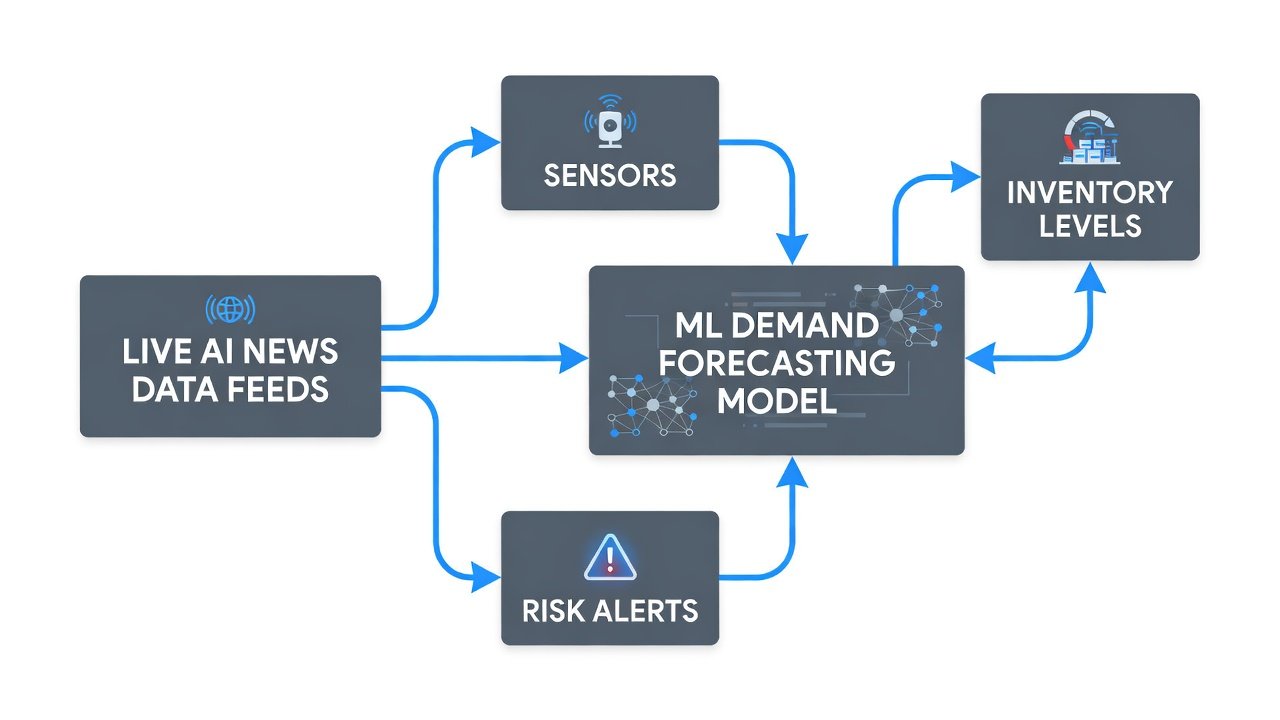
Internet of Things sensors combined with ML create dynamic inventory systems. When paired with AI news monitoring, these models can adjust stock levels based on predicted disruptions like port strikes or raw material shortages highlighted in recent reports. The combination turns passive monitoring into proactive replenishment planning.
Edge devices installed at distribution centers stream temperature, humidity, and movement data continuously. These streams are enriched with contextual news vectors that describe external factors affecting lead times. Reinforcement learning agents then optimize reorder quantities while respecting service-level constraints.
Practical Workflow Example
- Deploy edge computing devices at warehouses to collect real-time sensor readings at five-minute intervals.
- Correlate sensor data with AI news alerts on supply bottlenecks using timestamp alignment techniques.
- Implement reinforcement learning agents that recommend reorder points and safety stock multipliers based on combined inputs.
- Run A/B tests comparing news-augmented policies against baseline sensor-only models over 90-day periods.
Risk Prediction Workflows Powered by AI News
Risk prediction benefits greatly from continuous news ingestion. Models can flag potential issues such as supplier insolvency or regulatory changes days or weeks earlier than conventional methods. A typical workflow begins with multi-source news scraping followed by topic modeling to isolate supply-chain-relevant clusters. These clusters feed into gradient-boosted classifiers that output probability scores for disruption events. Teams then receive prioritized alerts with recommended mitigation actions such as alternative supplier activation or buffer stock increases.
Tool Comparisons: Custom APIs vs Commercial Platforms
Organizations must decide between building custom solutions or adopting commercial platforms. Custom APIs offer flexibility for proprietary data integration but require significant engineering resources for maintenance and scaling. Commercial platforms like those from major cloud providers provide pre-built connectors, managed NLP services, and automatic scaling with less upfront development effort.
Key decision factors include integration speed, ongoing maintenance overhead, customization depth, and total cost of ownership. Many logistics firms begin with commercial offerings from AWS or IBM to validate value quickly before evolving toward hybrid architectures that incorporate internal data lakes. Open-source frameworks can bridge the gap when teams need specialized feature engineering not available in off-the-shelf products.
Case Studies from Logistics Leaders
Leading companies in the sector have demonstrated measurable success with these approaches. One global shipping firm integrated AI news feeds into its forecasting pipeline and observed faster detection of regional demand changes during seasonal peaks. Another major retailer combined sensor streams with news-derived risk signals to reduce excess inventory holdings while maintaining high fill rates across distribution centers. A third example involves a freight forwarder that used custom NLP pipelines on trade news to reroute shipments proactively, avoiding costly delays during unexpected canal restrictions. These cases highlight how combining live signals with established ML techniques produces resilient operations under real-world pressure.
Benchmarks on Accuracy Gains
Industry observations indicate that models incorporating live AI news data frequently deliver meaningful lifts in forecast precision compared with baselines that rely solely on historical patterns. Risk prediction models similarly show reduced false-positive rates when enriched with current-event features. Teams typically measure success through metrics such as mean absolute percentage error for forecasts and area under the ROC curve for risk classifiers. Continuous evaluation against hold-out sets updated monthly ensures gains remain sustainable as news patterns evolve.
Implementation Roadmap and Best Practices
Successful deployments follow a phased roadmap. Phase one focuses on data pipeline construction and basic feature extraction. Phase two introduces model experimentation and offline validation. Phase three moves to controlled production pilots with human oversight. Throughout each stage, documentation of data lineage and model drift detection mechanisms proves essential. Common pitfalls include over-reliance on single news sources and neglecting to retrain embedding layers regularly.
Common Integration Challenges and FAQ
How do I handle noisy or biased news data?
Apply robust filtering layers that cross-reference multiple independent sources and incorporate bias-detection algorithms before any signal reaches the core forecasting engine.
What infrastructure is needed for real-time processing?
Cloud-based streaming services such as managed Kafka clusters combined with event-driven serverless functions support low-latency updates while keeping operational complexity manageable.
Can small teams implement these strategies successfully?
Yes. Many organizations begin with managed services from established providers and open-source NLP libraries, then gradually introduce custom components as internal expertise grows.
How should data privacy be managed when ingesting public news?
Store only aggregated embeddings rather than raw article text and apply strict retention policies aligned with NIST guidelines for AI data handling.
What fallback mechanisms exist if news feeds become unavailable?
Design models to degrade gracefully by increasing reliance on historical features and triggering alerts for manual review during extended outages.
Conclusion
Embracing AI news insights transforms machine learning for supply chain optimization into a proactive, adaptive system. By following the outlined steps, evaluating tooling options carefully, and iterating based on measured outcomes, organizations can build more resilient operations in 2026 and beyond. Continuous monitoring of both model performance and news-source quality remains essential for sustained competitive advantage.


No comments yet. Be the first!