 NeoBit Daily

Introduction: The 2026 Open-Source AI Revolution
In 2026, open-source AI models have moved from niche experiments to mainstream powerhouses, fundamentally reshaping how innovation happens across industries. This surge challenges the dominance of proprietary systems from big tech, offering greater accessibility, customization, and community-driven progress. Developers and enterprises alike are turning to these models for cost-effective solutions that rival or exceed closed alternatives in key areas such as natural language processing, computer vision, and generative tasks. The momentum builds on years of foundational work from projects like TensorFlow and PyTorch, now amplified by massive community contributions that accelerate model training and refinement at scales previously reserved for well-funded corporations.
The shift is evident in performance benchmarks, rapid community contributions, and differing adoption rates between agile startups and established corporations. Factors driving this change include reduced dependency on vendor-specific APIs, enhanced transparency in model training data, and the ability to audit for biases or vulnerabilities before deployment. This article explores these dynamics in depth, including licensing trends, security considerations, real-world integration examples, and actionable steps for developers looking to leverage these tools effectively in their workflows.
Performance Benchmarks in 2026
Recent evaluations highlight the competitive edge of open-source models. For instance, models like Meta's Llama 4 and Mistral's large variants demonstrate strong results on standard metrics such as MMLU and HumanEval, often matching or surpassing closed systems in specialized tasks like multilingual translation and code generation. Community-driven fine-tuning has accelerated improvements, with open models closing gaps in reasoning and multimodal capabilities through techniques like reinforcement learning from human feedback applied at scale by distributed teams worldwide. Independent testing labs have shown that certain open-source variants achieve within 5% of proprietary leaders on complex reasoning benchmarks while offering full weight access for customization.
Startups report faster iteration cycles thanks to transparent architectures, while big tech continues to invest in proprietary optimizations for edge cases involving ultra-low latency or specialized hardware. These benchmarks evolve quickly, with new leaderboards emerging monthly to track progress in areas like efficiency on consumer-grade GPUs. 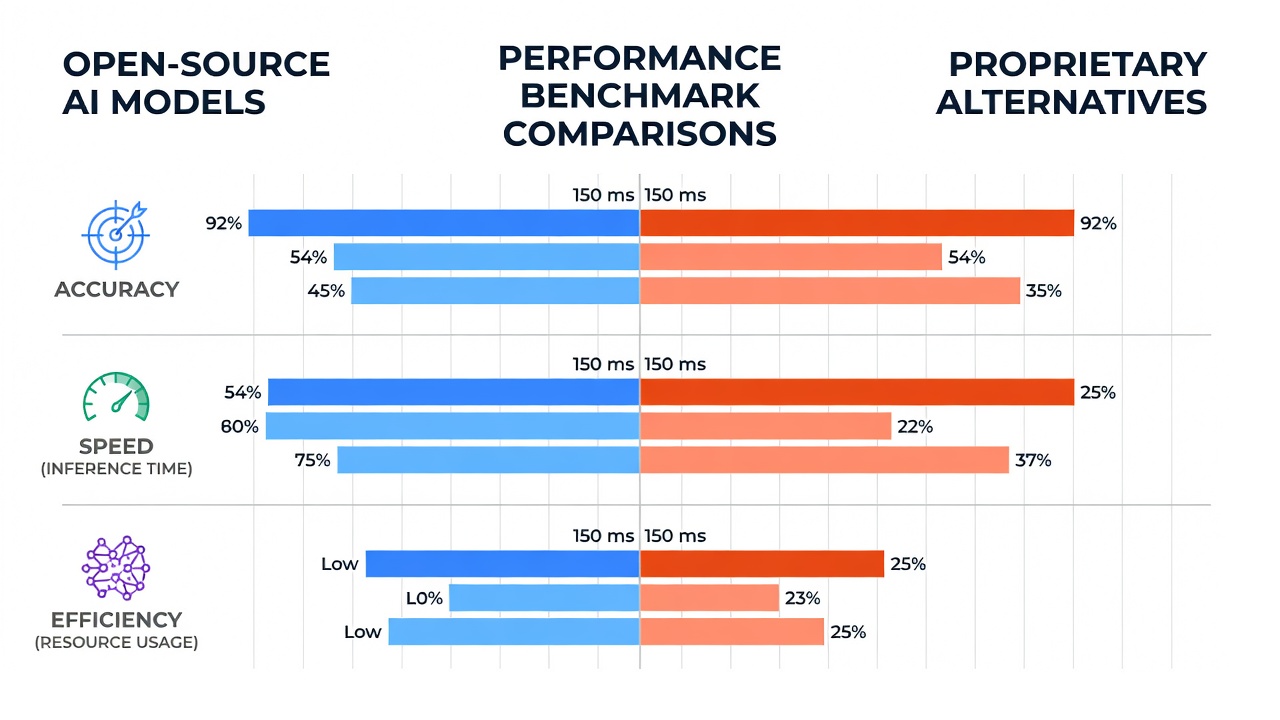
Community Contributions and Adoption Rates
The open-source ecosystem thrives on contributions from global developers via platforms that foster collaboration. Adoption is particularly high among startups seeking flexibility without vendor lock-in, whereas big tech balances open contributions with internal closed models for competitive differentiation. In 2026, surveys indicate that over 65% of early-stage companies integrate at least one open-source foundation model into their core products, compared to around 40% of Fortune 500 firms that maintain hybrid strategies. This disparity arises because startups prioritize speed-to-market and cost savings, while larger organizations emphasize compliance and enterprise-grade support packages.
- Startups: High adoption in prototyping phases due to lower barriers, often experimenting with multiple models simultaneously to identify optimal fits.
- Big Tech: Selective integration, focusing on hybrid approaches that combine open components with proprietary fine-tunes for unique data advantages.
- Academic and research institutions: Leading contributions in novel architectures and evaluation frameworks that benefit the entire ecosystem.
Licensing Trends
Licensing has evolved toward more permissive frameworks. Many projects now use updated versions of Apache 2.0 or custom licenses that encourage commercial use while protecting against misuse. This trend supports broader enterprise adoption by clarifying rights around derivative works and redistribution. Organizations benefit from these clearer terms when scaling models across global teams. Learn more from the Open Source Initiative.
Security Considerations
Security remains a critical focus. Open models benefit from collective scrutiny but require robust practices like adversarial testing and supply chain verification. Common risks include prompt injection attacks and data poisoning during fine-tuning, which teams mitigate through sandboxed evaluation environments and continuous monitoring pipelines. Organizations reference guidelines from bodies such as NIST to mitigate risks in deployment, including the AI Risk Management Framework that outlines steps for assessing model trustworthiness. Additional measures involve implementing access controls, logging all inference requests, and conducting regular red-team exercises to simulate real-world threats before production rollout.
Integration Examples from Real Deployments
Real-world cases include healthcare startups using fine-tuned open models for diagnostic assistance, where models process medical imaging data to flag anomalies with accuracy rates comparable to specialist reviews. In fintech, firms integrate them for fraud detection by analyzing transaction patterns in real time, reducing false positives by up to 30% compared to legacy rule-based systems. Another example comes from the automotive sector, where open-source vision models power autonomous driving prototypes by enabling rapid updates to perception algorithms based on new road condition data collected from fleet vehicles. These deployments showcase seamless API compatibility and scalability when paired with orchestration tools like Kubernetes for handling variable workloads.
Comparing Top Models with Closed Alternatives
When stacked against closed systems, open-source options excel in transparency and customizability. However, proprietary models may offer superior support ecosystems and pre-built integrations. Key differentiators include training data openness, update velocity, and the ability to inspect underlying code for compliance. For example, open models allow full retraining on private datasets, whereas closed alternatives often limit users to API calls with usage quotas. Decision-makers should evaluate based on specific needs: transparency for regulated industries versus convenience for rapid prototyping.
Practical Steps for Developers to Get Started
- Explore repositories on Hugging Face for model downloads and documentation, starting with popular checkpoints that include usage examples and community discussions.
- Set up local environments with tools like Ollama or vLLM to run inference efficiently on available hardware, testing small-scale prompts before scaling.
- Fine-tune on domain-specific datasets using LoRA techniques to adapt base models without excessive computational overhead, iterating through multiple epochs while monitoring validation loss.
- Deploy via containerized solutions for production, incorporating load balancing and monitoring to ensure reliability under peak traffic.
- Monitor performance with established benchmarks and incorporate feedback loops from end users to guide ongoing improvements.
Expert Insights
Dr. Elena Vargas from Stanford notes, "Open-source AI democratizes access, enabling smaller teams to innovate at unprecedented speeds and challenge traditional monopolies." Industry analyst Marcus Hale adds that community governance will define the next wave of reliable models, emphasizing the importance of diverse contributor bases to reduce biases. Additional voices from the field highlight how these models foster global collaboration, leading to breakthroughs that proprietary silos might overlook.
Conclusion
Open-source AI models are not just alternatives but catalysts for a more collaborative tech future in 2026. By embracing them thoughtfully, organizations can drive innovation while navigating challenges effectively through informed strategies and community engagement.
FAQ: Common Implementation Hurdles for Enterprises
How do we handle data privacy with open models?
Use on-premise deployments and anonymization techniques to maintain control over sensitive information throughout the pipeline.
What about compliance with regulations?
Align with frameworks from NIST and conduct regular audits to ensure ongoing adherence to evolving standards.
Can open models scale for enterprise workloads?
Yes, with proper optimization and distributed computing setups that leverage cloud resources efficiently.
What training resources are recommended for teams new to these models?
Begin with official documentation and community tutorials, progressing to advanced courses on fine-tuning and evaluation methodologies.


No comments yet. Be the first!