 NeoBit Daily

Introduction to Edge AI in the 2026 IoT Landscape
The year 2026 represents a major turning point for the Internet of Things as edge AI chipsets mature into powerful enablers of local intelligence. These specialized processors allow IoT devices to run complex machine learning models directly on hardware, delivering instant insights without relying on distant cloud servers. This shift dramatically reduces latency, strengthens data privacy, and lowers overall network bandwidth requirements across industrial, municipal, and consumer applications.
Traditional cloud architectures require constant data transmission from sensors to centralized data centers, which introduces delays measured in hundreds of milliseconds and creates single points of failure during connectivity outages. Edge AI chips overcome these limitations by performing inference at the source, enabling truly autonomous operation in environments where milliseconds matter, such as collision avoidance systems or critical infrastructure monitoring.
How Edge AI Chips Function in Modern IoT Devices
At their core, 2026 edge AI chipsets integrate neural processing units optimized for common deep learning operations like convolutions and matrix multiplications. These units work alongside traditional microcontrollers to handle both sensor data acquisition and real-time model execution. Many designs incorporate dedicated memory hierarchies that keep frequently accessed weights on-chip, further boosting speed while minimizing power draw.
Developers can now deploy quantized models that maintain high accuracy while fitting within the tight memory and thermal budgets of small form-factor devices. Frameworks supporting these chips allow seamless model conversion from popular training environments, accelerating time-to-deployment for custom solutions.
Performance Gains and Energy Efficiency Breakthroughs
Benchmarks released in early 2026 show edge AI chipsets achieving up to ten times faster inference compared with previous generations while consuming 40 percent less energy under typical workloads. These gains result from architectural refinements including wider vector pipelines, improved sparsity exploitation, and advanced power-gating techniques that deactivate unused cores during idle periods.
When measured against cloud-centric approaches, on-device processing eliminates round-trip network delays and reduces energy spent on radio transmission. This combination proves especially valuable for battery-powered sensors expected to operate for years without maintenance. Thermal management also improves, allowing denser deployments in confined spaces without active cooling.
Real-World Deployments Across Key Sectors
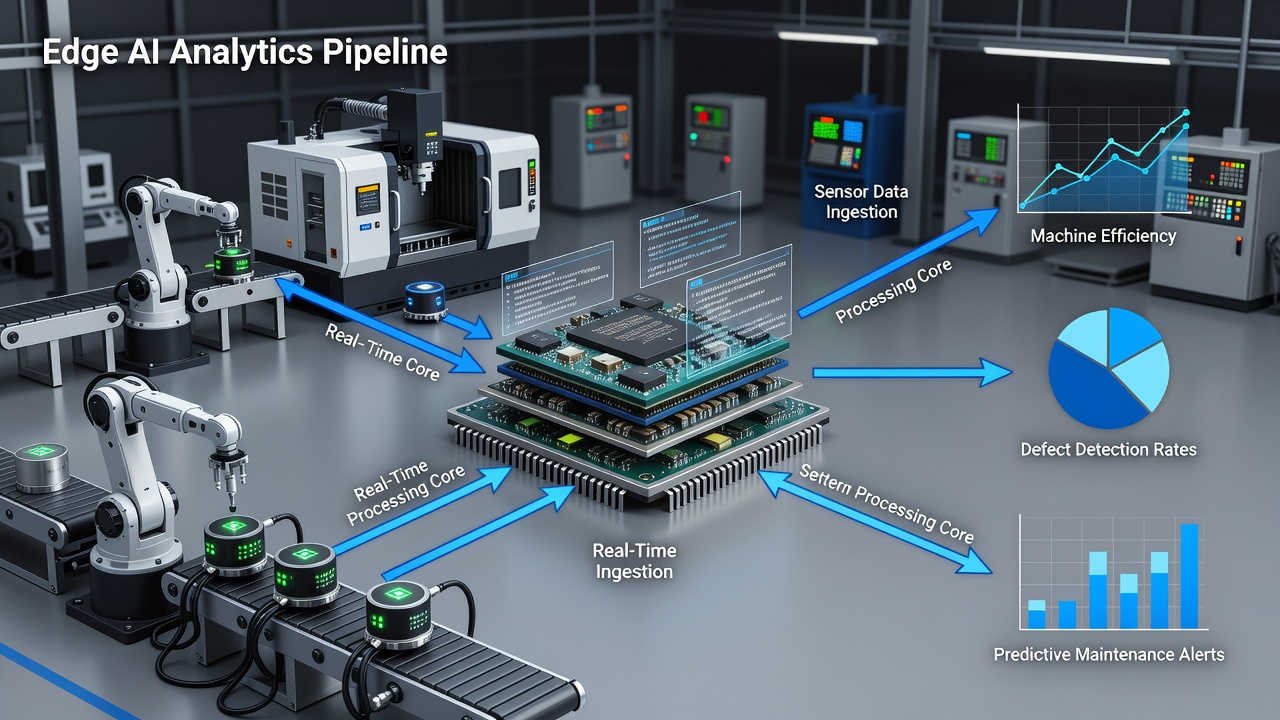
Smart city initiatives worldwide now embed edge AI chips in traffic cameras and environmental sensors. These devices analyze video feeds locally to detect congestion patterns and adjust traffic signals in real time, cutting average commute times while preserving citizen privacy by discarding raw footage after processing. Manufacturing plants deploy vibration and temperature sensors equipped with the same technology to identify bearing wear or overheating components before failures occur, enabling predictive maintenance schedules that minimize unplanned downtime.
Consumer wearables represent another high-growth area. Smart rings and fitness trackers process heart-rate variability and motion data on-device to deliver immediate wellness recommendations. Leading vendors showcase production lines where these chips operate continuously under strict power constraints.
Direct Comparison with Traditional Cloud Computing
Cloud computing excels at large-scale model training and centralized data aggregation, yet it struggles with strict latency and connectivity requirements. Edge AI complements the cloud by handling time-sensitive inference locally and forwarding only aggregated insights or model updates when bandwidth permits. Hybrid architectures therefore combine the best of both worlds: edge responsiveness paired with cloud-scale learning.
Practical Adoption Steps for Enterprises
Organizations evaluating edge AI integration should begin with a thorough audit of existing IoT fleets to identify devices capable of hardware upgrades or replacement. Next, teams run controlled pilot programs focused on one high-value use case, such as quality inspection on an assembly line, to measure tangible improvements in response time and cost savings. Selecting vendors that provide robust software development kits and pre-optimized model libraries reduces engineering effort significantly.
After successful pilots, enterprises scale by establishing standardized deployment pipelines that push model updates over-the-air while maintaining strict version control. Ongoing monitoring of power consumption, thermal profiles, and inference accuracy ensures sustained performance. Cross-functional training programs help operations and data science teams collaborate effectively on edge-specific challenges.
Challenges Including Security and Interoperability
Security remains paramount because local processing expands the attack surface to every deployed device. Best practices include hardware-rooted secure boot, encrypted model storage, and runtime attestation mechanisms that verify firmware integrity. Interoperability issues surface when mixing chipsets from different suppliers; adherence to open standards for model formats and communication protocols mitigates fragmentation.
Organizations are advised to reference guidelines from authoritative bodies such as NIST when designing security architectures. Additional considerations include lifecycle management for long-lived devices and strategies for handling model drift as environmental conditions evolve.
Future Outlook and Strategic Recommendations
Analysts anticipate continued rapid evolution of edge AI silicon through 2027, with new entrants introducing even more efficient architectures. Enterprises that invest early in pilot programs and skills development position themselves to capture competitive advantages in automation and responsiveness. Collaboration with established technology providers such as Arm and NVIDIA accelerates access to cutting-edge reference designs and long-term support roadmaps.
FAQ
What factors influence integration complexity for edge AI chips?
Integration complexity depends on firmware compatibility, availability of optimized libraries, and the degree of model customization required. Starting with vendor-supported reference platforms typically shortens development cycles from months to weeks.
How scalable are edge AI solutions across large IoT networks?
Modern chipsets support over-the-air model updates and hierarchical aggregation, allowing networks to expand from dozens to thousands of nodes while maintaining consistent performance and centralized oversight.
Are there specific interoperability standards gaining traction in 2026?
Industry consortia continue advancing open formats for neural network exchange and secure device onboarding, simplifying multi-vendor environments and reducing long-term maintenance overhead.
What skills do teams need to successfully deploy edge AI projects?
Core competencies include embedded systems programming, model optimization techniques, and familiarity with edge-specific monitoring dashboards. Many organizations supplement internal capabilities through targeted vendor training programs.
No comments yet. Be the first!