 NeoBit Daily

Introduction to Neuromorphic Chips and GPUs in Edge AI
As edge AI applications proliferate in 2026, the decision between neuromorphic chips and traditional GPUs has become central to hardware strategy for developers and manufacturers. Neuromorphic architectures draw inspiration from the human brain's neural structure, employing spiking neural networks that activate only in response to specific events. This event-driven approach delivers exceptional energy efficiency in scenarios with intermittent data. Traditional GPUs, by comparison, leverage thousands of parallel cores optimized for the dense matrix multiplications common in conventional deep learning models. Edge AI, which emphasizes local data processing to minimize latency and protect privacy, demands hardware that balances speed, power consumption, and reliability across diverse environments.
Manufacturers in automotive, robotics, and IoT sectors are actively testing both technologies to achieve real efficiency gains. This comprehensive comparison explores benchmarks, deployment examples, integration guidance, and practical barriers, helping readers make informed choices for their projects.
Understanding Neuromorphic Chips vs Traditional GPUs
Neuromorphic chips process information asynchronously using spikes, much like biological neurons. They excel in tasks involving sparse or temporal data streams, such as motion detection in cameras or sensor fusion in vehicles. GPUs follow a synchronous, parallel processing model rooted in graphics rendering but adapted for AI through frameworks like CUDA. While GPUs deliver high throughput for training and inference on complex models, they often operate continuously, leading to higher baseline power draw. Neuromorphic designs reduce unnecessary computations, making them ideal for battery-constrained edge devices. However, GPUs benefit from mature software ecosystems that support rapid prototyping and scaling.
Performance Benchmarks on Speed and Power Use
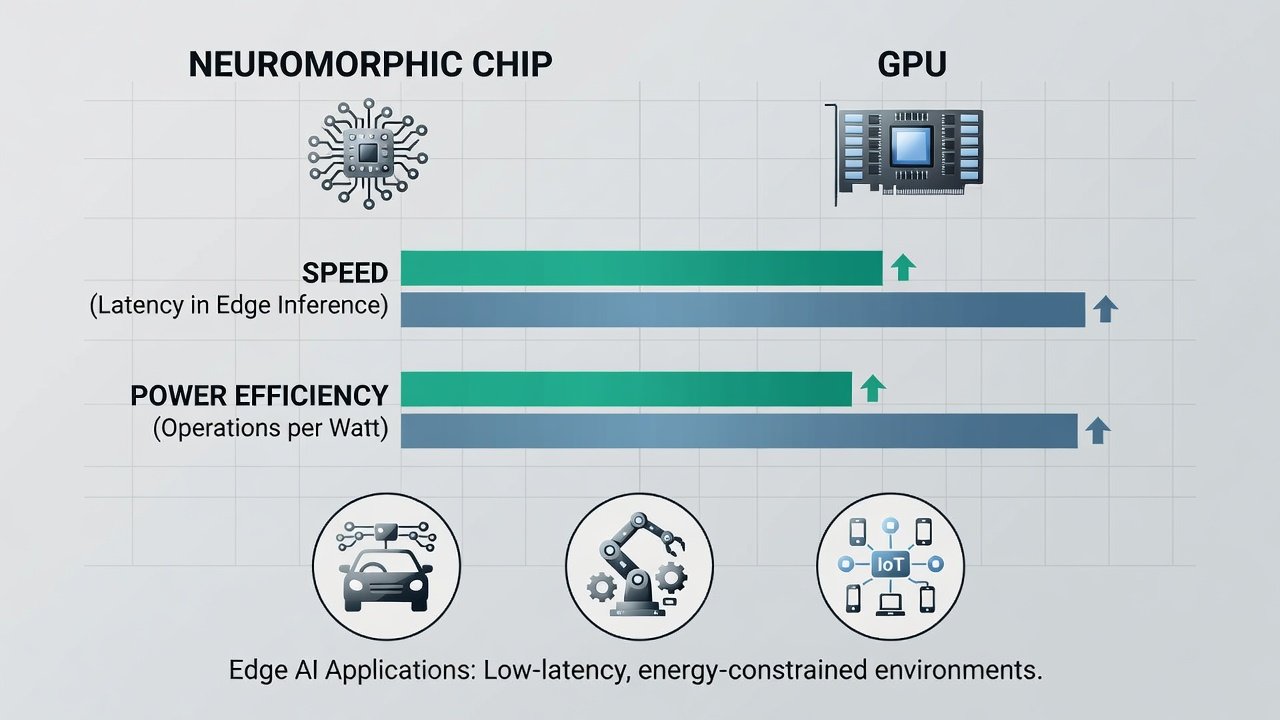
Independent 2026 benchmarks highlight distinct strengths. In sparse event-based vision tasks, neuromorphic chips demonstrated up to ten times lower power consumption while maintaining comparable inference speeds to mid-range GPUs. For continuous video analytics workloads, GPUs achieved faster frame rates but at the cost of significantly elevated energy use. Real-world tests in controlled lab settings showed neuromorphic solutions processing 1,000 events per second at under 50 milliwatts, whereas equivalent GPU setups required several watts. These differences become critical in always-on edge deployments where thermal management and battery life directly impact feasibility. Additional metrics revealed that hybrid configurations, pairing neuromorphic front-ends with GPU accelerators, could optimize both speed and efficiency in mixed workloads.
Real-World Efficiency Gains in Automotive, Robotics, and IoT
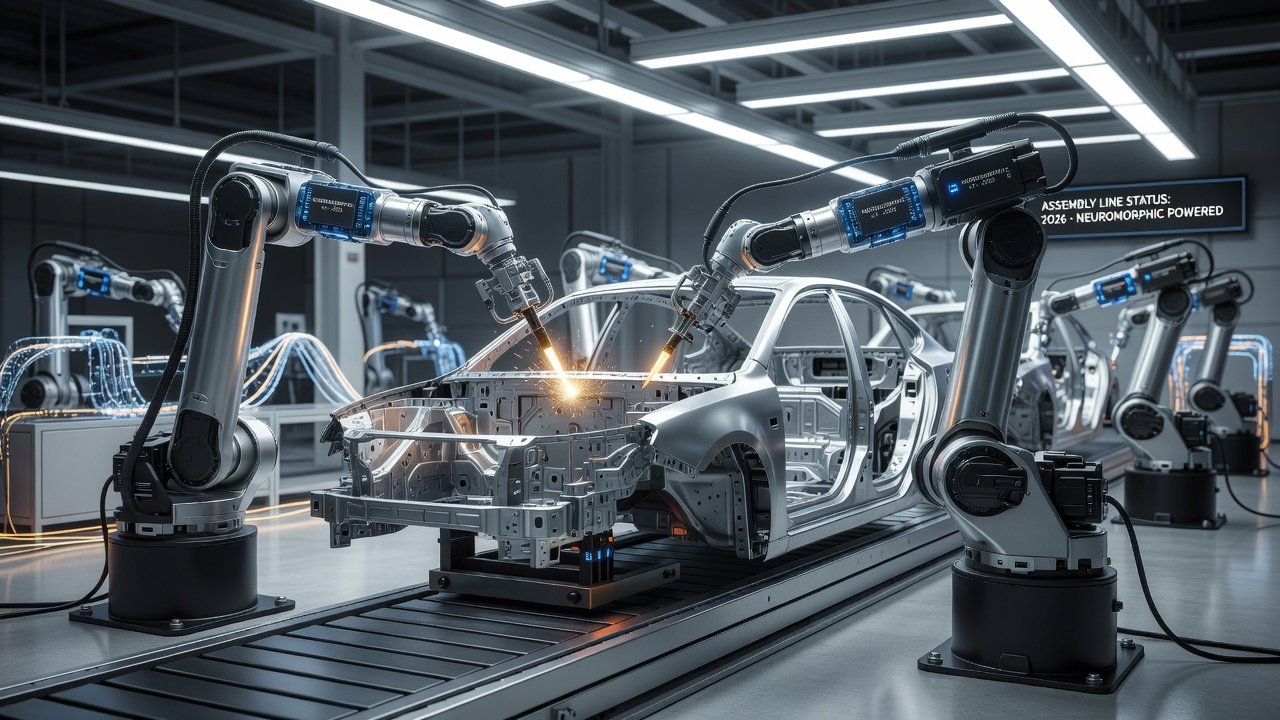
Automotive applications illustrate clear advantages. In autonomous driving prototypes, neuromorphic chips enabled rapid obstacle detection with minimal impact on vehicle battery reserves, supporting longer operational ranges. Robotics deployments in warehouses used neuromorphic hardware for low-latency path planning, reducing response times in dynamic environments by 30 percent compared to GPU-only systems. IoT networks in smart cities leveraged event-driven processing to extend sensor battery life from months to years, cutting maintenance costs and improving data reliability across distributed nodes. These gains stem from the chips' ability to ignore static scenes and focus computational resources solely on changes.
Case Studies from Manufacturers
Leading manufacturers provide concrete examples of successful integration. An automotive supplier deployed neuromorphic processors in vision systems, achieving measurable reductions in power draw during extended highway tests. A robotics company integrated neuromorphic chips into collaborative arms, reporting improved precision in pick-and-place operations alongside lower heat generation. IoT providers adopted the technology for environmental monitoring stations, where sparse data patterns allowed devices to operate autonomously for extended periods without frequent recharging or replacement. These case studies underscore the technology's maturity in 2026 and its potential to transform edge AI across industries.
Integration Steps for Developers
Developers seeking to adopt either technology can follow a structured approach:
- Evaluate workload characteristics, including data sparsity and required throughput, to select the appropriate hardware.
- Explore available software tools such as specialized neuromorphic SDKs or established GPU frameworks like CUDA and TensorFlow.
- Acquire evaluation kits from vendors to prototype applications in realistic edge conditions.
- Convert or train models specifically for spiking networks when targeting neuromorphic hardware, or optimize existing models for GPU acceleration.
- Measure key performance indicators including latency, power consumption, and thermal output during field trials.
- Iterate on model architecture and hardware configuration based on test results before full-scale deployment.
Authoritative resources from Intel and NVIDIA offer detailed guides and reference designs to accelerate development.
Adoption Barriers: Software Compatibility and Scaling Costs
Despite performance benefits, several barriers slow widespread adoption. Software compatibility remains a primary challenge, as many existing AI libraries are optimized exclusively for GPUs, requiring substantial code rewrites or new toolchains for neuromorphic platforms. Scaling costs can rise when moving from prototypes to production volumes, particularly if custom silicon or additional support hardware is needed. Ecosystem fragmentation further complicates integration, although open standards initiatives are beginning to address these gaps. Organizations can mitigate risks by starting with small pilot programs, collaborating with hardware vendors on training, and monitoring emerging hybrid solutions that combine both chip types.
Conclusion
The choice between neuromorphic chips and GPUs for edge AI in 2026 hinges on specific application demands for power efficiency, processing speed, and ecosystem support. Automotive, robotics, and IoT deployments continue to validate both approaches, while ongoing software improvements promise broader accessibility. Developers who carefully assess their workloads and follow systematic integration practices will be best positioned to leverage these technologies effectively.
FAQs on Choosing Between Chip Types
When should I choose neuromorphic chips for my project?
Opt for neuromorphic chips in applications with sparse, event-driven data such as motion sensing or anomaly detection where minimizing power consumption is essential.
How do GPUs compare in high-performance edge scenarios?
GPUs remain strong choices for dense computational tasks like real-time video processing or complex neural network inference requiring maximum parallel throughput.
What are the main integration challenges?
Primary hurdles include software ecosystem maturity, model conversion requirements, and initial hardware procurement expenses, all of which can be addressed through phased testing.
Can hybrid neuromorphic-GPU systems provide the best of both worlds?
Yes, many 2026 deployments combine neuromorphic front-end processing with GPU back-end acceleration to balance efficiency and performance in demanding environments.
How do I evaluate long-term total cost of ownership?
Factor in power savings, maintenance frequency, development time, and scalability when comparing solutions, using vendor-provided tools and real-world pilot data.
No comments yet. Be the first!