 NeoBit Daily

Introduction to Neuromorphic Chips in 2026 IoT Ecosystems
Neuromorphic computing has emerged as a transformative force for edge AI deployments in 2026. These brain-inspired chips process data with event-driven architectures that drastically cut power consumption compared to traditional GPUs. In IoT environments, where devices operate on limited batteries or harvested energy, neuromorphic solutions enable always-on intelligence without frequent recharging or oversized power supplies. The shift toward these specialized processors addresses core challenges in distributed sensor networks, including heat dissipation, maintenance costs, and real-time decision making at remote locations.
Organizations deploying smart sensors and edge systems now prioritize these chips for applications requiring low latency and high efficiency. This article examines real-world integrations, performance data, automotive-adjacent use cases, and practical guidance for developers seeking to modernize their infrastructure.
Understanding Neuromorphic Architectures and Their Edge Advantages
Neuromorphic chips emulate the structure of biological neural systems through networks of artificial neurons and synapses that communicate via discrete spikes rather than continuous signals. This design allows them to remain in a low-power idle state until relevant events occur, making them exceptionally suited for the sporadic data patterns typical in IoT deployments. In contrast to GPUs that rely on parallel matrix multiplications across thousands of cores, neuromorphic hardware processes information asynchronously, reducing unnecessary computations and heat generation.
Key benefits include native support for temporal data processing, which excels in time-series analysis from vibration or acoustic sensors. Developers appreciate the ability to run lightweight spiking neural networks directly on-device, minimizing reliance on cloud resources and associated latency penalties.
Real-World Integrations in IoT and Edge AI Systems
In 2026, neuromorphic chips power industrial IoT gateways, environmental monitoring nodes, and predictive maintenance platforms. Integration typically occurs at the sensor level, allowing raw data processing before transmission to the cloud. This reduces bandwidth needs and improves response times in remote deployments where connectivity may be intermittent or costly.
Leading hardware vendors have released second-generation neuromorphic processors optimized for edge constraints. These chips handle spiking neural networks that mimic biological neurons, making them ideal for pattern recognition in noisy environments such as factories or outdoor agricultural fields. Integration examples include embedding chips into wireless sensor nodes for soil moisture tracking or structural health monitoring in bridges and buildings.
Power Savings Versus GPUs: Benchmarks and Metrics
Neuromorphic architectures deliver substantial efficiency improvements. Event-based processing activates only when data changes, unlike GPUs that run continuous matrix operations. Independent evaluations show neuromorphic chips achieving up to 100x lower energy per inference in sparse-data scenarios common to IoT sensors. Latency reductions average 5-15 milliseconds in real-time classification tasks, critical for applications like vibration analysis or anomaly detection. Scalability tests confirm consistent gains as sensor density increases across large networks.
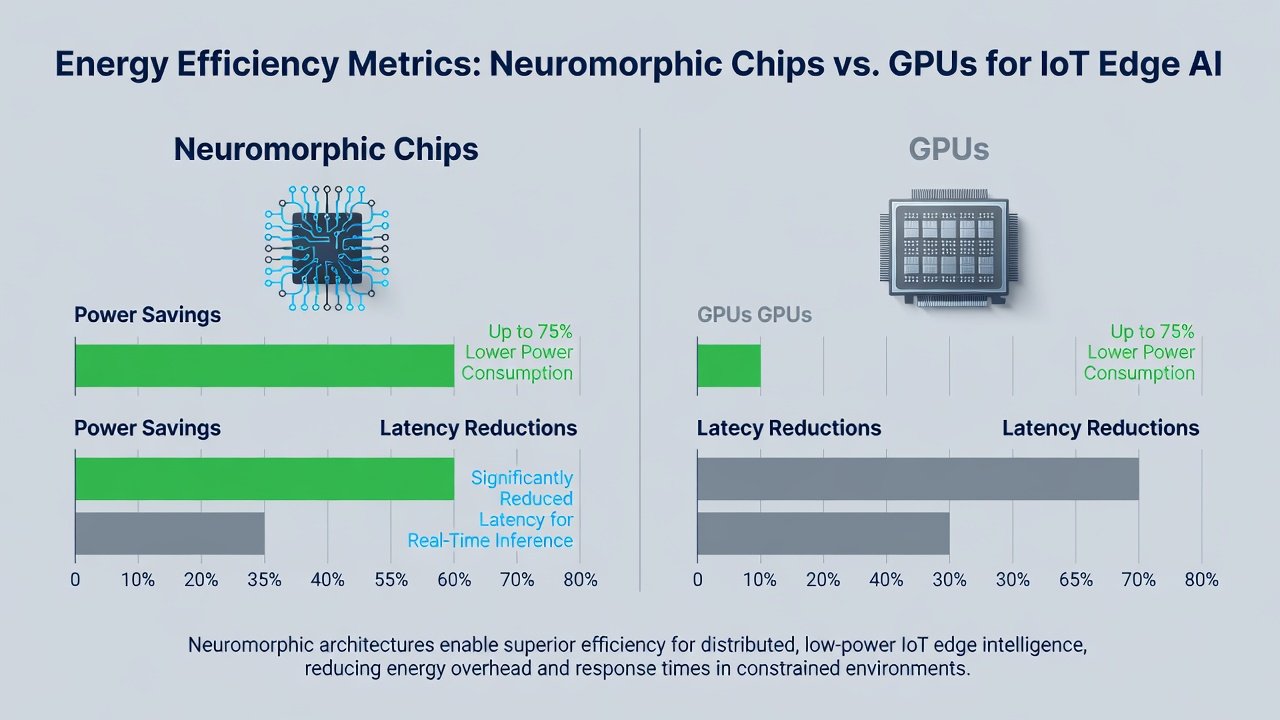
Additional benchmarks highlight how these chips maintain high accuracy while operating at milliwatt power levels, enabling multi-year deployments on small batteries or energy harvesters. GPU alternatives often require watts of power, leading to frequent maintenance cycles in field installations.
Automotive-Adjacent IoT Case Studies
Automotive-adjacent IoT deployments, such as fleet telematics and roadside infrastructure sensors, benefit significantly. One logistics company integrated neuromorphic edge nodes to monitor tire pressure and engine vibrations across thousands of vehicles, cutting data transmission by 80% while maintaining predictive accuracy for maintenance scheduling. Similar projects in smart city traffic systems use these chips for pedestrian detection with minimal power draw from solar panels, allowing continuous operation without grid connections.
Another example involves warehouse robotics where neuromorphic processors enable obstacle avoidance and inventory scanning at the edge, improving throughput without increasing energy budgets. These cases demonstrate tangible operational improvements in environments that mirror automotive sensor demands.
Integration Steps for Developers
Developers can follow these detailed steps to adopt neuromorphic chips successfully:
- Assess hardware compatibility by reviewing datasheets from established providers and selecting platforms that support standard interfaces like SPI or I2C for sensor connectivity.
- Convert existing models using specialized conversion tools that map conventional neural networks to event-driven spiking equivalents, preserving accuracy during the transition.
- Optimize firmware for low-power modes, incorporating sleep states and dynamic voltage scaling to maximize battery life in remote IoT nodes.
- Integrate with standard IoT protocols such as MQTT or CoAP while testing end-to-end data pipelines for reliability under variable network conditions.
- Validate performance through iterative testing on target hardware using real sensor streams, measuring both latency and energy metrics against baseline GPU implementations.
- Deploy with over-the-air update capabilities and monitoring dashboards to track long-term efficiency gains and facilitate future model refinements.
Additional considerations include selecting development environments that include simulation tools for spiking networks before hardware deployment.
Adoption Barriers and Mitigation Strategies
Key barriers include limited software ecosystem maturity and the need for specialized expertise in neuromorphic programming. Training data must be adapted for spiking formats, and debugging event-driven code requires new tools. Mitigation involves starting with vendor-provided SDKs and participating in open-source communities. Organizations often begin with pilot projects on a small number of nodes before scaling, allowing teams to build internal knowledge gradually. Partnerships with research institutions can also accelerate learning curves associated with novel architectures.
ROI Calculations with Enterprise Examples
Enterprises report positive ROI within 12-18 months through reduced energy costs and lower cloud egress fees. One manufacturing firm documented substantial operational savings after replacing GPU-based edge servers with neuromorphic alternatives in their sensor network, primarily from decreased electricity consumption and simplified cooling requirements. Another logistics operator achieved faster incident response times, translating into reduced downtime costs across their vehicle fleet. Qualitative factors such as improved reliability and extended device lifespan further enhance overall returns on investment.
Energy Metrics Comparison Across Chip Models
Comparative analysis across available models highlights differences in efficiency for various workloads. Neuromorphic designs consistently outperform GPUs in always-on IoT workloads while maintaining competitive accuracy on vision and audio tasks. Factors such as spike rate encoding and synaptic density influence overall performance, with newer iterations showing progressive improvements in handling complex multi-sensor fusion.
Scalability for Smart Sensors
Scalability remains strong for dense sensor arrays. Neuromorphic chips handle thousands of simultaneous inputs with linear power scaling, unlike GPU solutions that plateau under heavy parallelism constraints. This makes them suitable for expanding smart city or industrial IoT installations without proportional increases in infrastructure overhead. Future expansions can leverage modular designs that allow incremental addition of processing nodes.
Conclusion
Neuromorphic chips represent a practical path forward for efficient 2026 IoT edge deployments. By focusing on power savings, latency improvements, and structured integration, organizations can achieve measurable gains in automotive-adjacent and industrial applications. Continued advancements will further solidify their role in next-generation edge intelligence.
FAQs
What are typical implementation timelines for neuromorphic IoT projects?
Most teams complete proof-of-concept phases in 8-12 weeks, with full production rollout following in 4-6 months depending on sensor complexity and team experience levels.
What does the 2027 roadmap look like for neuromorphic hardware?
Expect third-generation chips with enhanced on-chip learning capabilities and broader framework support from major silicon providers, enabling more autonomous edge systems.

No comments yet. Be the first!