 NeoBit Daily

Introduction to Quantum Threats in Immersive and Decentralized Technologies
As quantum computing advances rapidly toward practical applications by 2026, traditional encryption methods face unprecedented risks. VR, AR, and blockchain ecosystems are particularly vulnerable due to their reliance on complex data exchanges, decentralized ledgers, and real-time immersive interactions. Organizations must shift from reactive defenses to proactive strategies that incorporate quantum-resistant encryption and secure multi-party computation. This comprehensive guide details how these technologies intersect with emerging threats, offering actionable insights for developers, security teams, and enterprise adopters preparing for the post-quantum era.
Understanding Threat Models in VR, AR, and Blockchain Environments
Immersive environments introduce unique threats such as side-channel attacks on spatial data streams and man-in-the-middle intercepts during collaborative AR sessions. In VR systems, attackers could exploit quantum algorithms to break session keys and inject malicious overlays that compromise user privacy or manipulate virtual environments in real time. Blockchain systems face quantum risks to elliptic curve cryptography, potentially exposing private keys and enabling transaction forgery on a massive scale. Decentralized ledgers must contend with harvest-now-decrypt-later attacks where adversaries collect encrypted data today for future quantum decryption once large-scale quantum computers become available.
Key Vulnerabilities Across Platforms
- Real-time data transmission in VR/AR susceptible to quantum eavesdropping on wireless protocols like Wi-Fi 6 or 5G
- Smart contract signatures at risk from Shor's algorithm, allowing forgery of digital signatures
- Multi-user environments enabling coordinated quantum-assisted breaches through shared AR spaces
- Supply chain attacks targeting hardware wallets or VR headsets with embedded quantum-vulnerable chips
These models highlight the need for layered defenses that address both current classical threats and future quantum capabilities.
Quantum-Resistant Encryption Methods: Comparisons and Analysis
Post-quantum cryptography (PQC) algorithms like lattice-based and hash-based schemes offer robust alternatives to RSA and ECC. Lattice-based methods such as Kyber provide efficient key encapsulation suitable for low-latency VR applications, delivering strong security with manageable computational costs. Hash-based signatures like SPHINCS+ excel in blockchain verification scenarios due to their simplicity and resistance to quantum attacks, though they produce larger signature sizes. Code-based algorithms such as Classic McEliece offer high security margins but require significant storage, making them less ideal for resource-constrained AR devices. Multivariate polynomial schemes like Rainbow provide fast verification yet face ongoing cryptanalysis concerns.
Compared to traditional RSA, these resist both classical and quantum attacks but may incur higher computational overhead in initial implementations. For balanced performance, hybrid approaches combining classical and PQC algorithms ensure backward compatibility during the 2026 transition period. Security levels are standardized by NIST, with Level 1 offering 128-bit classical security equivalent and Level 5 providing 256-bit protection. Developers should evaluate trade-offs in bandwidth, latency, and energy consumption when selecting algorithms for immersive or decentralized deployments.
Secure Multi-Party Computation for Decentralized Security
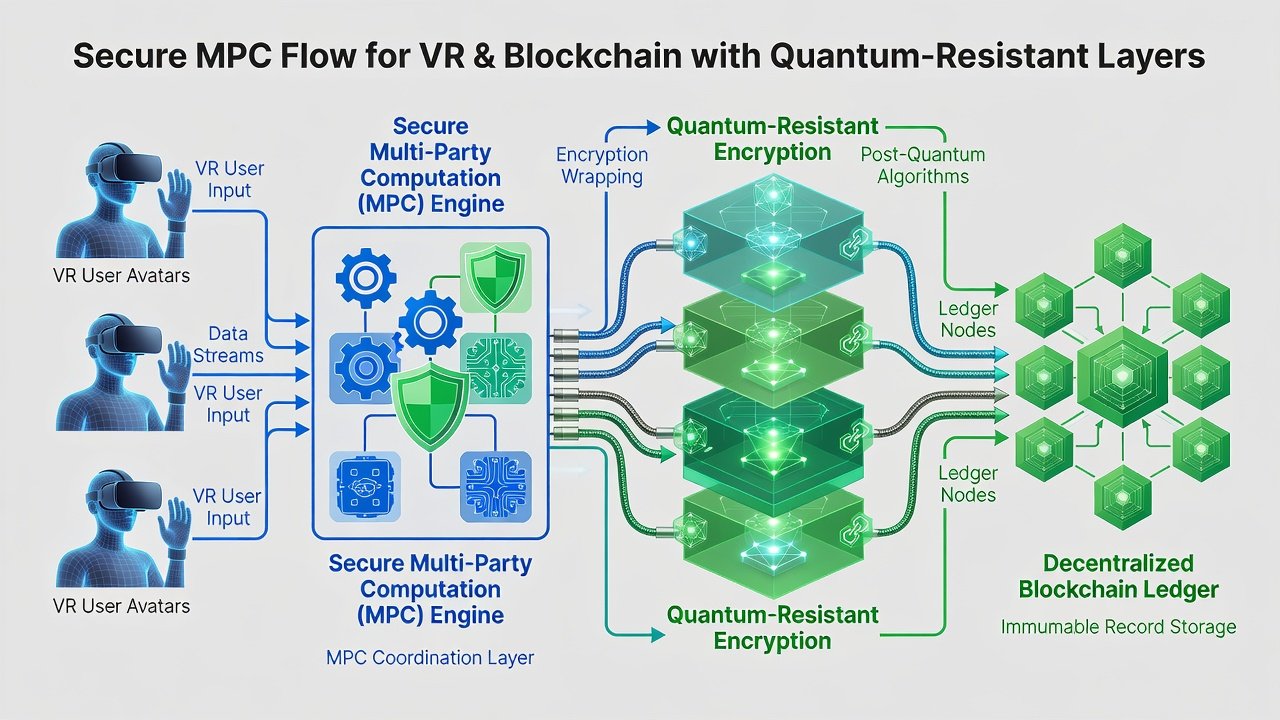
SMPC enables collaborative computations without revealing private inputs, ideal for privacy-preserving AR shared experiences and confidential blockchain transactions. Implementations using garbled circuits or secret sharing protocols protect against quantum threats by avoiding single-point decryption. In practice, SMPC allows multiple parties to jointly analyze spatial data in AR without exposing individual user movements or locations. For blockchain, it supports secure multi-signature approvals where no single node holds complete private information.
Advantages include resistance to quantum decryption of intermediate values and enhanced privacy in federated learning setups for VR analytics. Challenges involve increased communication rounds and the need for trusted setup ceremonies, which can be mitigated through verifiable secret sharing techniques. As 2026 approaches, open-source SMPC libraries are maturing to integrate seamlessly with major VR engines and distributed ledger platforms.
Practical Implementation Steps
- Audit existing cryptographic libraries for PQC readiness using tools from NIST guidelines, identifying all instances of ECC or RSA usage across VR SDKs and smart contracts.
- Integrate lattice-based encryption into VR/AR SDKs for session key exchanges, starting with pilot tests on non-critical environments to measure latency impacts.
- Deploy SMPC frameworks in blockchain nodes for multi-signature wallets, beginning with low-value transaction testing before scaling to production ledgers.
- Conduct penetration testing simulating quantum adversaries through classical approximations and hybrid attack models to validate defenses.
- Monitor and update to standardized PQC algorithms as they finalize, maintaining a migration roadmap that includes staff training on new primitives.
- Establish ongoing monitoring with quantum threat intelligence feeds to adjust encryption parameters dynamically as hardware evolves.
Real-World Examples from Emerging Tech Deployments
Leading VR platforms are piloting PQC in enterprise training simulations to secure sensitive spatial data against future quantum interception. For instance, industrial AR maintenance systems have adopted hybrid Kyber implementations to protect overlay instructions shared across global teams. Blockchain projects in supply chain management have adopted hybrid encryption to future-proof ledgers against quantum risks, with several networks testing SPHINCS+ for asset transfer signatures. AR navigation apps leverage SMPC for anonymous user data aggregation while maintaining accuracy, enabling collaborative mapping without compromising individual privacy. These deployments demonstrate measurable improvements in resilience, with early adopters reporting successful mitigation of simulated quantum attacks in controlled environments.
Mistakes to Avoid During Adoption
Common pitfalls include underestimating performance overhead, leading to degraded user experiences in latency-sensitive VR applications. Another error is neglecting hybrid models, which can cause compatibility breaks with legacy systems. Teams often overlook the importance of regular algorithm updates, leaving systems exposed as new quantum advancements emerge. Finally, failing to train personnel on PQC concepts results in improper implementation and increased vulnerability windows.
FAQ: Addressing Adoption Barriers and Integration Challenges
What are the main barriers to adopting quantum-resistant tactics?
Performance overhead and lack of standardized tools often delay integration, though 2026 frameworks are improving compatibility with future tech stacks like Web3 and spatial computing platforms.
How does SMPC integrate with existing VR/AR pipelines?
Through modular libraries that layer onto current rendering engines, enabling secure multi-user sessions without major rewrites to core graphics code.
Are there compatibility issues with legacy blockchain systems?
Hybrid models allow gradual migration, minimizing disruptions during upgrades while preserving transaction validity.
What training is required for development teams?
Focus on understanding lattice mathematics and secret sharing protocols through workshops and documentation from standards bodies.
How soon should organizations begin migration planning?
Immediate audits are recommended to align with 2026 timelines for standardized PQC deployment across tech ecosystems.
Conclusion
By prioritizing quantum-resistant encryption and SMPC, organizations can build resilient VR, AR, and blockchain systems ready for 2026 and beyond. Proactive adoption mitigates emerging threats while unlocking secure innovation in immersive decentralized technologies. For further reference, explore authoritative resources at NIST, Cloudflare, and IBM.

No comments yet. Be the first!