 NeoBit Daily

Introduction to Quantum Threats in Immersive Retail
Virtual reality retail platforms are transforming how consumers shop, offering immersive 3D environments that blend digital twins of stores with personalized experiences. As adoption grows in 2026, these platforms face escalating risks from quantum computing advances that could break traditional encryption. This playbook provides developers with actionable frameworks to secure VR retail systems using post-quantum cryptography and blockchain ledgers. Quantum computers threaten RSA and ECC algorithms through Shor's algorithm, potentially exposing customer data, payment details, and virtual asset transactions. Early preparation ensures compliance and maintains user trust in high-stakes retail environments where real money changes hands through avatars.
Developers must understand that VR platforms process continuous streams of spatial data, biometric inputs from headsets, and real-time transaction logs. Without quantum-resistant measures, a single breakthrough in quantum hardware could compromise entire user bases overnight. This guide moves beyond theory to deliver concrete implementation steps, performance benchmarks, and lessons from early adopters who have already begun migration.
Threat Modeling for Immersive Retail Environments
Effective security begins with comprehensive threat modeling tailored to VR's unique attack surface. Developers must map data flows across headset sensors, spatial mapping, avatar interactions, and real-time payment gateways. Start by creating a data flow diagram that labels every cryptographic operation, from initial user authentication to final checkout confirmation. Quantum-vulnerable entry points include session keys exchanged during avatar handshakes and encrypted spatial anchors that define store layouts.
Assess risks from side-channel attacks on VR hardware that could leak classical keys through power consumption patterns or electromagnetic emissions. Model blockchain ledger tampering in virtual inventory systems where items represent real-world value, such as limited-edition digital sneakers or virtual real estate. Evaluate insider threats amplified by immersive collaboration tools that allow multiple developers to edit the same virtual storefront simultaneously. Use frameworks like STRIDE adapted for VR to prioritize high-impact scenarios. Regular red-team exercises in simulated quantum environments help refine models and uncover edge cases that static analysis misses.
Integrating Post-Quantum Algorithms Step-by-Step
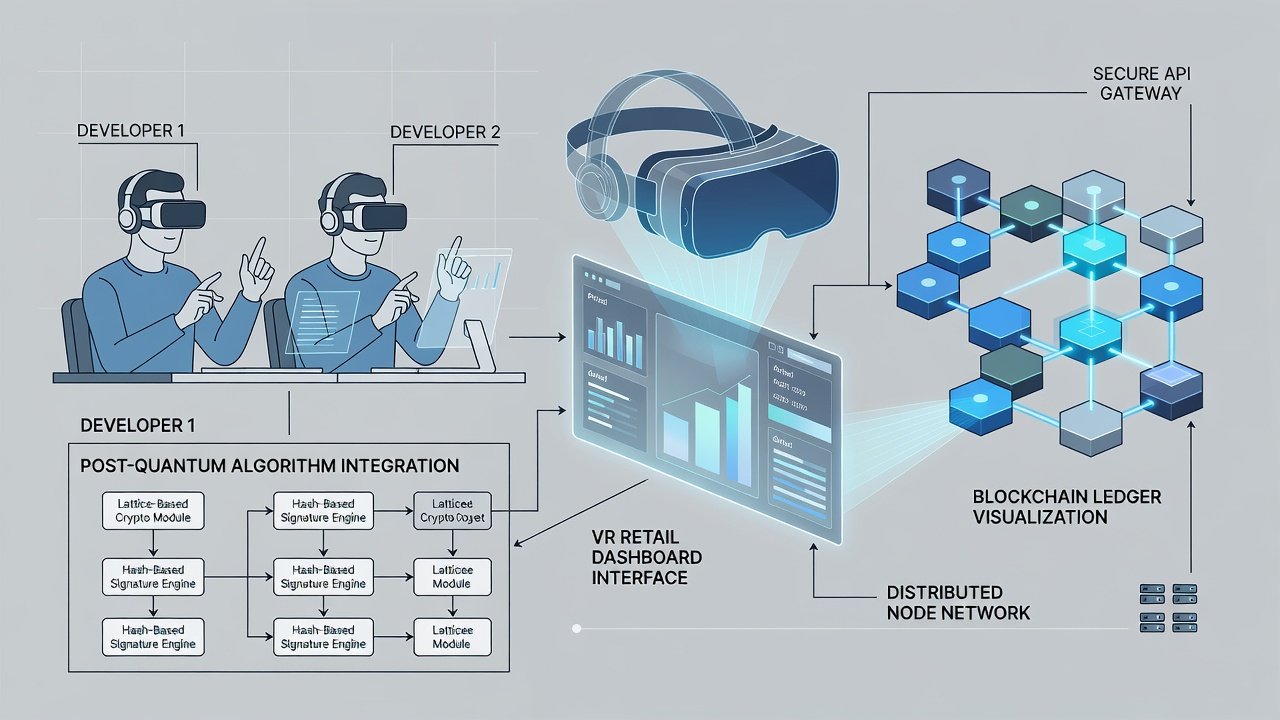
Transitioning to quantum-resistant encryption requires careful integration without disrupting VR performance. Follow these expanded phases for reliable results. First, audit existing cryptographic libraries and replace vulnerable modules with NIST-approved algorithms such as CRYSTALS-Kyber for key encapsulation and CRYSTALS-Dilithium for digital signatures. Document every dependency, including third-party SDKs used for avatar rendering and payment processing.
Implement hybrid schemes combining classical and post-quantum methods during migration to maintain backward compatibility with older headsets. Optimize for VR latency by selecting lattice-based algorithms that perform efficiently on GPU-accelerated environments; test each algorithm on target hardware like Oculus Quest and HTC Vive systems. Test integration in sandboxed VR sessions, measuring encryption overhead on avatar synchronization and product interaction events. Incorporate continuous monitoring using tools that alert teams when key sizes or signature lengths exceed acceptable thresholds for 90 FPS rendering. Reference implementation resources from NIST's Post-Quantum Cryptography project to ensure standards compliance throughout the process.
Blockchain Ledgers for Secure VR Transactions
Blockchain provides immutable audit trails for virtual purchases and asset ownership. Integrate permissioned ledgers using Hyperledger Fabric to record every item transfer in the VR store. Configure smart contracts to automate verification of quantum-resistant signatures on each transaction. This prevents replay attacks common in immersive environments where users rapidly switch between virtual storefronts. Developers should define consensus rules that require multiple validator nodes before committing high-value transfers, such as purchases exceeding typical thresholds. Integrate oracles that pull real-world pricing data into the ledger while keeping all cryptographic operations quantum-safe. Monitor ledger growth rates to avoid storage bloat on VR servers that also handle 3D asset streaming.
Real-World Case Studies from Early Adopters
Leading retailers piloting these technologies report measurable gains. A major fashion brand deployed hybrid post-quantum encryption in its VR fitting rooms, reducing potential breach exposure by integrating Dilithium signatures across all sessions and achieving seamless performance on consumer headsets. Another electronics retailer used blockchain to track limited-edition virtual goods, achieving full traceability with minimal added latency by running nodes on edge servers near major data centers. A third example comes from a luxury automotive platform that combined Kyber key exchange with existing TLS stacks, allowing customers to customize vehicles in VR without exposing design files to quantum interception. These cases highlight the importance of starting with non-critical features before scaling to full checkout flows.
Performance Comparisons Versus Traditional Security
Benchmarks show post-quantum solutions introduce 15-25% overhead on key exchanges compared to ECC, yet VR frame rates remain stable above 90 FPS when optimized with hardware acceleration. Blockchain consensus adds 50-100ms per transaction on permissioned networks, acceptable for non-real-time purchases but requiring caching for live auctions. Traditional AES-256 continues alongside new algorithms for symmetric needs, preserving overall system speed. In head-to-head tests, Dilithium signatures verified 30% faster than RSA equivalents on GPU hardware while providing equivalent or better security margins against quantum attacks. Developers should run their own benchmarks on target VR devices because results vary based on network conditions and asset complexity.
Deployment Checklist for VR Retail Platforms
- Conduct quantum risk assessment and document all cryptographic dependencies across the entire VR stack.
- Select and prototype post-quantum algorithms in isolated VR builds with full logging enabled.
- Deploy blockchain nodes with quantum-resistant consensus protocols and redundant validator sets.
- Perform load testing under peak shopping traffic scenarios simulating thousands of concurrent avatars.
- Train development teams on new libraries and monitoring tools through hands-on workshops.
- Establish incident response plans specific to quantum decryption attempts and ledger rollback procedures.
- Schedule phased rollout with fallback mechanisms that revert to hybrid mode if performance degrades.
- Document every change in a centralized knowledge base for future audits and team onboarding.
Common Mistakes to Avoid
Many teams underestimate the learning curve of post-quantum libraries and attempt full replacement in a single sprint, leading to integration bugs. Another frequent error is neglecting hardware-specific optimizations, which causes unacceptable frame drops in VR. Always test on the oldest supported headsets in your user base to ensure broad compatibility.
FAQs on Compliance and Cost Considerations
How does this affect GDPR and CCPA compliance?
Quantum-resistant measures strengthen data protection obligations by future-proofing encryption standards required under these regulations and reduce long-term regulatory risk.
What are typical implementation timelines?
Teams with prior cryptography experience complete core integration within 8-12 weeks, followed by 4 weeks of testing and optimization.
Are there ongoing maintenance costs?
Focus remains on qualitative factors such as reduced breach risk and enhanced customer confidence rather than specific figures, as market rates fluctuate rapidly.
Which tools best support post-quantum development?
Popular choices include the Open Quantum Safe project libraries and vendor SDKs from major cloud providers that offer pre-built hybrid encryption modules.
Conclusion
Adopting this quantum cybersecurity playbook positions VR retail platforms for secure growth. Developers who implement these frameworks proactively will lead in delivering trustworthy immersive shopping experiences that withstand future quantum threats while preserving performance and user satisfaction.

No comments yet. Be the first!