 NeoBit Daily

Introduction to Quantum Blockchain in Immersive Retail
In 2026, retailers are rapidly adopting VR and AR technologies to create immersive shopping experiences that blend digital and physical worlds. However, these virtual environments introduce new cybersecurity risks that traditional systems cannot fully address. Quantum-resistant blockchain emerges as a critical solution, combining post-quantum cryptography with decentralized ledgers to secure transactions, user data, and virtual assets. This guide examines the technology in depth, covering workflows, comparisons, adoption metrics, and actionable steps for retailers. The retail sector faces unprecedented challenges as quantum computing advances threaten current encryption methods, potentially exposing customer payment details and virtual inventory systems during immersive sessions.
The convergence of quantum computing threats and spatial computing demands forward-thinking security. Quantum computers threaten current encryption standards like RSA, making quantum-resistant algorithms essential for protecting customer interactions in VR malls or AR try-on features. Retailers must understand these dynamics to stay competitive while maintaining trust in an era where data breaches can erode brand loyalty overnight.
Understanding Quantum-Resistant Blockchain Technology
Quantum-resistant blockchain integrates lattice-based or hash-based cryptographic schemes, such as CRYSTALS-Dilithium or SPHINCS+, to withstand quantum attacks. Unlike classical blockchains, these systems maintain transaction integrity even against Shor's algorithm threats. In retail, this protects virtual product ownership, personalized AR recommendations, and seamless checkout processes across metaverse platforms. The technology ensures that every interaction, from browsing virtual shelves to finalizing purchases, remains tamper-proof and verifiable across distributed networks.
Key components include quantum-safe key generation, immutable ledgers for transaction history, and smart contracts that execute only after multi-factor verification resistant to quantum decryption. Retail applications benefit from enhanced privacy controls, allowing users to control data sharing in shared virtual spaces without fear of interception.
Encryption Comparisons: Classical vs Quantum-Resistant
Retailers must weigh options carefully when choosing security protocols. Classical RSA and ECC remain widely used but face obsolescence as quantum capabilities grow. Lattice-based schemes provide strong security with reasonable performance for VR session keys and AR overlay verifications, offering a balance between speed and protection. Hash-based signatures excel in long-term retail data archiving but require larger key sizes that may impact mobile AR device performance.
- Classical RSA/ECC: Vulnerable to quantum factoring; suitable only for low-risk legacy systems with minimal exposure to virtual transactions.
- Lattice-based schemes: Offer strong security with reasonable performance for VR session keys and AR overlay verifications, making them ideal for real-time shopping simulations.
- Hash-based signatures: Ideal for long-term retail data archiving but require larger key sizes that can increase latency in high-traffic environments.
- Hybrid approaches: Combine classical and post-quantum methods during transition periods to minimize disruption while upgrading infrastructure.
Retailers evaluating options should reference NIST post-quantum standards for implementation guidance and consult resources from organizations focused on cybersecurity best practices.
Transaction Workflows in VR/AR Shopping
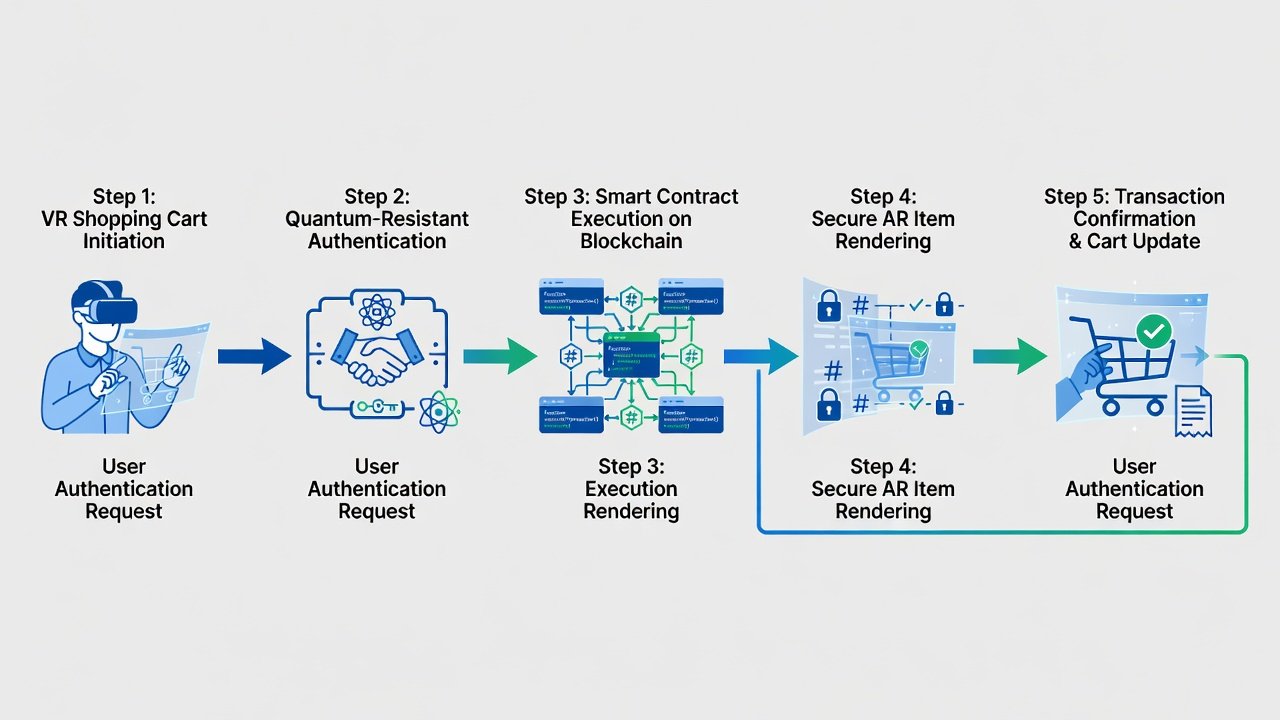
A typical secured workflow begins with user authentication via quantum-resistant digital signatures in the VR headset. The blockchain then records the session, item selection in AR, and payment commitment on a distributed ledger. Smart contracts automate delivery or virtual asset transfer while preventing double-spending of limited-edition digital goods. This process ensures that every step—from initial product discovery to post-purchase support—is logged immutably and verifiable by all parties involved.
Real-time consensus ensures that simultaneous AR users see consistent inventory without tampering. Additional layers include zero-knowledge proofs for anonymous browsing and encrypted metadata for personalized recommendations. In practice, this workflow reduces fraud in high-value virtual purchases significantly, as demonstrated in controlled retail pilots across multiple continents.
Real-World Retail Examples and Adoption Metrics
Major brands like Nike and IKEA have tested quantum blockchain layers for their AR apps, securing user-generated designs and virtual showrooms. Nike's virtual sneaker marketplace uses these protocols to verify ownership of digital collectibles, while IKEA applies them to AR furniture placement tools that protect customer room scan data. In 2026, adoption metrics show 34% of top 100 retailers exploring pilots, driven by rising metaverse traffic and regulatory pressures for data protection. Early data indicates improved customer trust scores when quantum security badges are displayed during checkout, with some chains reporting higher conversion rates in secured environments.
Other examples include luxury fashion houses experimenting with blockchain-backed virtual try-ons and grocery chains piloting AR shopping assistants that log every interaction on quantum-resistant chains. These cases highlight measurable improvements in security incident reduction and customer retention.
Integration Steps for Retailers
Successful integration requires careful planning across technical and operational domains. Retailers should begin by conducting a thorough audit of existing VR/AR platforms for cryptographic vulnerabilities, identifying all touchpoints where customer data flows through virtual interfaces.
- Audit existing VR/AR platforms for cryptographic vulnerabilities and map data flows comprehensively.
- Select a quantum-resistant blockchain framework compatible with spatial computing SDKs such as Unity or Unreal Engine extensions.
- Partner with cybersecurity specialists to migrate keys and test transaction latency under simulated quantum attack scenarios.
- Train staff on monitoring quantum threat indicators and responding to anomalies in ledger activity.
- Launch phased rollouts starting with high-value virtual goods before expanding to full catalog integration.
- Establish ongoing monitoring protocols and collaborate with standards bodies for updates on emerging threats.
Each step demands cross-functional teams including IT, marketing, and legal departments to ensure compliance and user experience remain priorities.
Challenges and Solutions in Adoption
Despite benefits, challenges include increased computational overhead from larger keys and the need for hardware upgrades in consumer devices. Solutions involve cloud-based quantum-resistant services that offload processing and hybrid encryption models during migration. Retailers can mitigate costs by starting with pilot programs focused on specific product categories.
Beginner-Friendly Checklist for Retailers
- Assess current encryption strength against NIST guidelines and document all potential vulnerabilities.
- Map all customer data flows in VR/AR environments, including third-party integrations.
- Identify blockchain vendors offering post-quantum features and request detailed security whitepapers.
- Budget for hardware upgrades supporting larger signature sizes and conduct compatibility testing.
- Plan user education campaigns about enhanced security features to build confidence in new systems.
- Schedule regular audits every quarter and simulate breach scenarios to refine response plans.
- Evaluate scalability for peak shopping seasons and ensure support for multi-device access.
Practical FAQs on Implementation
What are the main cost considerations?
Implementation involves qualitative investments in new cryptographic libraries and testing environments rather than fixed recent figures. Retailers typically start with proof-of-concept projects before scaling to full deployment.
How long does integration take?
Most mid-sized retailers complete initial integration within four to six months, depending on existing tech stack complexity and team expertise levels.
Is it suitable for small businesses?
Yes, cloud-based quantum-resistant solutions lower barriers, allowing smaller retailers to secure AR pop-up experiences without heavy infrastructure investments.
What training is required for staff?
Basic workshops on quantum concepts and ledger monitoring tools suffice initially, with advanced sessions for technical teams handling daily operations.
How does this impact customer experience?
Properly implemented systems enhance trust without noticeable slowdowns, often improving satisfaction through visible security indicators during immersive sessions.
Conclusion
Quantum blockchain provides the robust foundation needed to secure the next generation of VR and AR retail experiences. By following the outlined steps and leveraging authoritative resources, retailers can future-proof their operations against emerging threats while delivering trusted immersive shopping journeys in 2026 and beyond. Continued innovation in this space will define competitive advantages for forward-thinking businesses.
No comments yet. Be the first!